
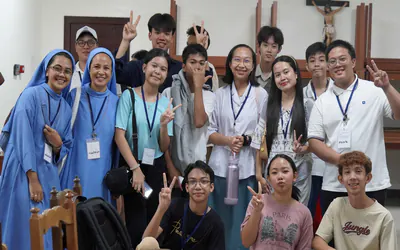
They are young artists who are taking part in “Arts & Culture – Reshaping Urban Life” which was organized by various partners from the worlds of art, culture, and education. They are financed by the European Union cultural program (EACEA). Among them is also the Starmacher Association, known for its Strong Without Violence program that was carried out together with Gen Rosso in many schools throughout Europe and the world. The group of urban artists has recently returned from Udine, Italy, where they worked together for ten days (24 August – 4 September) in the “Park of Cement” sharing their impressions of the city with its citizens through paintings, acoustic works, and sculpture, as in the filigree model of the city’s water tower. Udine was the itinerant project’s third stop, which foresees laboratories to be carried out in five different cities of three European states (Udine and Venice in Italy; Schwerte and Dortmund in Germany; and Sternberg in the Czech Republic). “The atmosphere among us is quite particular,” a young student from Monaco di Bavaria recounts, “It’s as if we’ve known each other for a long time. And we’re actually able to work together on a single work of art with several artists. And our hosts immediately perceive our every need and desire! This is quite an exceptional way of working!” During February, in Schwerte, Germany, the participants were joined by experts to examine the theoretical and cultural foundations of their work. The central topic was the mutual influence between urban development and artistic expression in society and in the cities of today. There is a direct link between art and city, and young people have a particular sensitivity for the place in which they live. Their works almost always reflect their birthplaces in some way. The second stop was in the Czech Republic (2-10 July) where an old and abandoned monastery in Sternbeck became the point of inspiration. Each artist could choose his or her own “art studio” in which to work. In the evenings they met to chat and know each other better, to sing and dance. Each seminar concluded with a public showing of their works that had been created during the days of the seminar, but also included some paintings or sculptures which came from their studios at home. The fourth stop is underway in Udine at a workshop with Gen Rosso ending on 23 September. Upcoming stops include: an interdisciplinary seminar with Gen Rosso in Dortmund, Germany and, finally the concluding congress in Venice on 23 February 2012.
Simple gestures of love
Simple gestures of love
0 Comments