
Photo: Federico Patti
The ecumenical convention “Together in Charity, from Dialogue to Cooperation” was held in the presence of the civil and religious authorities of Sicily, and exponents of the world of culture and information.
Maria Voce and
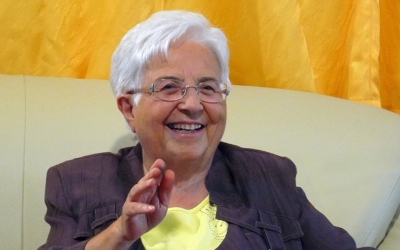
Jesús Morán (President and Co-President of the Focolare) were among the numerous protagonists, together with pastors and leaders of the various historical Churches and those recently constituted. Here are some passages of Maria Voce’s speech
: “The Conference is setting out to be a time of renewal and enhancement of this reciprocity, a time for reflection and a new stimulus to work together for the good of humanity. In this particular commitment of our Churches, I see a concrete response to one of the imperatives of the declaration of the Lutheran-Catholic International Commission,
From Conflict to Communion (2013), which was reconfirmed by Catholics and Lutherans in Lund, on October 31
st, 2016.

Photo: Federico Patti
. The starting point must therefore be that of unity and communion, in order to witness together to faith in Christ and render a service that is useful to all humanity. […]
What can the spirituality of the Focolare Movement, also called the “spirituality of unity” or “of communion”, offer to fulfill this goal? From 1943 onwards, God used a divine teaching method with the founder of our Movement,
Chiara Lubich, and her first companions. He taught them step by step how to achieve unity. Faced with the collapse of all types of ideal, even the most sublime, God made them discover that only he does not pass and that he is Love. To respond to his Love, they wanted to live the words of Jesus literally, and Jesus taught them that all people are children of one Father and, therefore, all are brothers and sisters to one another. By identifying himself with every person, Jesus explained to them that each neighbor should be loved, without distinction and with deeds. And if difficulties, obstacles and pain are not lacking along the way, Jesus revealed to Chiara the secret to transform every suffering into new life. If we unite ourselves to him, who, forsaken on the cross, took upon himself all evil and all divisions in humanity to redeem humanity, we will feel the strength and have the light to begin again. Then, if this love is lived by two or more, it becomes reciprocal, bringing about “love one another as I have loved you” (cf. Jn 15:12). It happens then that Jesus is attracted by this love and comes to dwell among those “two or more gathered in his name” (cf. Mt 18:20). That is how it is. It is precisely Jesus present among us who can make all become “one Christian family, a family that no one can separate, because it is Christ who binds us all together”.
[i] This presence of his, among Christians of different Churches, has led, for years now, to a new type of dialogue: the dialogue of life, the dialogue of the people, which includes the entire people of God, lay people and Church leaders. It forms a leaven in the great Ecumenical Movement to awaken and grow the desire for unity in Christians. […]
If the world can meet Jesus, present among us through mutual love, faith will be reborn in many, their way of thinking and behaving will change. The search for peace and just solutions will be victorious and the commitment to solidarity among peoples will grow. […]
Today, my wish is that together we can remain “on the journey” with Jesus among us “so that the world may believe”. [i] Chiara Lubich, Dialogue is life, Città Nuova 2007, p. 26
Read full speech

0 Comments