
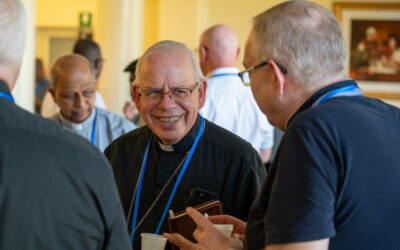
 Sub-Saharan Africa united in the thought of its peoples: “A land upon which to build a better future,” affirms Gisele Moulasta from Gabon, “not to stay closed in our own small world, but in order to be more and more open to the entire human family.” A statement charged with meaning, at the conclusion of the course on May 10-13, which gathered people together from several African nations.
What is the centre for inculturation? In his Apostolic Exhortation, Evangelii nuntiandi, Paul VI had expressed concern over the split between the Gospel and culture, seeing it as the drama of our age. He therefore hoped that this gap would be overcome by approaching the different cultures with more interest and care. The evangelization of the cultures is, as John Paul II also stressed, is the deepest and most complete for the message of Christ to enter into the consciousness and penetrate the customs of the people, the activities of the people, their institutions and structures. In line with this thinking, in May 1992, during a trip to Nairobi, Chiara Lubich founded the Centre for Inculturation inspired by the spirituality of unity, On that occasion she identified the goal: to discover the way of dialoging with the African culture and its values in order to promote evangelization among the peoples of the continent.
 This year, the focus was on the human person in Sub-Saharan Africa. It was examined from the perspective of the anthropology of the African community by geographical regions; Semitic Biblical and New Testament writings; Second Vatican Council documents and the contribution of the spirituality of unity. The participants also shared a variety of experiences that greatly enriched the academic discussion.
“Examining certain aspects of our culture in the light of the Gospel involves a confrontation of values that are divergent. Jesus is demanding,” explained Vital Muhindo who is from Congo: “The challenges are there: It’s not that the Gospel must enter into our cultures, but that our cultures that must enter into the logic of the Gospel.” In this context Victorien Kone recalled the powerful moment of his six year old daughter’s death. According to local tradition, the little one could not receive a burial because she was still in the process of becoming a person. “How could we give her a decent funeral?” her father asked. “Although still small, Joelle was spiritually a giant! She had a deep relationship with Chiara Lubich. She was loved by everyone, great and small. The funeral was held and attended by many people. It was a sign of life. This way of doing things was a surprise to many, but it also gave a testimony that had an influence on the common mentality.”
This year’s course also included a group of young people of the Focolare Movement from around the world who enthusiastically launched the Sharing with Africa Project, which is one of the many projects of United World Project. Simultaneously, United World Week 2013 was being celebrated inn Burkina Faso where a project was carried out in a pediatric ward of a hospital. In Nigeria there was a Genfest attended by 1,000 Christian and Muslim youths, and in the Ivory Coast the United World Project was presented to the UNESCO National Commission.

0 Comments