5 Jan 2015 | Focolare Worldwide
“Mercy”, and that is forgiveness, which leads to peace, “for a new world”: this is the invitation to the youth of the diocese of Bobo-Dioulasso – the second largest city of the country – as a reflection for the coming year. Burkina Faso lives an important phase of transition, after the riots of last October, when the capital Ouagadougou had been hit by demonstrations of the opposition and civil society, so much so that there was talk of a ” Burkinabé Spring “.
And it is an experience of forgiveness that is offered by Fidèle during the day for young people on 7 December: while he was going around looking for work, he was convinced by a friend to pick some fruit from a tree for an old lady who was sick, thus arousing the anger of those who had misappropriated the tree. The story ends for Fidèle with a broken nose from a stick in the face. “The anger inside me grew as I pondered revenge. I was going home to treat the wound when I was approached by the boy who had hit me. He had his mother with him who was very upset. I did not want to give in, but then I remembered the words of the Gospel where Jesus says we must forgive 70 times 7 … The next day I bumped into him at the store and I greeted him first, showing that I had forgiven him. Since that day we became good friends.”
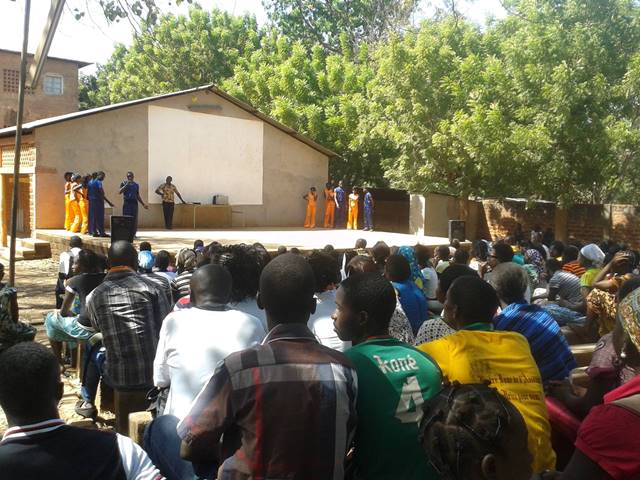
David and Laetitia, on behalf of the Youth for a United World of Bobo-Dioulasso, tell us about the initiative: “This year we decided to change our usual way of doing things in order to facilitate work with others. We got involved in coordinating the activities of the Youth Chaplaincy. Amazed by the previous experience of the Youth Festival, the leaders of the Chaplaincy asked us to organize a day of friendship among all the youth movements of the city, on the theme chosen for this year: “Young people, be merciful so as to build a new world. ‘”
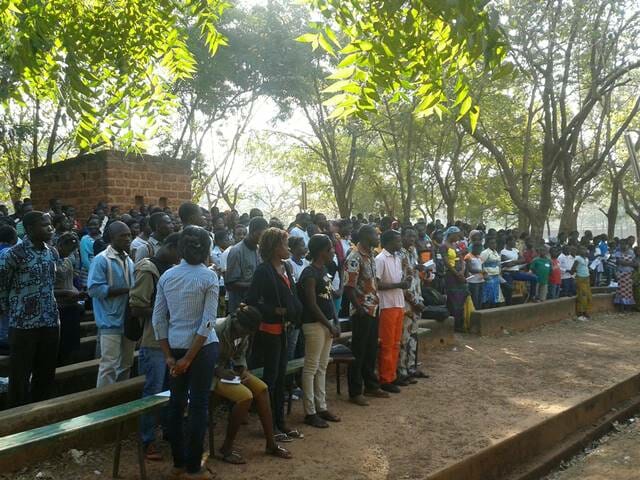 “The time was short,” they continue, “and the hardest thing was to work with people who have a different way of seeing things. The difficulties in agreeing things were not missing, especially when it got to drafting a program for the day; but our goal was primarily to establish unity among all, even at the expense of the quality of the organization. But the common desire to work together, to get to know each other, to have mutual esteem won out … And finally we got to the long awaited day. “
There were testimonies on forgiveness, including that of Fidèle, dancing, singing, “This day allowed us to get to know each other better. There have been many exchanges of contacts and we understood how the contribution of each one, however different, was necessary. We understood how the different movements are complementary and called to work together for the realization of unity, the same one that Jesus always teaches us. “
“This – they conclude – encourages us and gives us the desire to work together again. In a year’s time the next edition!”
4 Jan 2015 | Focolare Worldwide
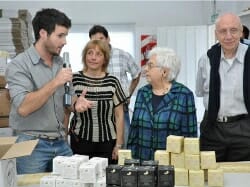
Gonzalo Perrín would never have thought that at the age of 29 he would become a partner and manager of a biscuit factory. He was still taking up Hotel Catering sciences when he got to learn about the Economy of Communion (EoC), and was so deeply struck that he put aside his studies to put the ideals of the EoC concretely into practice. “n 2008 – he recounts – I gave up my job and returned to my country, and at O’Higgins I started to produce biscuits, at home to begin with, while I was setting up the factory and buying the suitable machines.” Today he runs “Pasticcino”, a factory that is part of the Solidaridad industrial park in the Argentinean little town of the Focolare, and where 2.5 million biscuits are produced yearly, distributed to 25 chains of bars and cafes. He is currently considering the possibility of opening a branch in Brazil, at Spartaco, the EoC hub of the Focolare centre close to São Paulo.
To keep in line with the spirit of the EoC and share the company’s profits with the poor, Gonzalo even got to the point of asking the banks for a loan. Another particular experience is that among the staff of the “Pasticcino” there is a visually-impaired employee, Charley. During a visit, some pointed out to Gonzalo that Charley was an extra expense for the company: “In fact, it may seem a bit costly,” he replied, “but what you don’t see on the balance sheet is that he represents a great asset for the company because of the ideas he proposes, and for the good atmosphere his presence imbues among the colleagues.” In fact, today Gonzalo considers Charley not only as an employee, but more as a consultant and friend.
 To those who asked if this was all worthwhile, and if he did not wish to earn more, he answered: “At times when I get into a friend’s car, I say to myself: what a great car! But I myself have never been in need of anything and the important things in life are relationships, which are things money cannot buy. I don’t know how long the company will last, but if it doesn’t, the relationships will remain, and these are the most precious things I possess.”
Recently, Gonzalo had to conclude a big business deal with a new client: “We have already met five times. Ten days ago I attended the sixth and it seemed like things were really moving ahead. But since then I have passed my time looking at the telephone and waiting for it to ring. I was going crazy, when, during my dad’s birthday, my grandma who is 82, asked me how the company was faring. I told her all the details of this new business and she answered: “Don’t’ worry Gonzalo, if this new deal with that company doesn’t pull through, it will be for the better.” I don’t know how, but with those words, my worries vanished somewhat.”
After a few days it was grandma’s birthday and “precisely on that day the client I was talking about accepted me as his supplier!” The Pasticcino factory is expanding!
![Peace: No longer slaves but brothers]()
1 Jan 2015 | Focolare Worldwide
 “Today, due to an ever-increasing number of interconnections in today’s world that has made society powerfully aware of the common destiny of nations, slavery, an offence against human rights, has formally been abolished in the world. The right of every person to be free from slavery or oppression has been recognized in international human rights as an irrevocable norm. And yet, despite the fact that the international community has adopted numerous agreements to put an end to slavery in all its forms and undertaken various strategies to combat this phenomenon, still today millions of people – children, men and women of all ages – are deprived of freedom and forced to live in conditions similar to that of slavery,» Pope Francis wrote in his message for the World Day of Peace, celebrated on 1 January, feast of the family.
And as he writes, he remembers all «the many men and women workers, also minors, who are enslaved in different sectors,» and also recalls “the living conditions of many migrants who suffer hunger, and are deprived of liberty, stripped of their possessions or physically and sexually abused. My thoughts go to those who are dominated by fear and insecurity upon reaching their destination after a difficult journey, and are at times detained in inhuman conditions.”
Mohamed comes from Mali and has passed through a shipwreck and a life of poverty and suffering. Today, he strongly desires to express his gratitude. This what Flavia Cerino, a lawyer, tells New City. “When he was just fifteen years old, Mohamed decided to leave: a long journey through the desert in Libya (prisons and abuse) and then, finally, Italy. The Mare Nostrum operations saved him from the shipwreck but on touching ground, he was immediately handcuffed: his co-travellers had identified him as one of those engaged in the human trafficking business, but in reality he was not involved. In fact, he had distributed some food and drinks on the boat because the real traffickers had threatened to throw him overboard if he did not do so. Since he was just an adolescent he was not sent to a real jail. The long wait for the hearing which would confirm his arrest, took place in a small and cramped room in the city Court, but many people were there to take care of him: the policemen were kind and the social workers took interest in his life, health, and family. For months nobody had given him so much attention. Usually he only received commands, not questions. And then, since one of the policemen spoke French, and he was able to thoroughly explain the real facts.”
The hearing to confirm his arrest ended well: he would be assigned to service in the community, and not to jail.
“He will not be free, but it was undoubtedly better than jail. The structure was pleasant, in a small sunny town further south. Mohamed managed to gain the respect and affection of all: he was always willing to help in the housework, ready to learn new words in Italian, loved soccer but also silence and solitude. After some months, the time came for him to appear before the Court: for him this meant a return to the past, the brutal experiences he wished to forget. Though time had passed, his memories were still there, also the beautiful ones. And at the end of the hearing, he had only one wish: to return to the last floor in those dark and gloomy rooms, only to say thanks to that policeman who spoke French and those kind social workers. He would remember them forever. Unfortunately, none of these people he knew were on duty. But his ‘thanks’, quite a rare event, will be passed on to them by their colleagues.”
“We know that God will ask each of us: “What have you done to your brother?» – Pope Francis concludes. “The globalisation of indifference weighs on the lives of many of our brothers and sisters, and calls out to us to become the architects of a globalisation of solidarity that can give them hope and new courage to undertake the journey through our time and bring along with them new prospects, a task which God has entrusted to us.”
29 Dec 2014 | Focolare Worldwide
![Peace: No longer slaves but brothers]()
26 Dec 2014 | Focolare Worldwide
 “You left in silence, almost on tiptoe, without disturbing anyone. Perhaps you wanted to celebrate your Christmas in heaven, the Christmas celebration of Life…” wrote one of the focolarini who had lived with him in a focolare community over the last years in Rocca di Papa.
Born in Vicenza (Italy) on 22 February 1927, he met the Ideal through the group in Pisa in ‘52, where he was studying Medicine. After a few years in Rome, Pescara and Turin, came the turning point of his life: Africa.
This occurred at the start of October 1962, when Chiara Lubich and Don Foresi asked him, and Nicasio Triolo, another focolarino doctor: “Are you ready to leave for Africa?”.
On 11 February 1963 they landed in Cameroon together with Danilo Gioacchin, a vet and Venetian, like Lucio. Life over there was a daily query on the reality around them, in an attitude of crystalline and open respect for the culture of a people that was completely new to them. Wonder, uncertainty, discoveries and deep perceptions of their limits in face of a mystery, but above all always open to the plans of God who would have transformed their experience into a fantastic “love song” that developed simultaneously with the founding of the Movement and the spreading of the Ideal of unity in the black continent. Lucio would have lived that particular time in close contact with Chiara Lubich who later visited Cameroon in ’65, ‘66 and ‘69. Much later, in ‘92 Chiara went to Kenya and again to Fontem (Cameroon), where in the meantime, in 2000 the first Focolare citadel in Africa was built. Lucio was so happy to see that in “a span of 35 years Chiara’s dream had become a reality, that God exists, that love is real, and that mutual love is the secret of happiness; and that all was made possible because Our Lady has embraced us all as a sole family.”

Da sinistra: Lucio Dal Soglio, Georges Mani, Dominic Nyukilim, Teresina Tumuhairwe, Benedict Murac Manjo, Marilen Holzhauser, d. Adolfo Raggio, Nicolette Manka Ndingsa.
Lucio did not speak much about himself, and he never wanted to show off, or be in the spotlight. But for those who were lucky enough to have known him, Lucio was like a “huge Baobab” tree – as some African friends wrote recently. Numberless echoes have reached us from Africa: “We shall never be grateful enough to him for what he has done for the Work of Mary here in Africa!!!”. “His love for people was infinite, because he saw in each person, Christ, whom Lucio loved with all his heart…”. “We remember above all, his radicalism and sincerity in living the Gospel, a big brother, a true friend who has always walked with us along life’s “holy journey.” “I see an African Mary’ with her arms open wide to welcome this special son of hers, along with many others who have lived, suffered, worked and endlessly loved to bring the ideal of Unity to the lands of Africa. This is not a time of sadness, but of profound thanksgiving to God for the gift of having walked alongside Lucio on this holy journey, and who was our father, elder brother and friend.”
The world of the Gospel Chiara Lubich had given him as a guide and lighthouse for his life was: “”If a man owns a hundred sheep, and one of them wanders away, will he not leave the ninety-nine on the hills and go to look for the one that wandered off?” (Mt. 18,12).
“We are praying to him –Maria Voce wrote to the Focolare members –and asking him to help the entire Work of Mary to fulfill the God’s plan “that all may be one.”
![Peace: No longer slaves but brothers]()
21 Dec 2014 | Focolare Worldwide, Senza categoria
 Between 2002 and 2006, a civil war was underway in the Ivory Coast, which went virtually unnoticed by Europe and the world. It was a political conflict over control for power. The Focolare Movement has had a presence in that country, in the capital city of Abidjan and in Man, since 1975.
When hostility broke out and Man became the target of the rebels, the western countries advised their co-nationals to evacuate immediately. The welcoming centre for foreigners was located in front of one of our centres, Mariapolis Victoria. That centre began to fill up with refugees, and so we decided, Africans and Europeans together, to stay on with the population. It was certainly a risky decision, but motivated by the desire to partake in the drama that was engulfing everyone.”
Then they began working together in welcoming the thousands of people who poured into the centre. The refugees belonged to different tribal groups and were Muslim, Christian and followers of traditional African religions. All were welcomed without distinction. The Focolare Movement offered temporary spaces where they could stay. Many of the refugees brought with them all they could carry.
 “Life within the compound, even amidst the difficulties caused by the war, continued as it was in the city, in peaceful and integrated coexistence of the diverse communities, not without some natural tensions. There was also a vast sharing of goods and basic needs (clothing, food and water). All doctors and nurses had fled, according to the government, and the only doctor remaining was one of us, who cared for the people without any discrimination, including rebels who controlled Man for a period of time. As soon as the government took control of the region, the majority of people left for the villages, but some remained behind.”
The Man experience highlights how a Focolare community responds in risky situations: “Firstly, the many years of people in the area who are trying to live the Gospel, has created an inter-ethnic community that offered a place of welcome and peace; the members of our community, acting because of a powerful spiritual motivation, decided to stay with the people and share their fate. That principle of fraternity garunteed that all were to be welcomed, without any type of discrimination. This created mutual trust, which allowed the thousands of people not only to survive, but even to share what they had with others. the trust that was generated among all, even the rebels, secured the possibility of saving other lives. In fact, one group of rebels risked their lives, escorting a special bus that brought children from a hospital which had fallen into the hands of some of their fellow-rebels, into an area controlled by the government. Thanks to everyone’s effort, a certain social cohesiveness was preserved.”
See also: Witnesses to Peace, New City Philippines
