![First ‘Combined’ Doctorate in Theology]()
12 Nov 2013 | Focolare Worldwide
 The Great Hall of Sophia University Institute, on the morning of October 8, was filled and festive, as on great occasions. In fact, the conferring of the first joint doctorate granted by two academic universities: the Pontifical Lateran University and the SUI, was taking place.
It was about the first combined doctorate in Theology, in virtue of which, Fr. Stefano Mazzer, a Salesian, has contemporaneously obtained doctorates in Theology conferred by the Lateran, and in the Culture of Unity conferred by the SUI. He passionately defended the dissertation of his thesis: “He loved them until the end”. For a theological phenomenology of the non-being of love: historical pathways and systematic perspectives.
Through a rigorous and engaging historical overview re-proposing the outline of the Western philosophical thought from Parmenides to Schelling and that of Christian mysticism from Frances of Assisi to Chiara Lubich, Mazzer, in fact, was able to illustrate the novelty of the love lived by Jesus Forsaken on the Cross as the opening of a new relational space between the I and his other, in God and in the world. He argues that – it is – about that “trinitization” (as defined by Chiara Lubich) of ties, which is at one and the same time. «gift, coming from the trinity in virtue of the incarnation of the Son and of his death and resurrection» and «real experience of the participation in the life of God himself» in the living out of interpersonal relationships.
 Underlining the singular academic value of this event was the presence of the Co-president of the Focolare Movement, Giancarlo Faletti, Mons. Brendan Leahy, professor of Ecclesiology at the IUS and Bishop of Limerick, in Ireland, as a few months ago, and Andrea Bozzolo, rector of the Turin section of the Faculty of Theology of the UPS, along with many others.
As the Dean of the SUI, Mons. Piero Coda, underlined, the weight of the research and its existential and interdisciplinary, as well as the theological quality, make Mazzer’s thesis, which will soon be published, the happiest and most appropriate debut for doctorates in theology, in synergy between the IUS and the Pontifical Faculty of Theology such as the Lateran’s.
Similar agreements of combined doctorates are already in effect, with the Theologic Faculty of Central Italy (Florence), the Pugliese Theologic Faculty (Bari), and the Faculty of Theology of San Miguel (Buenos Aires, Argentina).
Source: Sophia University Institute online
![First ‘Combined’ Doctorate in Theology]()
11 Nov 2013 | Focolare Worldwide

“We’re in need of everything, because the city of Tacloban practically no longer exists.” This news arrived directly from the Focolare community in the Philippines during the dramatic hours following the passage of typhoon Haiyan and the destruction it caused on November 9, 2013 especially on the islands of Leyte and Samar. It was one of the worse typhoons in history: communication and electrical power were down in many regions and with the passage of time the death toll continues to rise.
Tacloban is the was the worst-hit city. It is the capital of Leyte Province, an island in the central southeast. 10,000 of its 200,000 inhabitants are thought to be dead, and the number continues to grow. As in many of the islands, there is a Focolare community also in this city. Many of the inhabited regions are unreachable: “We’re trying to make contact from the other islands and take supplies, but communication is still quite difficult.,” write Carlo Gentile and Ding Dalisay from Cebu. “One focolarino doctor, Himmel, along with Rey and Ladyliz attempted to rech Tacloban through the port of Ormoc, on the island of Leyte, but that city was completely destroyed and the roads were unusable.”
On the evening of November 10, 2013, some young people (Gen) from Tacloban, who were in Cebu at the moment of the typhoon, went with a coast guard boat to see how their families were, and check out the local situation.” “Also other relatives of persons with whom we are in contact on the island of Panay, in the path of typhoon, had their homes destroyed or greatly damaged.”

The central region of the Philippines, with the large group of Visayas islands was most at risk both because of the frequency of tropical storms and the construction of dwellings. The devastating typhoon hit the poorest islands of this region, the ones that are most difficult to reach. Aware of the risk, the government evacuated over 600,000 people and collaborated in the construction of refuges. Archbishop of Cebu, Jose Palma, invited everyone to pray, to ask for God’s help. Thanks to all this it seems that human damage was minimal compared to other times, even though the number of deaths is going to rise.”
Assistance arrived from around the world, thanks also to the prayer offered by Pope Francis at the Sunday Angelus. “In Cebu we are already receiving help from all over the Philippines and also from overseas (Hong Kong, Jordan).”
WHERE TO SEND YOUR DONATIONS
FOCOLARE MOVEMENT IN CEBU – see also Emergency Aid poster
Payable to : Emergency Typhoon Haiyan Philippines
METROPOLITAN BANK & TRUST COMPANY
Cebu – Guadalupe Branch
6000 Cebu City – Cebu, Philippines
Tel: 0063-32-2533728
Bank Account name: WORK OF MARY/FOCOLARE MOVEMENT FOR WOMEN
Euro Bank Account no.: 398-2-39860031-7
SWIFT Code: MBTCPHMM
Payable to: “Help Philippines– Typhoon Haiyan“
Email: focolaremovementcebf@gmail.com
Tel. 0063 (032) 345 1563 – 2537883 – 2536407
Association for a United World (Associazione Azione per un Mondo Unito – Onlus)
BANK: Banca Popolare Etica, Rome branch
IBAN: IT16G0501803200000000120434
SWIFT/BIC CCRTIT2184D
Payable to: “Emergenza tifone Haiyan Filippine”
New Families Movement (AZIONE per FAMIGLIE NUOVE Onlus)
c/c bancario n° 1000/1060
BANCA PROSSIMA
IBAN: IT 55 K 03359 01600 100000001060
Swift: BCITITMX
![First ‘Combined’ Doctorate in Theology]()
9 Nov 2013 | Focolare Worldwide
 On Saturday, 26 October, Liverpool Hope University welcomed a 400-strong gathering to mark the 50th anniversary of the Focolare Movement’s arrival in Great Britain in 1963. The participants came from Liverpool, Leeds, Newcastle and Wales representing various christian denominations and faith beliefs.
The story goes back to Canon Bernard Pawley who had just returned from the Second Vatican Council, which he attended as an observer. He suggested to the Dean of the Anglican Cathedral in Liverpool that he invite the founder of the Focolare Movement, Chiara Lubich, to speak at the Cathedral to a group of Anglican clergy. He had already mentioned the idea to Paul VI during a private audience and gained papal approval for this event which took place in November 1965.
Reverend Kirsty Thorpe, Moderator of the United Reformed Church, pointed out to those present: “It’s easy for us, 50 years later and living in such a different climate for inter church relations, to underestimate just how radically unusual this event was. For a woman to address a gathering of men was relatively rare in those days, wherever it happened … and in early 1960s, clergy were not known to sit and listen to a lay person as a main speaker …”.
In her diary, on that November 17th, Chiara Lubich remarked on the poignancy of the name, Hope Street, which connects the Anglican Cathedral to the Catholic Cathedral (still under construction at that time) and expressed a heartfelt prayer that, with faith, the ‘mountains’ of lack of understanding between the churches might be moved (cf Mt 17:20).
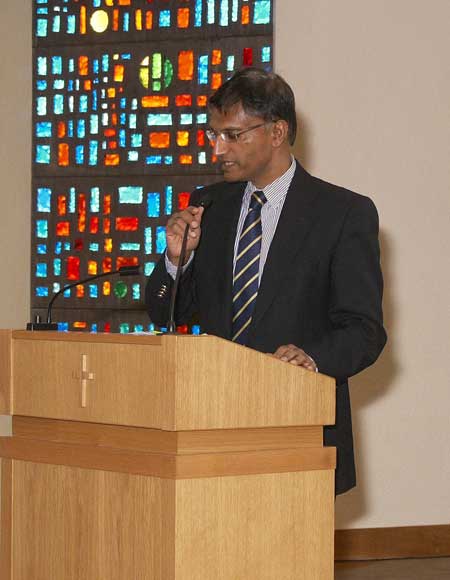
Professor Gerard Pillay
Today too, the word ‘hope’ continues to link Focolare very much to Liverpool. In his keynote address to Saturday’s gathering, Professor Gerard Pillay, Vice-Chancellor of Liverpool Hope University, reminded those present that the last honorary doctorate Chiara Lubich received, just two months before she died in March 2008, was from Liverpool Hope in recognition for her work of dialogue in ecumenism, in interfaith and with contemporary culture.
He paid tribute to her work describing the Focolare as “not institutionally focused, not empire building but part of the spreading out goodness all over the world … Chiara Lubich, from the very beginning was outward looking.” He recalled the words of the Ecumenical Patriarch Bartholomew I of Constantinople who said: “There are some people whose life touches lives so universally that upon their passing away they remain an indelible inspiration of grace. One such life, a life worth living and well worth remembering is that of Chiara Lubich”.
Professor Pillay went on to outline the strong bonds between the University and Focolare’s charism saying: ‘We at this university are drawn to a charism of seeking unity because of our ecumenical commitment (…). It is a peculiar Liverpool achievement for which we are all grateful (…). Chiara Lubich believed that dialogue (which for the university is rational discourse and living in peace) is the privileged way to promote the unity of the Church among religions and non religious people, without syncretism. It is not just a muddling together of everything for something palatable. It is the openness to all people while being faithful to one’s own identity. That is the deep wisdom of Chiara Lubich’s vision.”
![First ‘Combined’ Doctorate in Theology]()
7 Nov 2013 | Focolare Worldwide, Senza categoria
 “At the moment when the Youth Festival was to begin in the beautiful and modern grand open theatre of Bobo-Dioulasso, the electricity failed . . . and there were 420 of us!” The Youth for a United World then shared what happened during those first uncertain moments of the joy-filled event that took place on October 19, 2013, which they had organized in Burkina Faso. Electrical energy is distributed by region in the city, and precisely at the hour of the Youth Festival a blackout had been scheduled for that area. “When we realized this,” the young people recount, “we ran to the Electrical Energy Society of the country and, fortunately, when we told them about our gathering they immediately restored the power for the event.”
Omar, one of the Muslim Youth for a United World recalls, “The period leading up to the event was also quite beautiful, as we were preparing it. It took four months of working together and overcoming our diversity.”
Finally the day arrived. “The surprises began early in the morning at the press conference,” Liberta explains. “We found ourselves with nearly 150 people including the Vicar General and the Assistant Mayor of one of the cantons of Bobo-Dioulasso, and there was television and radio coverage.”
> Omar continues: “Also the 420 people who attended the event were a surprise, because even important concerts hardly ever reach that number.”
The young people included Muslims, members of the Saint Egidio Community, Christians from several Churches and representatives from traditional religions. Also present were the Episcopal Vicar, the Assistant Mayor, the Governor’s representative, President of the Association of Protestant Churches and that of the Assembly of God Churches.
“A beautiful dialogue was created among actors and the public; a family atmosphere, also through the experiences that were recounted by the Youth for a United World. We read what Maria Voce had written in her greeting, with her invitation to spread a culture of peace and unity around us so that love will triumph over hatred and war disappear. Her words were listened to with much attention by the young people.”
The programme contained song, dance and choreography not only by the Youth for a Untied World, but also by the Titiama artistic group and by Protestant youths. Mrs. Toussy, a famous singer in Burkina Faso, intoned the song Let us love one another, then a singer from Togo presented one of his songs.
> The speech by one young Muslim man was very moving, the son of an Iman and ex-president of the Burkina Muslim Community, who encouraged everyone not to r give up in the face of difficulties that can arise in the relationship between Christians and Muslims. He concluded saying: “The Focolare Movement is a river of love where there is no proselytism, but only desires to create a world of brotherhood.”
“I find myself in front of something here that goes beyond my thinking; I never imagined it would be this beautiful, or I would have invited all the young people of my Church,” said one Pastor. Everyone left filled with joy, and desirous to bring forward the ideal of fraternity that leads to peace and unity. “Working together, we have realized that this fraternity is too beautiful to keep among ourselves,” commented one young woman from the Saint Egidio Community.
National television broadcasted portions of the event several times on news broadcasts, and the radio continued for several days to broadcast portions of the concert.
“Now,” the Young for Unity enthusiastically explained, “we want to get to work, to continue to collaborate and build dialogue among us, in this atmosphere of openness to each other. At our next event we want to fill the stadium.”
![First ‘Combined’ Doctorate in Theology]()
6 Nov 2013 | Focolare Worldwide, Senza categoria

“The show communicated so much, it was direct and filled with joy and energy. The performers are happy people who share a genuine relationship of mutual love.” “This performance was fresh and spontaneous and the instrumental and voice quality was quite good. The dynamic and rhythm of the show kept you on the edge of your chair.” “The show transformed me without my realizing it. At the end I was different.” These are a few of the impressions that were shared by some of the spectators of the show when the concert ended. It is one of the most recent shows to come from the Gen Verde Musical Group.
Start Now! took off on October 11th when it was first performed in little town Loppiano before an international audience of 300 people at Gen Verde’s permanent theatre. The band took stage together with 67 young people from both the local area and abroad.
During the three-days of rehearsing for the show – with song, dance, theater and music – the young people were encouraged to practice their talents and discover new ones. Throughout this creative exercise that was guided by respect and transparency, the artists from Gen Verde and the participants in the workshop worked side by side as members of the same team and concluded with a pop-up performance on the Loppiano stage.
“The educational objectives of the project,” Gen Verde explains “are to promote the arts as a means of educating toward peace, intercultural dialogue, human dignity and the creation of interpersonal relationships that promote human development.”
These goals are achieved through multidisciplinary artistic workshops. “This educational method is based on an experiential approach in which workshop participants share in the group’s growth by working not only as students, but also as protagonists on stage with us,” the artists affirmed.
“First I thought it would be helpful to be a bit egocentric in order to perform,” says one of the young people, “but now I realize that being on stage doesn’t mean thinking about me, but about the other.” “While we were on stage,” another girl adds, “I felt like there was no difference between us and Gen Verde.”
This project seeks to help young people discover art as a universal language that transcends every type of barrier, instilling skills that can be applied in every area of daily life.
Start Now! is intended for schools, universities and youth groups, and can be adapted to the target age and artistic experience of the participants.
![First ‘Combined’ Doctorate in Theology]()
5 Nov 2013 | Focolare Worldwide
 “Existential peripheries”: these two words had particular significance during the two-day seminar held during 21-24 October in Brazil. The seminar was attended by participants from 12 Latin American countries representing 40 social welfare organisations inspired by the Focolare’s charism of unity. From the exchange of experiences it appeared that the encounter with those on the peripheries, for whom Pope Francis has appealed, seems to have been underway for many years: where drug dealers were sewing death, very often among young people; where children of tender age were spending their lives on the streets; where farmers were being forced to migrate to cities for lack of work, increasing the number of favelas. The stories were deeply moving of those working in many different social organizations under great hardship because of a scarcity of human and material resources. This led to the need for a permanent network, for an ongoing exchange of experiences, problems and resources. The social organisations from Spanish-speaking lands launched the website www.sumafraternidad.org so this network could spread more widely; also in other expressions of the Focolare that have begun in the fields of economy, politics, education, law, family and youth. Sumafraternidad.org is far more than a simple crowd funding platform, say the creators of the digital support; what we are really aiming at is generating connections that are transformational. The fraterntiy in action: basis for social cohesion in the 21st century seminar addressed the socio-political landscape of the continent that even until now is plagued with a lack of social cohesion, resulting in exclusion and profound inequality, claims Argentine political scientist Juan Esteban Belderrain. With Uruguayan Susana Nuin from the Communications Commission of the Bishops Conference of Latin America (CELAM), elements of the Church’s social doctrine were examined inasmuch as they relate to the problematic situation of Latin America.
  The transformational potential of the charism of unity rooted in the thinking of Chiara Lubich, refocused on making yourself one, and was described by Brazilian sociologist Vera Araujo. She defined this as the indispensable evangelical method for building relationships; the horizons of fraternity that imposes a removal of inequality; Jesus crucified and forsaken, “who became identified with all the crucifixes of the world and opened new areas of resurrection.” “It is this cry,” said Father Vilson Groh, who has been involved for many years in helping children on the peripheries of society, “that makes us enter into the abandonment of those who are excluded, makes us capable of entering into communion with them, and prevents us from becoming accustomed to social injustices.” Some disturbing questions emerged from the chorus of voices: “Do we take it to be normal that strong social imbalances continue to exist? Have we silenced our own consciences, because others are already directly involved in finding solutions to these dramatic situations? There was a strong call for collectively assuming social responsibility.

