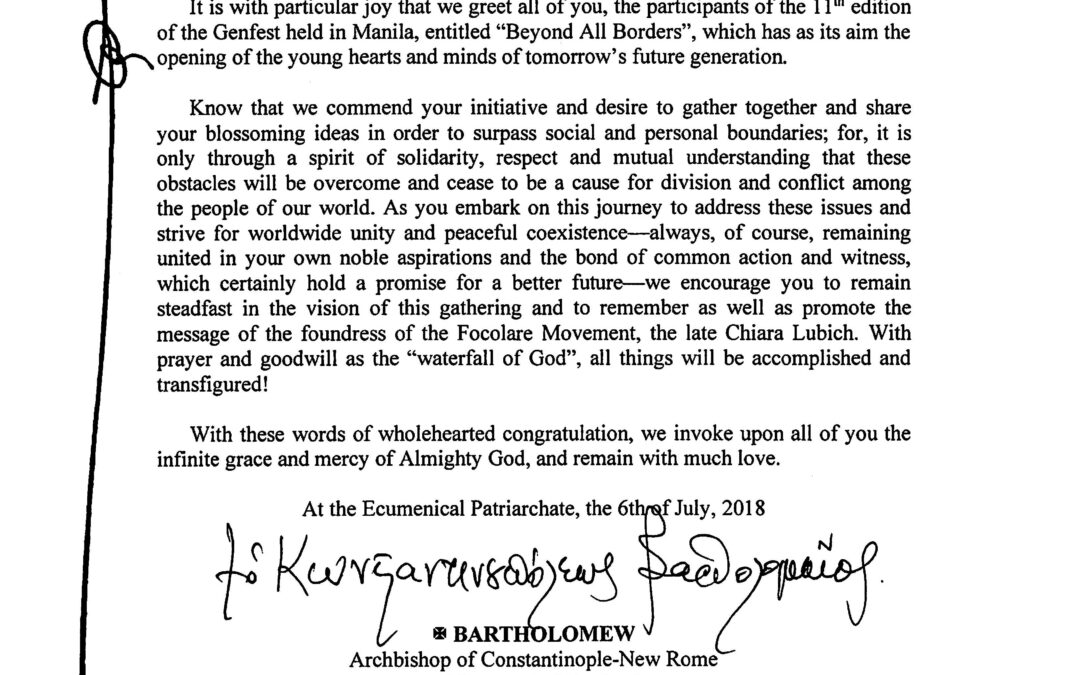
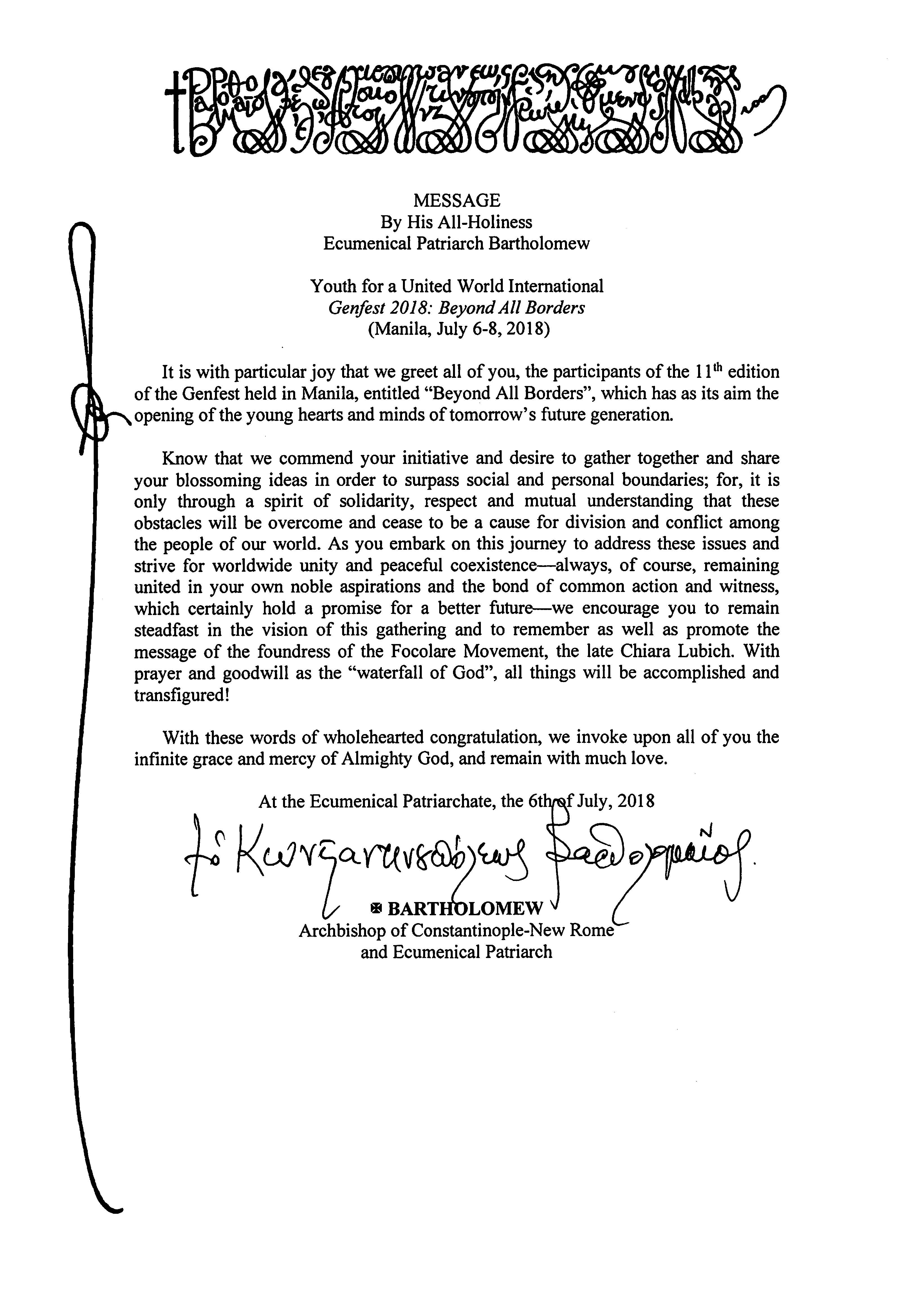
MESSAGE By His All-Holiness Ecumenical Patriarch Bartholomew
Youth for a United World International Genfest 2018: Beyond All Borders (Manila, July 6-8, 2018)
“It is with particular joy that we greet all of you, the participants of the 11th edition of the Genfest held in Manila, entitled “Beyond All Borders”, which has as its aim the opening of the young hearts and minds of tomorrow’ s future generation. Know that we commend your initiative and desire to gather together and share your blossoming ideas in order to surpass social and persona} boundaries; for, it is only through a spirit of solidarity, respect and mutual understanding that these obstacles will be overcome and cease to be a cause for division and conflict among the people of our world. As you embark on this journey to address these issues and strive for worldwide unity and peaceful coexistence-always, of course, remaining united in your own noble aspirations and the bond of common action and witness, which certainly hold a promise for a better future, we encourage you to remain steadfast in the vision of this gathering and to remember as well as promote the message of the foundress of the Focolare Movement, the late Chiara Lubich. With prayer and goodwill as the “waterfall of God”, all things will be accomplished and transfigured ! With these words of wholehearted congratulation, we invoke upon all of you the infinite grace and mercy of Almighty God, and remain with much love.”
At the Ecumenical Patriarchate, the 6th of July, 2018
[Signed]
+ BARTHOLOMEW Archbishop of Constantinople-New Rome and Ecumenical Patriarch
The second day is full of novelties. With its 117 activities like forums, workshops and 10 ecological, social, intercultural and interreligious activities, the Genfest participants will be offered a unique chance to pass from theory to practice in less than 24 hours. “Learning by doing,” is one of the pillars of the professional pedagogy. This is exactly what the youths are now experiencing: a personal and social school of change, and the overcoming of walls and fences not only as themes of discussion and sharing of good practices, but also with action and hands-on experimentation in a “global” context like the Philippine scenario, with ideas, projects and actions from the whole world. The young finals have been signed up in the workshops for months now, and expectations are high. A Portuguese boy said: “I’m going to the ’I want to help’ forum on how to win over the ’spectator’ effect. The title is attractive and I feel at times that I am a powerless spectator facing situations that are bigger than me: unemployment, racism, and the sense of inadequacy before the challenge of life in relationships. I want to succeed in overcoming the feeling that there is nothing I can do to change things.” A group of young people from Cebù will participate in the very popular forum, “Nurturing Nature.” Kim Atienza, a famous Filipino anchorman and expounder of environmental issues, encourages the youth to get to deeply know nature with the cycle of life and its processes, and will lecture on sustainable lifestyles and production. One can also do a full immersion in Asian culture, with workshops in origami and fusion cuisines, or attend laboratories dedicated to knowledge and working on oneself: management of stress, fears, and care for the others. Many workgroups will be dedicated to social, civil economy and economy of communion, architecture, and the language of cinema. Politics will not be missing, “but will be the politics of hope.” A girl from Burundi said: “I signed up for that on corruption. We studied the different forms and the tools to fight it. I come from a continent where corruption is a wound. What has given me hope? It is the fact that we came from all over the world to bring down this wall.” In the afternoon the young people will pass on to phase 2 of the day, “Hands4Humanity.” The proposal will consist of 10 activities in solidarity, reception and urban re-qualification in various places in Manila, to experience small acts that can change the reality around us, slowly but in an irreversible way. Then upon returning home proposals will be offered to implement ad hoc initiatives. There is a wide choice: from service in the children’s canteen to the social center of Bukas Palad, to the cleaning of roads and other city areas, visits to hospitals, the aged, the deaf and dumb, up to street theater and the intercultural exchange with the Muslim and Hindu communities. In Tramo Street in the peripheral belt of Manila, a big group of kids coming from Australia, Brazil, Europe, besides other Filipinos, will paint and clean together with the local people. A Californian boy explained: “I would never have thought of doing something for a city which isn’t mine, and where I may not return to, but I am glad, and what’s more I would like to know Manila better. At the start I thought I didn’t care, but now it’s no longer so.” “Making Genfest a laboratory for learning and experimentation on human transformation techniques is a choice of great impact, both for the youths and the city,” explained Tina Bonifacio, businesswoman and coordinator of the forums. “The aim is to make a real experience of the overcoming of borders, both physical and mental. Each person, culture, and piece of the world always has something to give and share with the others.” It will be an intense day therefore for the young people now in Manila. But this is not all: it will end tonight with the international concert where many will stage their songs and performances. Music and art will recount another piece of “Beyond all borders.”
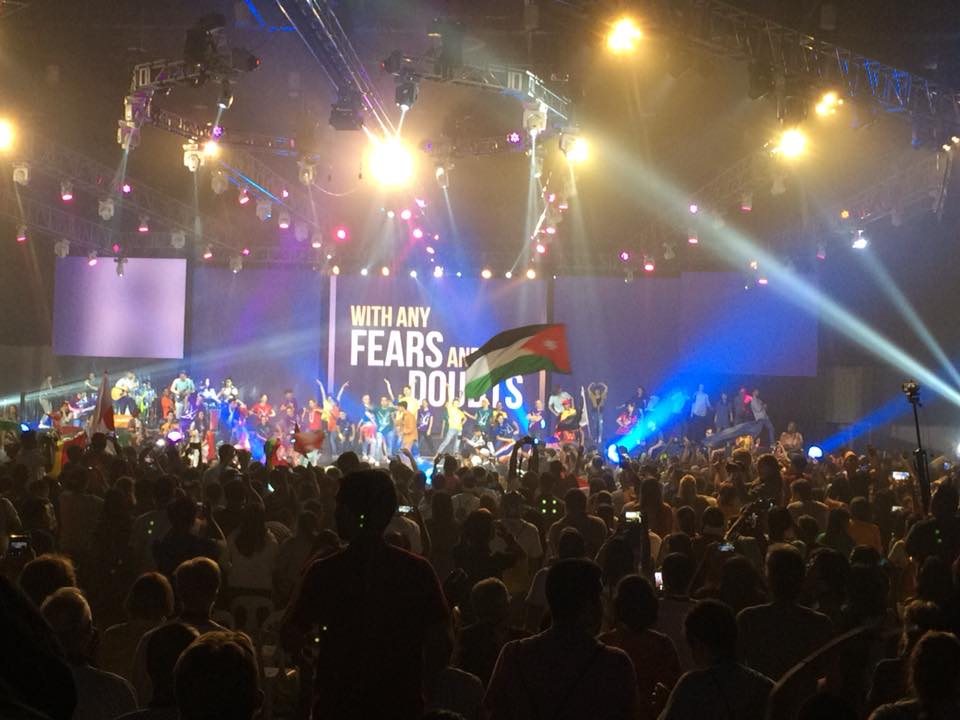
Here we are: Genfest kicked off today in Manila’s World Trade Centre. It’s the main international event, while around 20 national Genfests are taking place in all five continents. The program has one main focus: to overcome every sort of barrier and thus the slogan: “Beyond all borders”. The daring title was chosen by the young people as an answer to the many forms of divisions present in many parts of the world. It’s also the motivation behind all the activities which preceded this moment during the period of preparation. Right from the start, the Genfest has been a collaborative effort; every actor is a main actor. The morning session, which has just concluded, began with videos from several locations showing pre-Genfest activities that have been taking place in twenty south-Asian countries between June 28th and July 5th where hundreds of young people organised social projects for communities. The microphone is passed onto the presenters and the “vloggers” who accompanied the participants in the program. For those born before the mid-1990s, we should specify that the vloggers have had great influence on teenagers and young people through the social media. In recent months, Louis from Burundi, Maria Clara from Brazil and Ceska from the Philippines all have a growing number of followers on Facebook. Powerful testimonies have been shared during the first session of the Genfest, like that of Josef Capacio from San Diego, California and Noah Herrera from Mexicali, Mexico. At a time of political and social imbalance and all kinds of division, they decided to promote peace right beside the wall that divides nations.
Watch interview on Facebook
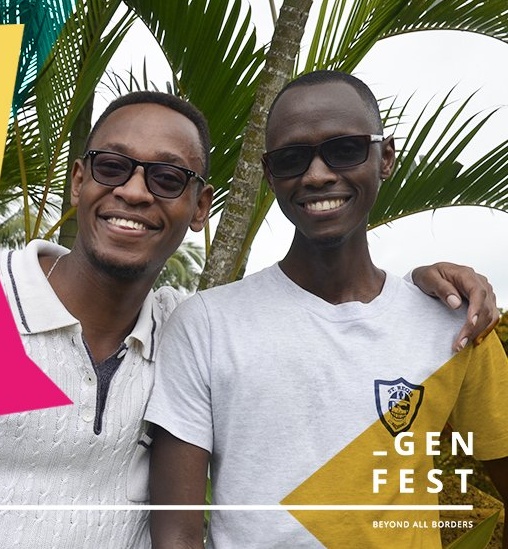
The joint initiative carried out by young people from the United States and Mexico, Noah recounts, allowed us to discover the values, objectives and vision of the world from opposite directions. “We are all equal and we can love our own country as our neighbour’s.” Then, there was the story of Jean Paul Muhanuzi from Burundi, and Egide Nduwayezu from Rwanda. Theirs was the story of a true and growing friendship amidst dramatic conditions. After an assassination attempt on both of them, which left Jean Paul seriously injured, Egide gave up everything to support him during his rehabilitation after spinal surgery. The overcoming of borders in their case led to mutual appreciation of the beauty of different peoples and cultures. Jaime Zayas, from El Salvador, launched the idea from the stage of the need for a change in one’s own “square mile”, as he himself had experienced in his own land within the context of urban violence and mistrust. The strength came from the desire of being peace-builders: “We know that our country has huge problems, but we can change things on a daily basis, building relationships founded on reciprocity.” Tommaso Carriere, Italian and founder of the association, “Not From War,” a project formed by people of peace, showing what war is like and how development brings growth in the form of “fragments of solidarity, little steps that draw people closer and nurture peace. “We recount what we’ve seen in a country afflicted by war and how conflicts only serve to destroy society, undermining hope and the possibility of a better future.” Since 2014, the association promotes summer camps in Jordan where European teenagers visit refugee camps and interact with those who suffer through the consequences of war. The voices of these first days in Manila speak of pathways of life and plans for the future.
Pope Francis will be in Bari (Italy) on Saturday, 7 July, for the ecumenical meeting of reflection and prayer with the Patriarchs and Heads of Christian Churches of the Middle East. The event will be introduced by Cardinal Leonardo Sandri, Prefect of the Congregation for the Eastern Churches, and Cardinal Kurt Koch, President of the Pontifical Council for the Promotion of Unity of Christians. “The idea of a meeting like the one to be held in Bari was conceived a long time ago by various people – Cardinal Sandri remarked – different Churches or Patriarchs expressed this desire personally to the Holy Father. In Bari, Pope Francis will be joined in prayer by Bartholomew I, Ecumenical Patriarch of Constantinople and Pope Tawadros II of Alexandria and the entire Africa.” The event, of great ecumenical value in itself and unprecedented in the history of ecumenism, will consist of two moments: the prayer meeting along the seafront promenade together with the faithful, and a moment of reflection and mutual listening between the Holy Father and Heads of the Churches and Ecclesial Communities of the Middle East, where each will contribute with their own standpoints, observations and proposals. The city of Bari is called the “window on the East” since it guards the ancient tomb of St. Nicolas, venerated by Catholics and the Orthodox alike.
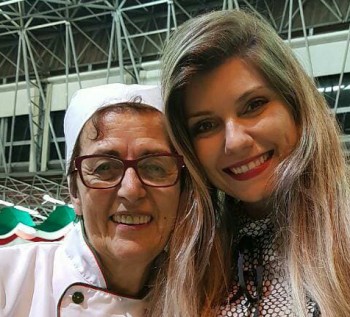
The Espiga Dourada story shows how dedication to helping the poor can inspire the entrepreneurial spirit. The artiginal bakery has achieved a great deal over the years, overcoming many obstacles and threats in the volatile environment along a major expressway on the outskirts of Brazil’s largest city. Started in 1988 as a bread-making initiative, selling loaves on the roadside, the enterprise was a forerunner of the Economy of Communion project which Chiara Lubich launched from Saõ Paulo in 1991. Espiga immediately embraced the courageous vision and values of this revolutionary new approach to economic activity. «It was during a serious economic crisis,” recalls Espiga pioneer Adriana Valle, originally from Italy, for the past 38 years in Brazil. “Money was scarce, there was rising inflation and high unemployment. In the midst of this situation, we were a group of girls with different talents and skills who got together to start baking bread and selling it from baskets to the drivers passing by the Focolare town “Mariapolis Ginetta” in Vargem Grande Paulista». They did this a few times, but when they suspended production for several days, drivers kept stopping and asking for the “girls with the bread and big smiles”. At this point, they realised it could be a permanent activity, offering work opportunities to local mothers and young people, to help them support their families and their education. There was no clear business plan at this time, but the customers kept growing in number, drawn by the friendly atmosphere. In 1994, the sales activity moved from the pavement to a small roadside store, at the same time as the Economy of Communion Business Park was developing close to the Focolare town. A second sales point was established on the other side of the road, bordering a favela slum, so that the people living there could buy their bread without the danger of crossing the busy highway. Chiara Lubich chose the names Espiga Dourada I and II for the two shops, with a logo showing a ripe ear of corn shining under the sun. The aim: to offer a welcoming, harmonious and calm environment with a family atmosphere for all who come. From the start, there were those convinced it would fail, people who scorned the possibility of success from such humble beginnings (“how can you hope to achieve anything with just half a sack of flour?”). Others held the faith, and got involved to make it work. For example, two local businessmen were so impressed by the progress made with such flimsy infrastructure, that they decided to contribute financially. This investment came just in time to avoid having to lay off some of the staff, and allowed plans to go ahead to improve and redesign the two locations and to raise the standards of the products on offer. Many customers have spoken of how these two bakeries have had an effect far beyond good-tasting bread. Some travel for kilometres just to experience the “positive energy” they find there as they enjoy their coffee and cake. Some discover the strength to make a new start in their lives, encouraged by the welcome they know they will find there. But it has not all been sweet aromas and smiling faces. The bakeries have been attacked several times. During the last incident, Adriana was ordered to empty the till by a masked gunman. At gunpoint, she found the courage to start talking with him. She told him how worried she was about how things would turn out for him and his gang once they went outside. Her sincere concern and respect disarmed the boys, literally. They even took off their masks and did no harm. And there have been no more incidents since then! Today the bakery and two shops employ 20 part time and 15 young part time workers. They use ten sacks of flour and serve between 1,200 to 1,500 customers each day. For the more affluent weekend customers, they offer a selection of specialist breads, savoury dishes, cakes for special occasions, and their own artisanal ice-cream range. At the same time, they maintain production of high quality, low-price bread for their regular clients from the favelas. As well as creating jobs and working with an attitude of love, a cherished part of Espiga Dourada’s aim is to facilitate interaction between different social categories. Those less advantaged financially feel part of the Espiga family, while those who are better off come back, bringing their own contribution and then thank Espiga because they find they have received far more than they have given. Source: EdC online
Isn’t insisting on dialogue actually just caving in to relativism, where you only need good manners in politics without caring about fundamental values? The “Movement of Politics and Policy for Unity (MPPU) is not a political party, but a space for dialogue in parliaments and cities, between all coalitions. It proposes that we reflect on the soul of representation in order to overcome the crisis, through consensus-driven, deliberative democracy. The tool we use is an “elected-electorate pact.” It’s not about good manners; it’s a proven method, one of fraternity, that leaves us free and equal in our diversity. It is possible to rediscover the soul of politics beyond a pragmatism that has no ideals, in order to serve the common good with the “love of loves,” as Focolare’s founder Chiara Lubich taught. We’ve started a series of dialogues about topics that are both lofty and practical. We approach these through reasoning, and certainly not what currently tends to happen, which ranges from insults to all out frontal assault. That’s no longer acceptable. Where does democracy risk – and not just in Italy – losing its soul? Representative democracy is in crisis because of the dominance of globalized finance over the everyday economy and politics itself. Weak parties are easily influenced by one lobby or another. The end of ideologies often coincides with a lack of ideals. What’s needed is a hearty injection of popular participation, in order for citizens and the parties to commit to solving issues such as employment, social justice, peace and disarmament, mitigating risks, standing against mafias and corruption, and preserving the common good and the great cultural and environmental resources we have here in this country. The elected-electorate pact that we have seen in a number of parliaments and councils can bring citizens closer to their institutions and give a soul to a representative democracy, which is enriched by being deliberative and consensus-driven. MPPU has stayed current, addressing issues where there is genuine conflict. What are the most urgent items you would like to take on today? The Movement of Politics and Policy for Unity is above all a fraternal meeting space for people who are active in most of the different political parties. And this is not a problem; it’s enriching. In recent legislation we have made social and civil rights a priority. Now we think that the most urgent issues to face are jobs for young people and fighting poverty. We need to disarm the economy and convert factories that produce weapons to civil uses, especially in a country whose Constitution “repudiates war.” We need integration beyond just welcoming immigrants and their children, without forgetting the importance of security and lawfulness. Are there practical proposals that you are thinking of putting forward? MPPU needs to facilitate, alongside its work in the halls of government and commissions, practical proposals from parliamentary workshops, where different political cultures meet with academics and competent members of civil society. We can promote a series of dialogues in the legislature, both on an idealistic and practical level. Source: MPPU online


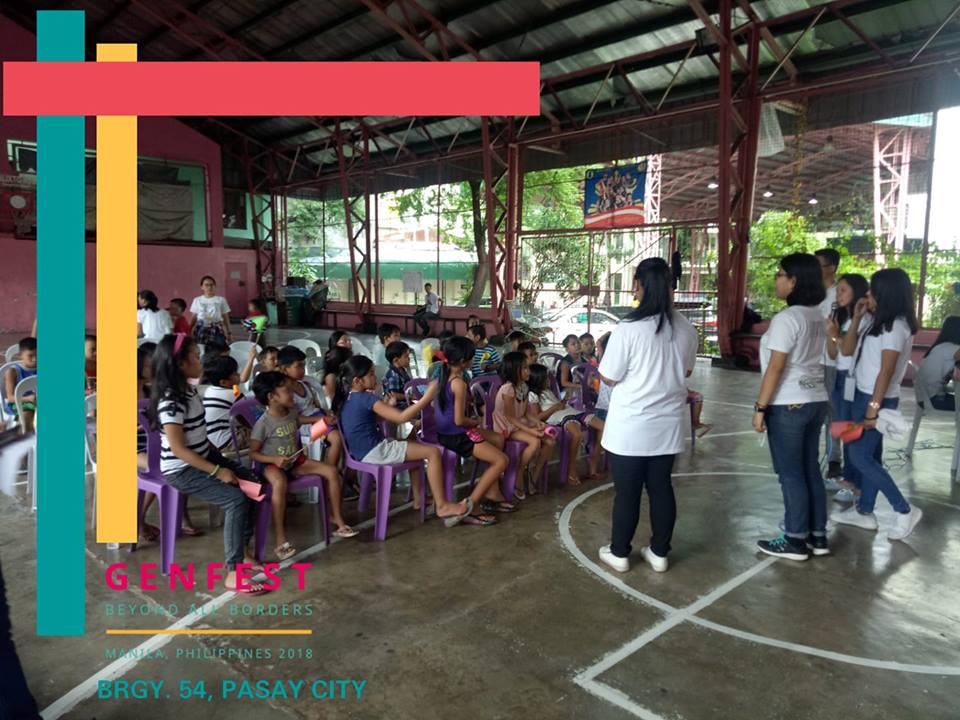 The second day is full of novelties. With its 117 activities like forums, workshops and 10 ecological, social, intercultural and interreligious activities, the Genfest participants will be offered a unique chance to pass from theory to practice in less than 24 hours. “Learning by doing,” is one of the pillars of the professional pedagogy. This is exactly what the youths are now experiencing: a personal and social school of change, and the overcoming of walls and fences not only as themes of discussion and sharing of good practices, but also with action and hands-on experimentation in a “global” context like the Philippine scenario, with ideas, projects and actions from the whole world. The young finals have been signed up in the workshops for months now, and expectations are high. A Portuguese boy said: “I’m going to the ’I want to help’ forum on how to win over the ’spectator’ effect. The title is attractive and I feel at times that I am a powerless spectator facing situations that are bigger than me: unemployment, racism, and the sense of inadequacy before the challenge of life in relationships. I want to succeed in overcoming the feeling that there is nothing I can do to change things.”
 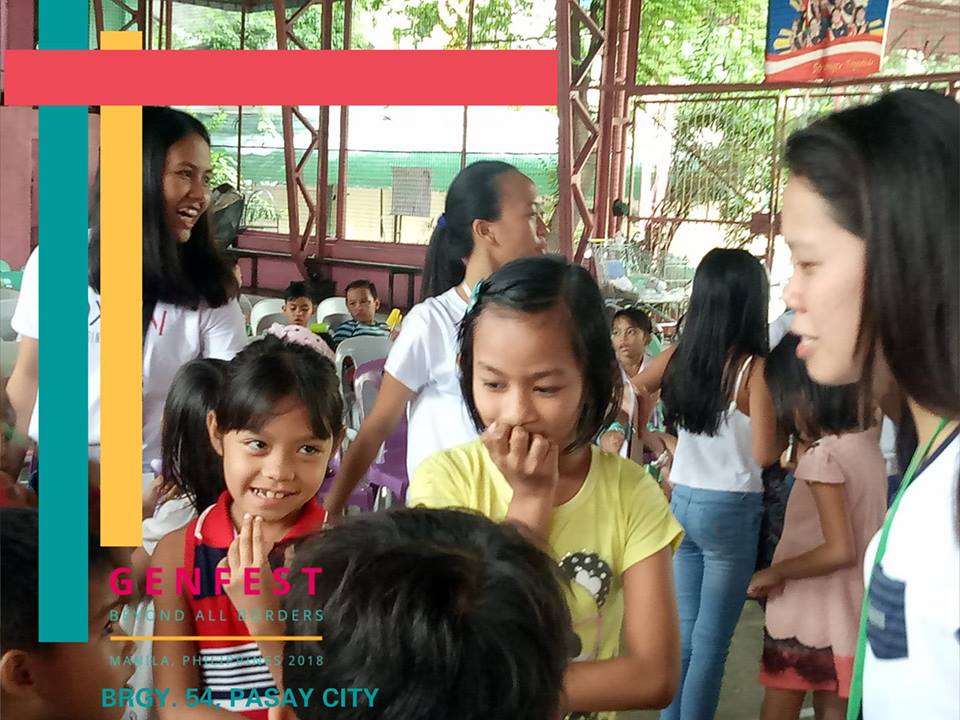 A group of young people from Cebù will participate in the very popular forum, “Nurturing Nature.” Kim Atienza, a famous Filipino anchorman and expounder of environmental issues, encourages the youth to get to deeply know nature with the cycle of life and its processes, and will lecture on sustainable lifestyles and production. One can also do a full immersion in Asian culture, with workshops in origami and fusion cuisines, or attend laboratories dedicated to knowledge and working on oneself: management of stress, fears, and care for the others. Many workgroups will be dedicated to social, civil economy and economy of communion, architecture, and the language of cinema. Politics will not be missing, “but will be the politics of hope.” A girl from Burundi said: “I signed up for that on corruption. We studied the different forms and the tools to fight it. I come from a continent where corruption is a wound. What has given me hope? It is the fact that we came from all over the world to bring down this wall.”
 The
The 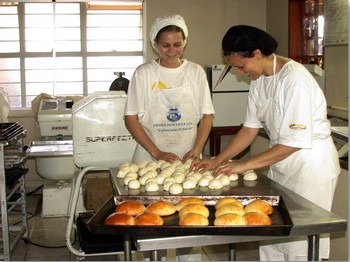 Chiara Lubich chose the names Espiga Dourada I and II for the two shops, with a logo showing a ripe ear of corn shining under the sun. The aim: to offer a welcoming, harmonious and calm environment with a family atmosphere for all who come. From the start, there were those convinced it would fail, people who scorned the possibility of success from such humble beginnings (“how can you hope to achieve anything with just half a sack of flour?”). Others held the faith, and got involved to make it work. For example, two local businessmen were so impressed by the progress made with such flimsy infrastructure, that they decided to contribute financially. This investment came just in time to avoid having to lay off some of the staff, and allowed plans to go ahead to improve and redesign the two locations and to raise the standards of the products on offer. Many customers have spoken of how these two bakeries have had an effect far beyond good-tasting bread. Some travel for kilometres just to experience the “positive energy” they find there as they enjoy their coffee and cake. Some discover the strength to make a new start in their lives, encouraged by the welcome they know they will find there. But it has not all been sweet aromas and smiling faces. The bakeries have been attacked several times. During the last incident, Adriana was ordered to empty the till by a masked gunman. At gunpoint, she found the courage to start talking with him. She told him how worried she was about how things would turn out for him and his gang once they went outside. Her sincere concern and respect disarmed the boys, literally. They even took off their masks and did no harm. And there have been no more incidents since then!