![A eulogy to fraternity from Colombia]()
29 Apr 2013 | Focolare Worldwide
 Called “Condecoration” of the “Order of the Congress of Colombia”, it was instituted in 1987 by the Colombian parliament: it is an honour that the two houses can confer, in the name of the people, upon citizens or institutions that have served the country. It was in recognition of this that the “Condecoration”, solicited by the Senator of the Republic, José Darío Salazar Cruz, was conferred upon the Focolare Movement and delivered to the Italian magistrate, Dr Giovanni Caso, Honorary Deputy President of the Italian Appeals Tribunal.
“We welcome this recognition of the work of Chiara Lubich as a added encouragement to continue with a greater impetus and enthusiasm, on the path she has shown everywhere, and particularly in Colombia”. This was the message of thanks that the Focolare president, Maria Voce, sent to the honourable members of parliament and to all those present at the extraordinary session of the Congress of the Republic of Colombia held on the 25th April. The title of “Commendatore” was conferred upon the Focolare with a citation that “recognized the lofty contribution that the Movement had given during its 40 years of presence in Colombia to the benefit of living together and of fraternity”.
 Among those present was the Secretary of the Bishops’ Conference, Mons. Daniel Falla Robles, the Anglican bishop Francisco Duque, and the Personero of Bogota [Head of the District Office of Human Rights], Dr. Ricardo Cañón. The citation particularly recalled how the Focolare, in its 40 years of presence in Colombia, gave rise to “models of living together in various social circles, in the fields of education, law, economy…”. Among the various concrete realizations, mentioned by the Senator in his speech, were that of Los Chircales, the Sol Naciente school, and the collaboration with Social Pastoral Care of Soacha.
Maria Voce laid emphasis on fraternity as the “necessary condition for every living together”, considering how its application “on a larger scale in political, legal, and social behaviour opens up remarkable possibilities. It favours dialogue at various levels and enables to keep together and valorise diverse cultures and thoughts, and divergent human experiences, which otherwise could lead to irremediable conflicts. Freedom and equality, foundations of democracy, acquire new meaning thanks to fraternity. Fraternity can sustain and give new vision to those organizations committed to overcoming the barriers between individuals and peoples, so as to accelerate the stages towards the unity of mankind and to ensure peace”.
So, the Focolare commitment continues in Colombia, which in these past days has also been realised through a series of meetings held by Dr. Caso, member of the International Central Commission of Communion and Law, an international network of professionals and academics in the field of justice, who strive to combine the paradigm of fraternity with justice. The calendar of events in the past also reached Central America, with an important meeting of professionals in the field of justice in Guatemala.
![A eulogy to fraternity from Colombia]()
26 Apr 2013 | Focolare Worldwide
 The Peace Centre is located in the multi-religious and political heart of Bethlehem. In the same square – a square of white stone and surrounded by palm trees – there is the Basilica of the Nativity and the Mosque, a coexistence that has nothing of confrontation or intolerance. Next door is the Town Hall and all around the colours of the Bethlehem market. There is also the haunting wall that the Israeli government has constructed in defence of its territory.
 The Focolare Movement’s Youth for a United World have decided on the Peace Centre as the venue for strengthening the bridges of brotherhood that were begun at the Genfest event that took place in Budapest, Hungary (September 2012). Now they are building bridges everywhere in the world. The slogan in Hungary was Let’s bridge and this was an invitation to construct bonds among people around the world, overcoming barriers among peoples, faiths and cultures. Now the slogan has become Be the bridge! and this is the project that is being launched from the Holy Land with a database that provides a catalogue of best practices that have been inspired by brotherhood and implemented by individuals, groups, organizations and states.
First Lady and Mayor of Bethlehem and the Palestinian territories, Vera Baboun, welcomed the proposed launching “happily and proudly because I believe in the power and ability of dialogue in a land that is wounded by the absence of brotherhood.” Cristina, who is a university professor, widow and mother of five children, shared her experience as a woman mayor and answered questions that were posed to her by the lively young audience. As an enthusiastic supporter of innovation and of the new generations, she repeated several times: “It’s up to us to take the steps that will lead to what is new. Three things are needed to build bridges: courage, good will and truth. You need to have trust in yourselves and believe that you can change.”
 In confirmation of the innovation that has distinguished her administration she presented the idea of an advisory council made up of young people alongside the elected city council. In her closing remarks she could not but make reference to the wall surrounding her city. “This wall was built by human hands. What will bring it down? Human hands. Let us make a disadvantage into an advantage and work for a common dream: that of making the world a home for people who really are a single humanity. And the Palestinians are this humanity.”
Meanwhile in Jerusalem the final stage of the Genfest continues until May 1st with the workshop on brotherhood that is being run by the Focolare’s young people in the Holy Land. It began on April 24th. Several events are planned involving Jews, Arabs, Christians and Muslims that will help them to continue in the commitment they made in Budapest to build bridges everywhere. There is a workshop at Bethlehem University on reconciliation, involving 200 Christian and Muslim students; while other young people are involved with the international Gen Rosso and Gen Verde bands, as well as other local artists, for a journey into the world of music and art.
On May 1st there will be an international link-up from Jerusalem with Italy, Hungary and India during which a worldwide pact of brotherhood will be made and the United World Project will be re-launched. This project aims to increase the unity among peoples, individuals and institutions also through the creation of a database of all the projects that have worked over the years.
Source: Città Nuova online
“Be the Bridge” website
![A eulogy to fraternity from Colombia]()
25 Apr 2013 | Focolare Worldwide
 «As we know, our Movement came about because a small group of people, a microcosm of humanity, discovered a “wellspring” and let themselves be imbued by a stream of living water – a new and deeper understanding of the good news: God is Love! God loves us. God loves everyone. In our lives, even in the particular circumstances of everyday living, with its problems and projects, its sufferings and joys, we are not alone. If we so desire, and if we are open to it, the presence of God, this extraordinary superior presence, can play a role in all that we do, helping in unexpected ways, and enriching and ennobling each and every aspect of our daily lives.
We have a Father: a divine Providence is looking down on us and watching over us. Certainly, this faith in God’s love is present, even today, in the hearts of many. Nonetheless, oftentimes we fail to perceive the logical consequences of this faith. We lead our lives, building the earthly city and wanting to renew the world, as if we had to do all of this completely on our own. … To give you just one example, one of the strongest convictions that our Movement has developed throughout its forty years of life, a conviction supported by daily experience, is this one: that living in accordance with the Good News and launching the revolution of the Gospel in the world, is synonymous with launching the most powerful social revolution.
Is there social inequality in the world today? Are the rich and the poor still on opposing fronts? We believe, like Mary (and through the grace of God we have seen this fulfilled in more than one place on earth) that the law of the Gospel put into practice can truly fill the hungry with good things and send “the rich away with empty hands” (Luke 1:53). We can attest to the fact that if the beatitude on poverty (cf. Luke 6:20) and Jesus’ warning, “Woe to you rich” (Luke 6:24) are taken seriously, they can give a powerful thrust to the restoration of social equality.
Are we now faced with the problems of unemployment, of the elderly, the alienated, people with disabilities, the hungry and the many concerns of the developing nations? Doesn’t the entire history of Christianity indicate that the page of the Gospel concerning the “final exam” which will be given to every Christian, “I was hungry and you gave me food…” (Mt. 25:35) offers us remarkable solutions? Haven’t we ourselves also experienced that by putting that page of the Gospel into practice with commitment, in accordance with today’s demands and using methods suited to the times, many of these problems can be resolved?
And the “giving” that the Gospel demands (“Give, and it shall be given to you”) which guarantees the promise of the “good measure pressed down, shaken together, running over” (Luke 6:38), which our Movement has experienced many times, isn’t this also a practical way of acting, capable of relieving those who suffer from poverty, hunger, and loneliness, those who are in need of everything?
It is also our daily experience that in “asking” as the Gospel teaches, we receive (see Luke 11:10); that “all these things” (and “these things” could be for some health; for others a job; for still others a house, or a child, or something necessary) “all these things will be given you besides” (Mt. 6:33).
We have often seen with our own eyes, to the glory of God, the “hundred times over” that Christ promised to those who have left everything to follow him (see Mt. 19:27). … And if it happens here, for the little that we do, through the grace of God, for the little that we love, why can’t it happen everywhere?»
Chiara Lubich’s message to the Day Meeting of the New Humanity Movement
Rome, 20 March 1983 – Source: Chiara Lubich Centre
![A eulogy to fraternity from Colombia]()
24 Apr 2013 | Focolare Worldwide

They were in the same car that had come from the Turkish border. When they reached the outskirts of Aleppo a group of armed men stopped them. The men made everyone get out. They killed the deacon who was the driver. Since then the two metropolitan bishops have not been seen.
Mor Gregorious Yohanna Ibrahim, Archbishop of the Syrian Orthodox Church in Aleppo is well-known. He is a bishop friend of the Focolare Movement and works with the Community of Sant’Egidio, as does Bishop Paul Yazigi.
The director of the Vatican Press Office, Fr Federico Lombardi, said that it is ‘a dramatic confirmation of the tragic situation faced by the people of Syria and its Christian communities.’ Speaking on behalf of the Vatican, he went on to say, ‘The Holy Father Francis is following events with great concern and intense prayer for the health and release of the two kidnapped bishops, so that, with the commitment of all, the people of Syria may finally see effective answers to their humanitarian drama and the prospect of real hope for peace and reconciliation.’
At the moment the condition of the bishops is unclear. On 23 April the news of their release was announced in the media, but this is still being verified locally. In the evening a small crowd gathered in front of the residences of the bishops in Aleppo, but eventually they returned home. In the next few hours new developments are expected. The whole world is praying for their release.
Source: Città Nuova online
http://cittanuova.it/c/427746/Incertezza_sulla_sorte_dei_due_vescovi.html
http://cittanuova.it/c/427729/Rapiti_due_vescovi_in_Siria.html
http://cittanuova.it/c/427611/Diario_dalla_Siria32.html
![A eulogy to fraternity from Colombia]()
24 Apr 2013 | Focolare Worldwide
 “Patterns of unity: an interdisciplinary dialogue on the thought of Chiara Lubich”, was the title of the seminar held from the 12th-13th April at the Fu Jen Catholic University (Taipei).
Organised in tandem with the Sophia University Institute and two other Catholic universities from Taipei, the event sealed a rapport that the Focolare foundress had been cultivating with the Church and the academic world of the island since the ‘50s, and that reached its apex, as Maria Voce recalled in her greetings on the occasion, in the event organised by the Catholic University of Taipei that conferred on Chiara the Honorary doctorate in Theology in 1997.
Today’s event hosted in the very same place, highlighted Chiara’s charism and her legacy. In his goodwill message to the participants, Pope Francis encouraged them “to renew the joy of the meeting with Christ and to witness His presence in the world” through this very charism.
 The opening address by cardinal Joao Braz de Aviz, prefect of the Congregation for Institutes of Consecrated Life and Societies of Apostolic Life, highlighted a challenge faced by the Church: to combine unity that is “it’s essential feature” and catholicity. “In other words”, he specified, “how to reach oneness within the great variety of cultures, traditions, spiritual and theological experiences”. In this journey towards the fullness “of unity in diversity”, Chiara’s charism entered as a “greatest gift”.
Papers were presented by Piero Coda and Luigino Bruni in the fields of theology and economics respectively, along with contributions from local speakers, in a fruitful synergy and bright prospects of further collaborations in the future, as evidenced by the memorandum of understanding signed with Sophia.
Taiwan parliamentarian, Yu-Xing-yang, shared an enthusiastic testimonial of how Chiara’s charism was also a source of inspiration in his own political life.
The significant presence of members from various Buddhist schools of thought, as well as the representative of the Taiwan Orthodox Church, added an interfaith and ecumenical flavour to the event.
We conclude with the words of P. Ramon from the Providence University, that best summarise the illuminating days of the conference: “Chaira visited Taiwan in 1997. Today she came back a second time and we should never let her go”.
![A eulogy to fraternity from Colombia]()
23 Apr 2013 | Focolare Worldwide
 “Above all its a tale of friendship”. These words opened the meeting jointly organised by the Muslim community in Sicily and the Focolare Movement at Catania on the 14th April. “Some of the Focolare Movement members had met the Imam of Catania, and their friendship grew to include other Muslims and members of the movement, especially families. There were moments of sharing together the values of universal brotherhood through concretely lived experiences.” This was shared by Giusy Brogna of the Focolare, an expert in interfaith dialogue with Islam after having lived for years in the Middle East, who had organised the event together with journalist Roberto Mazzarella, Kheit Abdelhafid, Imam and President of the Muslim community in Sicily, and Vice President Ismail Bouchnafa. Nearly 500 people attended the event: it included entire families coming from various cities of Sicily, wherein a bond of friendship has already been built between the Focolare Movement’s local community and some Muslim families.
  The Christian vision of the family and the enrichment brought by the Muslim family in the Italian society were among the main speeches, respectively presented by the couple Gaetano and Grazia Maria Amore, and Imam Kheit Abdelhafid. The latter voiced his satisfaction with the event as well as the long preparatory work involved. The family is a central reality in both our religious traditions, especially with regard to the future of our children, whom we would like to live in a world without barriers, which considers diversity as an enrichment”. The lived experiences confirmed what was spoken: they were shared by a family from Scicli; Giosi and Zanja, school mates from Ispica; Fatima and Hamed from Rosolini with their daughter Rabia and some Catholic friends. Among them were people who have been hosting education programmes for immigrant women in their parish premises since years. The afternoon programme was conducted by the youth. Christian and Muslim youth had shot a short movie in the earlier weeks to depict with irony, the common prejudices encountered when one does not know the different cultural and religious traditions.
 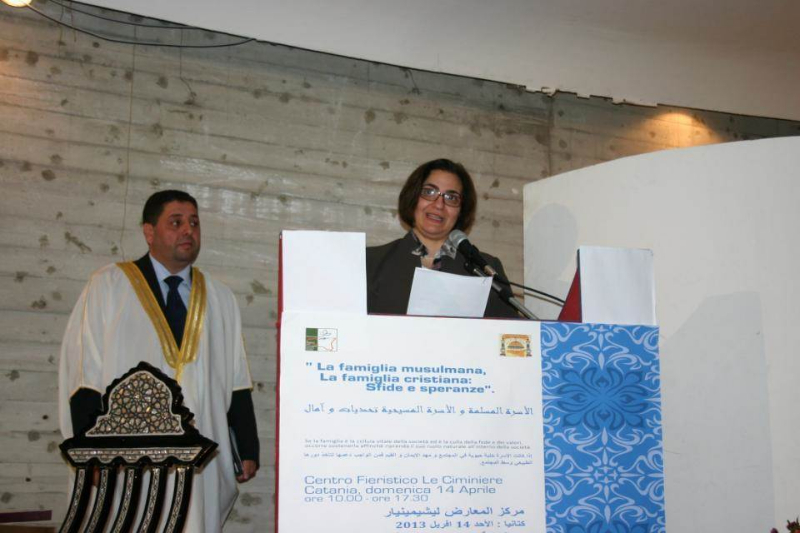 The archbishop of Catania, H.E. Monsignor Salvatore Gristina, who was present at the event, encouraged the organisers to continue on this endeavour. He said, “Let’s trust in God’s help. Let’s hold hands and go ahead.” Among the public figures who spoke, there was also the mayor of Catania, Raffaele Stancanelli, who thanked the organisers for having chosen his city to host this important event that is “capable of positively influencing our national community”. The 14th April event at Catania forms part of the experiences of fraternity promoted since a while between some Muslim communities and the Focolare, as part of the Progetto Italia (Italy Project), and which figured significantly last November at the event at Brescia.
