![Genfest on the Road]()
5 Sep 2012 | Focolare Worldwide
 4 September 2012. 14:00. Following a twenty hour-long bus ride we arrived in Castelli Romani, Italy. We were different from when we had left. How many were we? There were ninety-six on the bus and twenty on the plane, and the others whom we met in Budapest. There were the four who had travelled by car in order to save some money, some others in a camper, some friends working behind the scenes in the underground area of the Sports Arena: the people working in productions, the Internet coordinator, the youths who were working on the social networks and many others. Our group was like a small slice of the Genfest with people of different ages (some younger than fourteen – the group’s mascot – and some who were already over thirty). There were also people of different beliefs in our group (many Catholics, even practicing, many who were just curious to experience something different. And then there were some agnostics and nonbelievers, and also a few priests and religious sisters).
News of the Genfest could be had through various means (press releases, social networks, the instant replay of the event). But how will we know what this even meant for those who were there? Only time will tell, but we did get some sense of what it was like. Before leaving Budapest, this very Italian group sat for a while on a lawn in the in front of the “downtown Church” just a few metres from the Chain Bridge which had been the site of the largest flash mob in history, ever to be performed on a bridge (it actually shook under the weight of the 12 thousand rejoicing youths!). As they sat there on the lawn it seemed that time stood still.
They no longer heard the noise of the traffic or the voices of pedestrians as they hurried by, nor were they bothered by the roasting afternoon temperatures and thirst. All they were hearing was the river of life sharing that flowed from those who overcoming their timidity, raised their voices to tell what was taking place within them. “I found the courage to ‘allow myself to be wounded’ by the sufferings of others without trying to move beyond it,” says 22 year-old Tiziana who is studying economy. And Francesco, who is not yet eighteen: “I had decided to come at the last minute just to do something that might be interesting at the end of the summer holiday. I was never expecting such a big change in me. It began with an apple that rolled over my foot and a smile as I handed it back to the one who had dropped it. For the past few days I have only tried to love the person who was near me, and I’ve never felt as alive as I do now.” Fourteen year-old Anna confides: “This year has been a bit sad for me, thinking about the many friends with whom I’ve tried to share this great ideal and little by little they drifted away. That’s why, when I heard about Genfest I did everything I could to attend. And with the charge I received during the days of this event, seeing how many we are, all of us believing that a united world is possible, I want to go back home and shout out to everyone about this great dream.” Freddy, eighteen years old: “We are all agnostics in a group I belong to, atheists and nonbelievers. But welcoming others is fundamental for us. This is what we experienced over these past few days, we felt like brothers and sisters in spite of the differences.”
I can leave now as the Genfest challenge has been won. One year ago, when we planned the trip, the young group leaders had said that we would need a whole week, since the fundamental thing would be to build relationships, strong bonds with our friends. And that’s how this trip turned out. It brought us through Vienna, and we stayed on in Budapest for an extra day in order to get to know this marvellous city. At the heart of it all were the two days at the Sport Arena, the Chain Bridge and the gathering in front of St Stephen’s Cathedral. “As soon as I stepped into the Arena something happened,” says Paolo; the concert on the 31st of August, the language of the songs that united the young people from all over the world, the feeling that you needed to jump up and down, to embrace each other, to share our feelings. But this emotion was immediately transformed into life, as is shown by the experiences they have shared; it has translated into courage and decision. And it has given them the courage to return home and live their motto “Let’s bridge,” to be a living bridge to anyone we may meet.
![Genfest on the Road]()
31 Aug 2012 | Focolare Worldwide
 Following a year of hard work and great expectation, Genfest 2012 has finally begun in Budapest! There is a festive atmosphere on the streets of the Hungarian capital among friends who are finally meeting one another not on the world wide web, but in person.
On the morning of 31 August an international delegation of young people was welcomed by the Hungarian Parliament together with president of the Focolare Movement, Maria Voce. The Minister of External Affairs, Martonyi Janos, delivered a welcoming address in which he underscored that: “The challenges are global and the answers are universal and linked to universal values.” Then he added: “We must respond to the culture of hatred with the culture of love.” Then he thanked the youths from Young People for Unity “who have brought such extraordinary projects here. Through their love we discover ours.”
Yesterday afternoon there was the inauguration of Fraternity Corner in one of the public parks of the capital, which the youths had planned and brought about with the collaboration of Budapest’s City Hall. “We would like to give hope to our city,” says Rita, a twenty-five year old Hungarian. And they did it in the presence of the civil authorities and a colourful crowd of several hundred young people who attended the inauguration.
 Gergo Jedliscita, an architect, is thirty years old. He is the one who had designed the corner, which is located in the very heart of Budapest’s young nightlife. It has five rectangular marble blocks of different sizes, which stand on a platform in one of the corners of the park. The blocks represent the five continents. On the faces of stone is chiseled the Golden Rule – Do unto others as you would have them do unto you – written in the major languages of the world, also in Braille. It is meant to be a tangible sign of Genfest 2012’s message to the world.
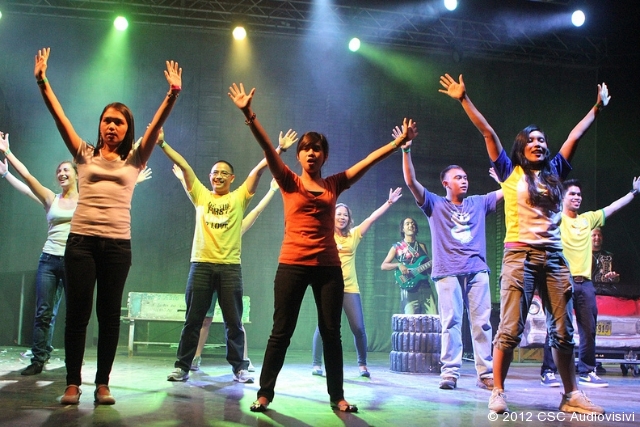
The day concluded with a performance of the Streetlight Musical by Gen Rosso, before an audience of more than 4,000 people. On stage with the artists there were also 120 Hungarian teenagers who had attended a two-day workshop with the music group.
A hundred and four nations from five continents were represented including a group of 250 young people from the Middle East. There were many Christians from different Churches and around 100 from other religions together with a constant presence of youths with no religious affiliation.
![Genfest on the Road]()
30 Aug 2012 | Focolare Worldwide
 Program of the Genfest
It’s not long now before the start of this much-awaited international event! We’ve been inundated with requests from people around the world asking how they can follow Genfest 2012. Here are some details: LIVE INTERNET STREAMING: http://www.genfest.org/live
It will be possible to follow the transmission from the Sports Arena in Budapest in these languages: Hungarian, English, Italian, French, Spanish, Portuguese and Arabic. Scheduled transmission times (Central European time):
Friday 31st August – from 7.30 pm to 10.00 pm
Saturday, 1st September – from 10:30 am to 12.30pm and from 3.30 pm – 5.00 pm. The flashmob at the Chain Bridge will be held between 9.00pm – 10 pm.
SOCIAL MEDIA The official channels of Genfest 2012: 


RECEPTION PARAMETERS – Duna World (audio transmission in English, Hungarian and Italian – the official languages of the event) http://dunaworld.hu/eng/reception.html Schedule:
Saturday 1st September
10:00 am – “Opening of Genfest 2012” (a summary of the previous day’s program)
10:30 am – Live from the Sports Arena
3:30 pm – Live from the Sports Arena
5:30 – “Genfest Confert” (from previous day’s program).
.ITALY: TV Channel Telepace will be transmitting most of the program. On Friday, 31st August, Channel TV2000, will transmit the event during its program “Nel cuore dei giorni”, from 5.00pm to 6.00pm (CET) in a slot dedicated to the Genfest 2012. For additional information regarding Genfest 2012, see official website www.genfest.org
 |
 |
 |
The Genfest 2012 project has been funded with support from the European Commission.
This communication reflects the views only of the author, and the Commission cannot be held responsible for any use which may be made of the information contained therein.
|
![Genfest on the Road]()
29 Aug 2012 | Focolare Worldwide

Video: Chiara Lubich, Genfest 1990
![Genfest on the Road]()
28 Aug 2012 | Focolare Worldwide
 “A gathering of thousands of youths from every part of the world, from different ethnic groups, cultures and religions, moved by a common idea that is already a life experience and social action: to build a more united and inclusive world.”
This is the way the official newspaper of the Catholic Church describes this grand event organized by the youths of the Focolare Movement and already underway in the Hungarian capital. The Vatican newspaper also underscores the building of bonds of unity across the board and, in particular, “among groups and Movements, among Christians of different denominations and among faithful of different religions.” The journalist recalls how Chiara Lubich liked to describe the Genfest as a “Waterfall of God” whose source,” the Roman Observer article continues, “is the very inspirational spark of the Focolare Movement itself, the discovery of God who is Love.”
Leggi tutto l’articolo
Official Genfest website
Press Section (Servizio Informazione Focolare)
![Genfest on the Road]()
16 Aug 2012 | Focolare Worldwide

This time it would be appropriate to say that the time has finally arrived for Portugal! The time has arrived for the long-expected visit of the president and of the co-president of the Focolare Movement to the land of Portugal. The trip, which had originally been planned for last January, was postponed for health reasons. But now neither the fierce summer heat nor Maria Voce’s busy schedule have prevented the Focolare community in Portugal from gathering together to give a warm welcome to the president and co-president Giancarlo Faletti.
There are two antecedents which the Portuguese proudly include in the history of the Movement in this country.
The first goes all the way back to 1948 when Igino Giordani (known as Foco), then Deputy of the Italian State, held a conference at the Geographic Society. During this conference, Giordani, who had met Chiara Lubich only three months earlier and was left fascinated by her spirituality of unity, met then Cardinal Patriarch of Lisbon, Manuel Cerejeira.
The second antecedent is particularly dear to the Portuguese Focolare community. It was Chiara’s visit to the Shrine of Fatima in 1955 when the Movement had not yet begun in Portugal. She wrote about it in her diary three years later: “It was September 1955 when a truly exceptional circumstance procured for us the great fortune of meeting with Sister Lucia of Fatima. . . I don’t remember much from that much loved trip, which lasted from 8 September (the Nativity of Mary) until 12 September (the Holy Name of Mary), perhaps because my heart was completely taken by the Cova da Iria, where Our Lady had presented her message to the world.”
 Many years would go by before Chiara could personally meet with the Portuguese Focolare community at Santiago di Compostela (1989) along with the community of Spain. Later in 2003, she was preparing to visit Lisbon when her health prevented her from going. On this occasion as preparations were underway for the 60th Anniversary of the Focolare’s arrival in Portugal, she wrote to the members of the community who were gathered for the festivities: “Dearest Everyone, I am imagining you all gathered there in Fatima (…). Even though it hasn’t yet been possible for me to be with you, may you feel that I am with you more than if I were there in person. I know that you’ll welcome this opportunity to renew the unity among you. . . to spread Love through the world.”
Now, with Maria Voce and Giancarlo Faletti in Portugal, it is as if they are fulfilling the desire of the founder.
We shall remain watching and reporting on their visit so that all those interested from around the world will be able to share in the happenings among the Focolare community in Portugal.
By our correspondent Gustavo Clariá
Photos © M. Conceicao / M. Freitas
