![Panafrican Meeting for Priests of the Focolare Movement]()
8 Aug 2011 | Focolare Worldwide
 One hundred and ten priests from twenty African nations met in Nairobi from 27 July to 4 August for a “Panafrican Conference of Focolare Priests”. The meeting was entitled: “In God’s Family the Church: A Way for Priests Today”. Through discussions in workshops and plenary sessions, they explored some of the challenges facing the Church on the African continent. What united these priests from so many ethnic backgrounds at a small Focolare town near to Nairobi in Kenya? They wished to contribute to the rediscovery and actualisation of God’s design for this continent, in the light of the evangelical lifestyle proposed by the Focolare Movement, which has been present in Africa for nearly forty years. The president of the Focolare Movement, Maria Voce, welcomed the priests in a written message at the opening of the conference: “I heartily wish that the presence of the Risen Lord in your midst may be the Light for understanding how Jesus desires priests to be in this day and age, and how they can serve the Church in our most beloved Africa, which has so much to offer to the whole world.” The conference gave living expression to the potential of the African clergy today. It also underscored the average age of the attendants – thirty-five – many of whom are already in positions of responsibility.
  In an Africa which some of the participants described as the “Africa of crises”, the idea of the family, which is so central to African social and ecclesial culture, took on new intensity and light when viewed from the perspective of mutual love and evangelical unity. The discovery of Jesus Crucified and Forsaken as the key to reconciliation and peace, led them not to feel that the challenge was a utopia, but to enter into the wounds and to become protagonists on the road of renewal and of communion which have the measureless love of Christ as their standard. The meeting was based on listening and sharing, with moments for reflecting and examining in study groups. And there were plenary meetings for sharing and discovering ways to incarnate their vision in a culturally liveable proposal for the Church in Africa. The meeting was interspersed with real life experiences that were “offered,” as one attendant wrote, “not in the form of scientific accounts, but in a family style which was nevertheless not disorganized, and had much to offer for meditation.”
  This renewed in them their calling to rediscover themselves as men of God who are called to evangelize Africa with the weapons of the spirit, of love and of unity. Also through their ability to go against the current, as the Nunzio Apostolico of Kenya, Paul Alain Lebeaupin stated during his presentation. The Archbishop of Mombasa, Boniface Lele, invited the participants to a great openness and mutual assistance among priests so that they may be coherent servants among the Family of God.” The nations represented at the conference stretched from the Atlantic to Indian Oceans and embraced the austral and central regions of Africa: Gabon, Democratic Republic of the Congo, Angola, Zambia, South Africa, Kenya, Tanzania, Uganda, Rwanda, Burundi and Madagascar. Compiled by the Secretariat for Priests of the Focolare Movement
![Panafrican Meeting for Priests of the Focolare Movement]()
5 Aug 2011 | Focolare Worldwide
 The course was held at the impressive Vallombrosa Abbey in Italy, during July 17-30 and it concluded the second part of the course for educators which began last year. It involved seminary educators from thirteen countries (Pakistan, India, Korea, China, Venezuela, Uruguay, Argentina, Brazil, Poland, Austria, Switzerland, Portugal, and Italy). The open forum surprised the attendants with its daily motivational richness and its content. The guiding theme of the interactive course was “Prayer, Life, Thought”. Faced with the profound changes that affect a person’s life in the modern world – influenced by the digital revolution – it has become necessary to constantly update educators both on this subject and on educational approaches which can be used with candidates for the ordained ministry.
  In Novo millennio ineunte (n. 43), John Paul II had already invited the Church to become a “home and school of communion”, also in “places where ministers of the altar are formed”. The priests of the Focolare Movement have responded to this expectation by offering this Pastoral Theology Course for Educators in Seminaries, and the Congregation for Catholic Education (office of the Holy See which serves seminaries around the world) has expressed its support and appreciation ever since this course began. The undersecretary of the Congregation, Archbishop Vincenzo Zani, himself, launched this year’s course by attending and making a presentation entitled: “The Communitarian Dimension of Formation”.
 The course is structured around four residential weeks in two years. The first year presents the foundations of the paradigm of communion applied to the delicate task of training future priests. The second year moves into the practical and more complex aspects of formation, dividing it into seven main areas of concern: the gift of self and communion, dialogue and witness, prayer life and life in the “Mystical Body”, entertainment in community, study and, finally, communication at the service of communion. It is in their intertwining that these areas become a valuable approach to the formation of seminarians: one which is not fragmented but unitary, integral and harmonious. Individual participants are invited to enter into a relationship of openness; to attend group workshops exploring specific topics that relate to the main theme; to come up with concrete formation practices; and to make group presentations at a plenary session.
  The support from experts in the fields of theology, pedagogy and other human sciences was also invaluable, together with the personal contributions of the educators themselves who are experts in the field of formation. The interest shown and the need to give formation to educators suggest that this course will continue to be offered in future years. Beginning this year, the course will be held at the Sophia University Institute of Loppiano. Course members will be expected to present a dissertation and will receive academic credit. Links Priests of the Focolare Movement Vallombrosa Abbey Sophia University Institute
![Panafrican Meeting for Priests of the Focolare Movement]()
4 Aug 2011 | Focolare Worldwide
 “We were halfway through the school year, in the middle of the school’s afternoon extracurricular activities. But since I’m in athletics, it was also the middle of sport preps for the season of competitions which was about to begin. Our Italian teacher had arranged for us to meet the author of a book which we had read. A few days before my trainer suggested that I take part in some competitions that were to be held on the same day as our appointment with the author. The dilemma began as to whether I should choose what I wanted to do or choose to do what would be most correct. I tried to focus my attention not only on feelings, but also on them, on the consequences of my actions for these two people.
  Since I didn’t have any active role to play in the appointment with the author, except to be a listener, I decided to attend the competition. It was in telling my teacher of my absence that my ‘trying to love’ would be put to the test. I was fearful, in fact, that she would be displeased because she was so looking forward to this appointment. And so, upon the advice of some friends, I decided to invent an excuse, a doctor’s appointment or some illness that would excuse me from attending the event and avoid any such risk. But, perhaps because of the way I had set out to do things from the beginning, aside from feeling that this choice would clearly be wrong, I found the courage to face this small challenge of telling the truth. To my great surprise and that of the entire class, the teacher didn’t react negatively in the least. On the contrary, she told of how she had been involved in sport in her younger years, and she encouraged me to attend the sport event. The sport events turned out to be the best I had ever attended, because of the joy I felt and because my previous dilemma had shown how important each tiny choice of love can be, a choice that God welcomes and multiplies in the happiness He gives us. A small attention to respect a neighbour and a small lie never spoken that allowed sincerity to triumph, and fair play made me feel that on that day, I was a real Gen3!” Who are the Gen3 according to Elena? “They’re teenagers who try to live the Gospel and to bring unity through their actions. Gen3 life is normal everyday life, but and everyday life that plants each moment in eternity, a normality in which each gesture is made exceptional because it is addressed to God, and aimed at winning Heaven.”
![Panafrican Meeting for Priests of the Focolare Movement]()
3 Aug 2011 | Focolare Worldwide
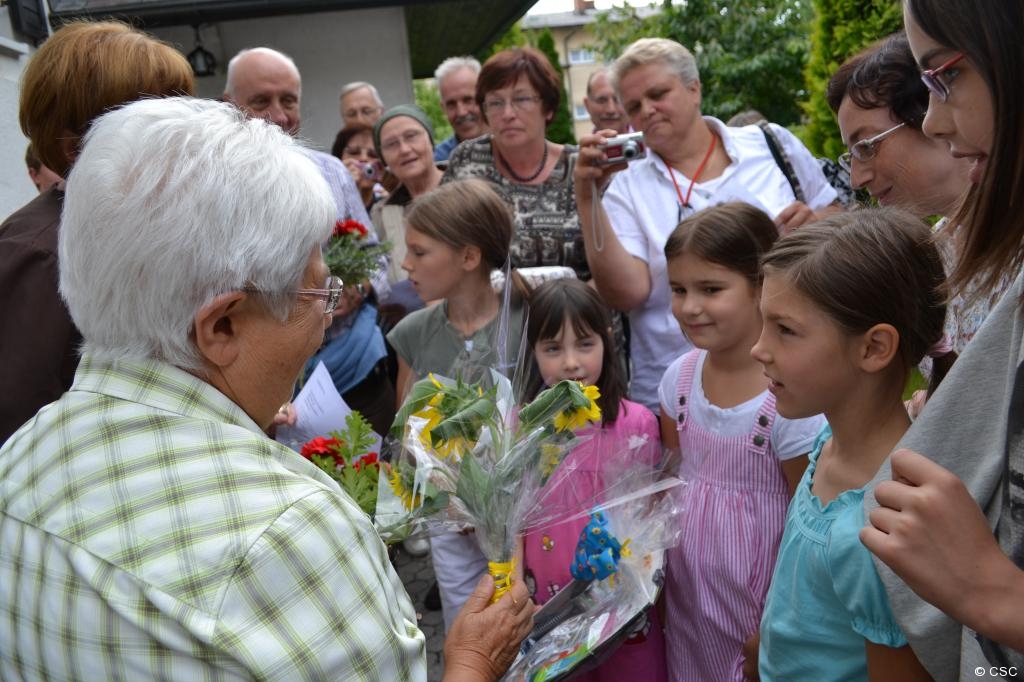
A surprising welcome for Maria Voce and Giancarlo Faletti in Slovenia where a group of smiling Friulians and Slovenians waited for them with flowers. It was an unusual sight, given that these two peoples have had mutual disagreements since 1918 due to the world wars. The Focolare’s Gospel Ideal has helped them in overcoming the past, and for this reason the atmosphere is warm and festive as the Slovenian people are.
This is a community that has been strengthened by long years of fidelity even through great suffering. A community which Maria Voce noted presented itself “mature” and rooted “in mutual love, that love which links one to the other.”
It is a small people in terms of its territorial expansion, but decisive and concrete in its Gospel experience. The lively youth of this land gathered together 600 of their countrymen, and presented to them the life of Chiara Luce Badano, a Gen who was recently beatified. Another original experience has been the constructive contact with other Catholic movements without which “the Church cannot go forward,” as the recent Archbishiop of Ljubljana pointed out. And it is for the contact with the faithful of other churches and religions.
Faced with a growing secular trend, on the 20th of June major representatives of the religions in Slovenia signed and launched a public appeal for religious freedom. Thousands of people had previously held public manifestations in defence of family values and against legislation that opposed them. These were projects that involved the community of the Movement in standing up for that “quality in relationships that creates the family, to that Gospel spirit which is a family spirit,” as Maria Voce stated on the last day of her stay in Slovenia.

Skofja Loka
Another significant moment was the August 2 visit of Maria Voce and Giancarlo Faletti to a noteworthy educational project at the “Sunray” Pre-school in the historic city of Skofja Loka, twenty-five kilometres from the capital. The whole is immersed in green and overlooked by a castle – one of the two-thousands castles to be found in the whole state – the summer residence of the ancient patriarchs of Aquileia.
Twenty-eight teachers – including twenty from the Focolare – have been bringing ahead this educational project since 2003. It involves 120 children between the ages of six months and six years, and is founded upon the spirituality of communion of Chiara Lubich. It is amazing to witness how such a pilot-project, which is born from a Gospel experience, provides a life education based on relationships of mutual love and respect, and of listening and it engages teachers, parents and the children themselves.
Although they do not teach the catechism in the traditional sense, they do present Jesus to the children as someone who was born into the simplicity of a family and as someone who accompanies their growth.
The project has been a large success and more requests are arriving to open similar pre-schools based on the same pedagogical model. Few know the suffering that lies beneath it all, due to the State’s reluctance to support such projects. Maria Voce exhorted the teachers to “write of their extraordinary experience” as she continued to hold up the value of a work that strives to educate children at a relational dimension which is based on the new commandment of Jesus: “This is my command: Love each other as I have loved you.” It was an historical moment for Sunray Pre-school whose very name expresses the sensation one has while visiting there. To the joy of everyone, Maria Voce suggested two “protectors” for the project: two focolarini who showed great love for the youth: Camilla and Vincenzo Folonari.
By our correspondent Mario Dal Bello
![Panafrican Meeting for Priests of the Focolare Movement]()
3 Aug 2011 | Focolare Worldwide
 We’ve heard from the Focolare community in Kenya about their immediate commitment to respond to the appeal of Benedetto XVI to skip a meal and donate the price of that meal to help Somalia. Giovanna Vasquez and Flavio de Oliviera write: “Dear Everyone, as you will have come to know from radio and television news, the Horn of Africa is undergoing a devastating human disaster. Our brothers and sisters have come to the bottom of the well, they are dying for lack of food and water due to the drought that is affecting the region.” There are many organizations working on site while, on behalf of the Pope, the Pontifical Council Cor Unum has sent its first aid money in the amount of 50,000 euros. It arrived through the Bishop of Djibouti and Apostolic Administrator of Mogadishu, Msgr. Giorgio Bertin. In their letter Giovanna and Flavio from the Focolare Movement in Kenya continue by mentioning one of the main points of Focolare spirituality; that is, recognizing the face of the crucified Jesus in every human suffering. “Standing before the face of Jesus forsaken in this great suffering, we asked what we could do to heal at least a bit of this pain, and the idea came of launching a campaign that we’d like to call: “skip a meal”. It would involve depriving yourself of at least one meal during the month of August and, by donating the price of the meal, you could put into practice the words of Jesus: ‘I was hungry and you gave me food. . . (cf Mt 25:35). In living for universal brotherhood, we salute you!” Any sums of money which we are able to collect through your generosity will be placed at the disposal of the interested diocese which are already directly involved in providing aid to the populations affected by the drought. You can make bank transfers to one of the following accounts, specifying the reason: “Emergenza Corno d’Africa”. Other assistance can be given through: International Secreteriat of Youth for a United World Account Name: Pia Associazione Maschile Opera di Maria Intesa San Paolo – Filiale di Grottaferrata (Roma) codice IBAN IT04 M030 6939 1401 0000 0640 100 codice BIC BCITITMM Cause: Emergenza Corno d’Africa AMU – Action for a United World Account Name: Associazione “Azione per un Mondo Unito – Onlus” c/c bancario n. 120434 presso Banca Popolare Etica – Filiale di Roma codice IBAN: IT16 G050 1803 2000 0000 0120 434 codice SWIFT/BIC: CCRTIT2184D Cause: Emergenza Corno d’Africa New Families New Families Projects ONLUS Presso “Banca Prossima” IBAN: IT55K0335901600100000001060
![Panafrican Meeting for Priests of the Focolare Movement]()
1 Aug 2011 | Focolare Worldwide
 You have visited all the continents over the past few years, meeting with different cultures and social situations. You have had a close-up look at the Focolare communities spread throughout the world. In light of these rich experiences, could you tell us what you see as the main vocation of the Movement in the world? “It is a vocation to unity, a vocation to contribute at all latitudes, in different contexts and in different ways toward the realization of Jesus’ prayer to the Father: ut omnes unum sint (that all be one). This is the goal that each of us is called to, the imperative which is impressed upon each one of us who shares in the charism of unity (…).” Before arriving in Slovenia, you visited Russia, the Czech Republic and Hungary, three significant countries of the “ex-Soviet-bloc”. What was it that urged you to take these trips? “It is the same thing that urged me to visit Asia, Africa, North America and other European countries: the commitment to stay focused on relationships. My travels allow me to enter into a listening attitude and to grasp the problems and the riches of the peoples I meet, to appreciate their growth and to see where there is potential for development. What are the ones I’ve found in these lands that for years have been built upon a Communist ideology? Chiara Lubich always saw a special calling to unity in this area of the world, precisely in response to the forced unity that characterized these countries. In 1989, just after the crumbling of the Berlin Wall, Chiara saw those historic events as a great step toward unity. Within the process, however, the positive values that were present in that society up until then should be safeguarded: the yearning for unity, a global vision of the world, attention for the poorest classes, exaltation of the human person’s propensity to be social. Grand ideals, but often blatantly contradicted by the facts. She seemed to understand that the charism of unity, which the Holy Spirit had given to her, had a contribution to make in returning those ideas to their original source and rooting them there: in God. (…) Unity could really become the distinguishing mark of this region in particular. For if it is lived in God, the greater the diversity, the more extraordinary the experience of unity that is derived. I had an anticipation of it last summer during my voyage in Croazia, in which I met a group of the Movement’s members who came from different geographic and cultural regions: a single people comprised of many peoples, united in the name of God and living for unity (…).”
  IThese years we are witnessing growing polarization in Slovene society that undermines the relationship between the Church and the secular world. It sometimes erupts in a certain intolerance. How can this wound be healed and how can we help to restore true values to the world we live in? “I think that we must above all believe and bring forth all that is good and profound in every human soul. Believers and non-believers alike, hold to certain values that are within them. It’s a matter of highlighting what is positive in each person and find ways to build bridges with everyone. The charism of unity that we strive to practice has a force and light within it that goes beyond each one of us. (…). Then I believe that these values can be offered through personal witness and the witness of the community: the value of life, of the human being, of the family. . . These are values that God places within us and which should shine forth from our life, and be quite compelling. Finally, I believe in the importance of offering your own opinion, but freely, with detachment, with respect for others. In other words, as a gift of love.” Entire interview by Irena Santoro – Source: Novi Svet

 In an Africa which some of the participants described as the “Africa of crises”, the idea of the family, which is so central to African social and ecclesial culture, took on new intensity and light when viewed from the perspective of mutual love and evangelical unity. The discovery of Jesus Crucified and Forsaken as the key to reconciliation and peace, led them not to feel that the challenge was a utopia, but to enter into the wounds and to become protagonists on the road of renewal and of communion which have the measureless love of Christ as their standard. The meeting was based on listening and sharing, with moments for reflecting and examining in study groups. And there were plenary meetings for sharing and discovering ways to incarnate their vision in a culturally liveable proposal for the Church in Africa. The meeting was interspersed with real life experiences that were “offered,” as one attendant wrote, “not in the form of scientific accounts, but in a family style which was nevertheless not disorganized, and had much to offer for meditation.”
  This renewed in them their calling to rediscover themselves as men of God who are called to evangelize Africa with the weapons of the spirit, of love and of unity. Also through their ability to go against the current, as the Nunzio Apostolico of Kenya, Paul Alain Lebeaupin stated during his presentation. The Archbishop of Mombasa, Boniface Lele, invited the participants to a great openness and mutual assistance among priests so that they may be coherent servants among the Family of God.” The nations represented at the conference stretched from the Atlantic to Indian Oceans and embraced the austral and central regions of Africa: Gabon, Democratic Republic of the Congo, Angola, Zambia, South Africa, Kenya, Tanzania, Uganda, Rwanda, Burundi and Madagascar. Compiled by the Secretariat for Priests of the Focolare Movement

