27 Nov 2015 | Focolare Worldwide
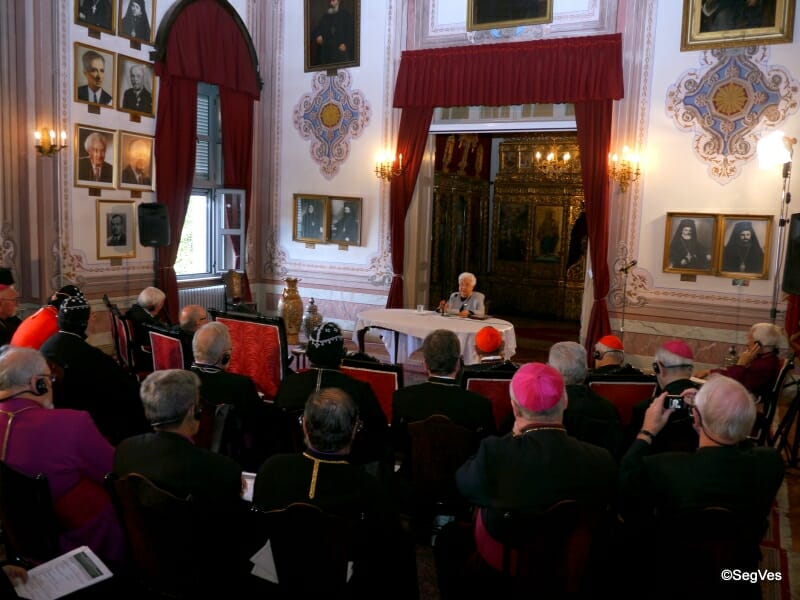
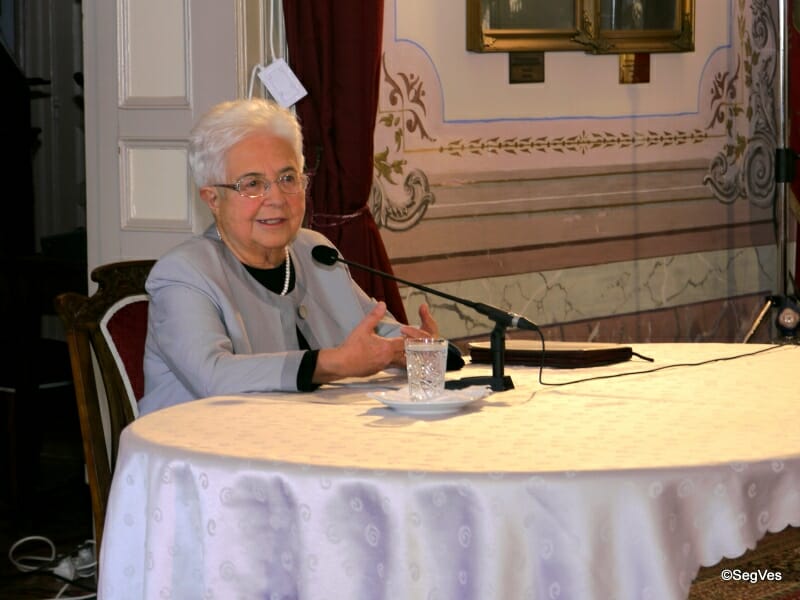 In the present context it may seem absurd or anachronistic to speak of unity. And yet the motivation which animates the bishops present at the Ecumenical Convention on the island of Heybeliada (Halki) is anything but a utopia. Their commitment to live reciprocal love among themselves and with their churches is already a vital testimony for anyone who has lost hope in dialogue and peace. On November 25th, Maria Voce spoke to the bishops about unity in her programmatic speech. Unity is not only a gift from on high, but also becomes an impelling commitment which, she assures us, allows us to “insert ourselves into the sacred history of humanity.” A sacred story in which Christians have an essential role. Unity becomes a response to the challenges of today. “In the face of powerlessness, which at times assails us even today,” she continues, “perhaps we need to take a single first step: to give ourselves to God as instruments in his hands, because he builds unity upon our nothingness. This is our first obligation, the first step we must take singularly and together.” With the dramatic social problems of today, many people, especially the young, feel the need to be visibly present next to those who suffer. But the Focolare Movement’s task does not finish here. One must understand that unity is an objective towards the goal of a united world. “We are called to unity with all, excluding no one,” stresses Maria Voce. Citing various excerpts by Chiara Lubich, she reveals to the bishops the way discovered by the Focolare foundress. “For us, the door which leads to unity is Jesus Crucified and Forsaken,” which “carried out the reunification of the human race with the Father and among men and women, and it is He, crucified and forsaken, the key to unity, which he will fulfill even today.” The task which the Focolare Movement poses is to bring the richness of unity to every corner of the world, to awaken life everywhere. “In the refugee camps, ” continues Maria Voce, “in the hospitals for the wounded by war, in the public demonstrations, in the queues of people looking for work and finding none, in the ports crowded with immigrants…everywhere, everywhere, God is asking us to light ever-greater flames.” In the subsequent dialogue several bishops related their actions in difficult situations, and the solidarity of the faithful of different churches wherever there is war and suffering. They have a strong certainty that the cross of Jesus is the common bond between them and will make lively communities blossom in the most unthinkable places. The program then took a particular look at the situation of the local churches in the Middle East, the role of Christians and their difficulties. Bishop Sahak Maşalyan, despite the complex situation of the Armenian Church in Turkey, spreads optimism, and asserts: “When Christians lose their sense of optimism, in the end they emigrate to some other place.” An appeal was also made by Bishop Simon Atallah, of the Maronite Church of Lebanon. He asked all to pray with fervor to end the war, so that Christians would not abandon their lands and could return to living in peace and harmony. At the end of the day Angela Caliaro e Carmine Donnici, representatives of the Movement, spoke about the development and the influence of the Focolare in the whole Middle Eastern area; a seed of hope which engages Christians, Muslims, and Jews and encourages them to continue on the road to reconciliation and peace. From correspondent Adriana Avellaneda
26 Nov 2015 | Focolare Worldwide
![Pope Francis: a pilgrim of peace in Africa]()
25 Nov 2015 | Focolare Worldwide
 Today Pope Francis sets out on his first trip to Africa where he will be visiting Kenya and Uganda (English-speaking nations) and the Central African Republic (a French-speaking nation). It’s a particularly delicate and significant time in the Central African Republic due to it’s security situation being a country at war. “Mariapolis Victoria”, the Focolare’s little town located in the Ivory Coast, extends its best wishes for this trip and has timed the launching of its new website today to coincide with this meaningful journey of the Pope in Africa . Although West Africa is not on Pope Francis’ itinerary, we totally adhere to his message of brotherhood and peace. Many nations in West Africa, such as Mali, Niger and Nigeria, have suffered repeated attacks of terrorism. We sincerely hope that the presence of Pope Francis, which promotes dialogue, in particular interreligious dialogue, may open up pathways of fraternity in Africa. “Bon voyage” Pope Francis! Source : www.focolare.org/mariapolivictoria
25 Nov 2015 | Focolare Worldwide
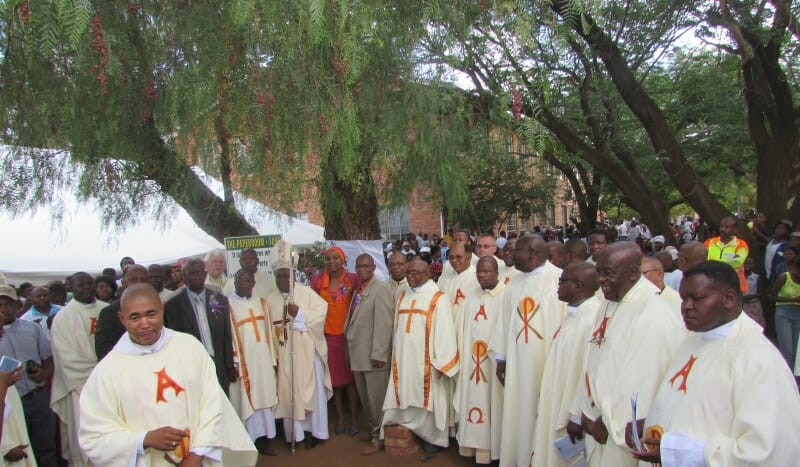 Taung forms a sole diocese with Kimberley, famous for its ancient and deactivated diamond mine. Visitors flock from all over the world to Kimberley to admire its Big Hole, the hollow that remained after the diggings, and where, surpassing the steep ravines, the bravest tourists can immerse in a really fantastic lake. But also Taung boasts its own primacy. In 1924, precisely there, the fossile of a child’s skull was found , and traced to 2.3 million years ago, a very important find for scholars and researchers, and was named the Taung Child. However, the 24 October feast was not only a geological-cultural one. Four thousand people from far-off towns and village reached Taung to celebrate the 120th anniversari of the arrival of the Catholic Church among the Tswana people of South Africa. The Prior of the Oblates and the local bishop were the honoured hosts. Also Bishop Klerksdorp and about fifty priests and religious were there. The Minister of Culture of the province represented the government. Also present was Kgosi, the traditional chief of the Tswana population – about 300,000 in all – living in the villages of Taung.
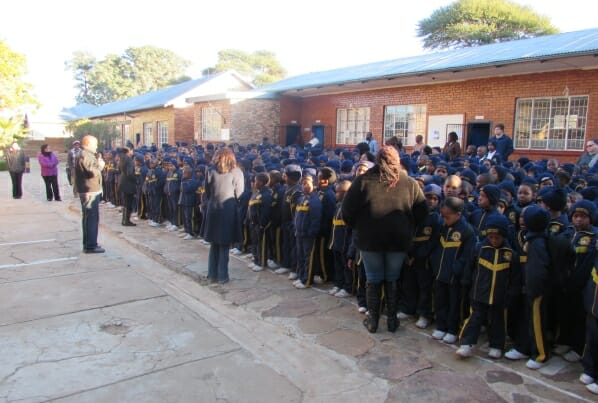
 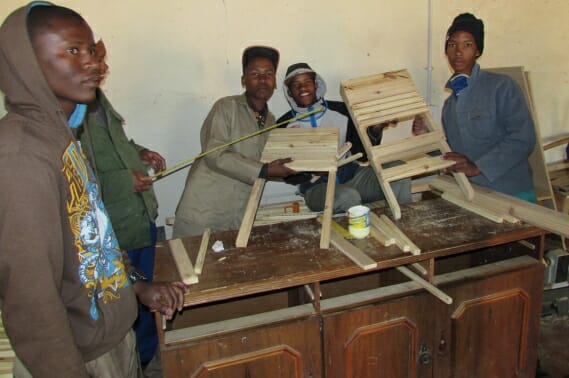 During the celebrations, great importance was given to the activities of the missions, especially those conducted by three members who live in the Focolare community: Dominic, from Cameroon, and Chris who is German and Moris from Kenya. Each of them play a key role in the mission. Dominic, who is a priest, acts as vice-parish priest. Given that he has been there for a short time, he is still learning the Tswana language, and so, during the sermon, is helped by Rapelang, father of a family who has embraced the spirituality of the Focolare and more than willingly acts as his interpreter, and often completes the sermons with his own experiences on living the Gospel. Chris has been entrusted with the two-year professional school and which certifies yearly about thirty young and promising carpenters. These are young people who had to leave for various reasons the public school, and are offered a second chance to learn a trade. Moris is the dean of the primary school with 550 students. It is really impressive to see, in the morning, this throng of kids and children line up for inspection, which is performed by the assigned students themselves every time, to check the hygiene and uniform of the students. Besides a professional education the school also offers a spiritual and moral education for their personal lives. Its innovative programme and teaching style, centred on authentic values, has earned the school its reputation as a school of excellence. It is attended not only by the children of Catholic families but also of Protestants (who represent about 30% of the entire South African population) and among whom ecumenical dialogue is always open and constructive. The Catholic Mission schools, across the 100 years of activities have formed men and women of great human and professional stature, who have played key roles in society.
24 Nov 2015 | Focolare Worldwide
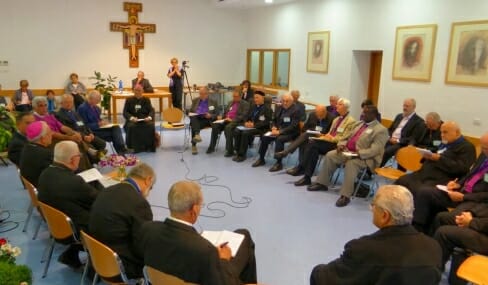
The 34th Conference of Bishops of different Churches, promoted by the Focolare Movement, will start on 25 November 2015. It will be held on the island of Heybeliada (Halki), in the sea of Marmara, near Istanbul. The 150 participants, from 9 different countries, will be hosted in the Monastery on this island, which was once the seat of the prestigious Greek-Orthodox theological Academy of Halki. The 50 participants, from 19 countries, are much awaited by His Holiness Bartholomew I, who during a recent interview, in the wake of the Honoris Causa doctorate in the Culture of Unity conferred upon him by the Sophia University Institute, affirmed that: “At Halki we will together remember Chiara Lubich and pray for the repose of her soul. We will be able to express our commitment to work for the unity of Churches. We, the Church of Constantinople are pleased to welcome these cardinals and bishops, and we are ready to exchange our experiences and give one another the kiss of peace between the East and the West”. “Together for our common home” will be the theme of this conference, which will focus on unity, as a service to the human family, through a diversity of gifts. The main speakers will be Patriarch Bartholomew I and Maria Voce, while Cardinal Francis Kriengsak, Archbishop of Bangkok will be the moderator of the conference. Various bishops from different Churches will share their reflections; among them, the Anglican Bishop Robin Smith; Åke Bonnier, Lutheran Bishop of the Swedish Church; the Catholic Bishop Brendan Leahy, Bishop Sahak Mashalyan of the Armenian Apostolic Church and the Metropolitan Elpidophoros of Halki. Jesús Morán, the co-president of the Focolare Movement will offer his reflection on “The Charism of Unity and the challenges of today’s humanity”. Gerhard Pross, an Evangelical from YMCA, Germany will speak about “Achievements and experiences on the road to unity” in the name of “Together for Europe”, the ecumenical network of movements and communities. Cardinal Kurt Koch, who will lead a Holy See delegation to Istanbul for St. Andrew’s feast, will also speak during the Conference. His talk will be about “Pope Francis and the cause of Christian Unity”. In a church of Armenian Apostolic tradition of ancient Chalcedon, the seat of the Chalcedonian Ecumenical Council of 451, the bishops will once again formulate a pact of reciprocal love, thus renewing the mutual relationship of charity that goes beyond all divisions and answers Jesus’s invitation: “Love one another as I have loved you” (Jn 15:12). In this particular context, this invitation implies the reciprocal promise “to love the Church of the other as one’s own”. The bishops are invited by Patriarch Bartholomew to participate in the celebrations at the Phanar on the 29 and 30 November on the occasion of the feast of St. Andrew, Patron of the Patriarchate of Constantinople. These meetings for bishops of different Churches, promoted by the Focolare Movement, are held annually. These meetings have been taking place since 1982, and they owe their beginning to a suggestion made by Pope John Paul II to a group of Catholic bishops, friends of the Focolare Movement, when he invited them to share their experience of “effective and affective” communion even with bishops of other churches. Promoted by Klaus Hemmerle, who was then bishop of Aaachen, Germany, and after his death by Miloslav Vlk, Cardinal of Prague, these meetings aim at offering vital spaces of communion and fraternal sharing in the light of the spirituality of unity. The venue for these meetings changes; they are held in places that are meaningful to the various Christian denominations. In 2016 the meeting will be held in Ottmaring (Augsburg – Germany).
23 Nov 2015 | Focolare Worldwide
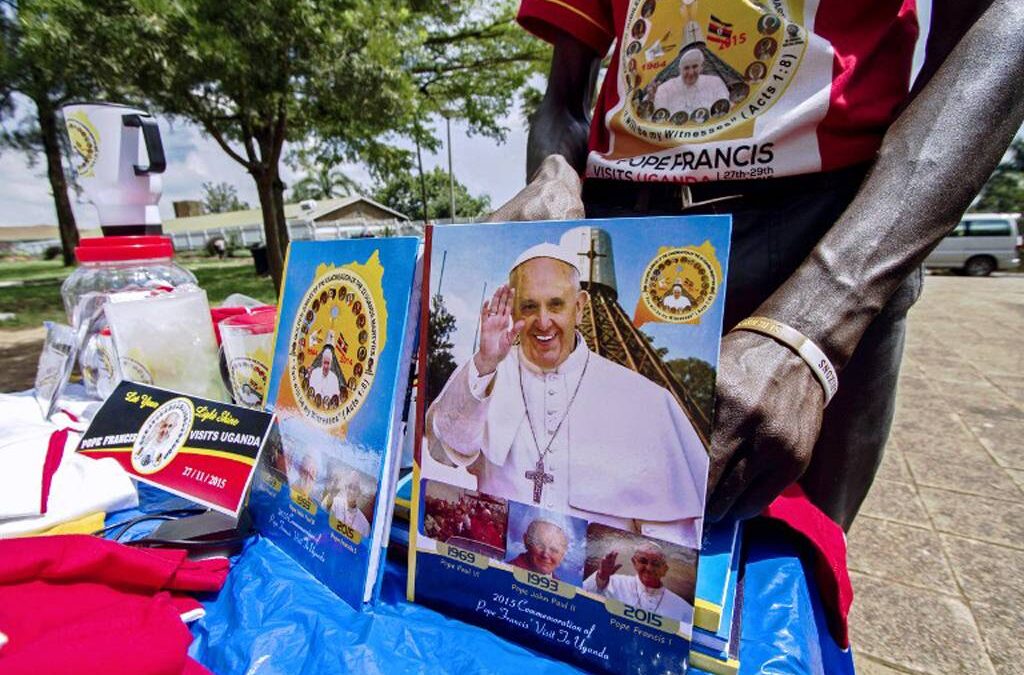
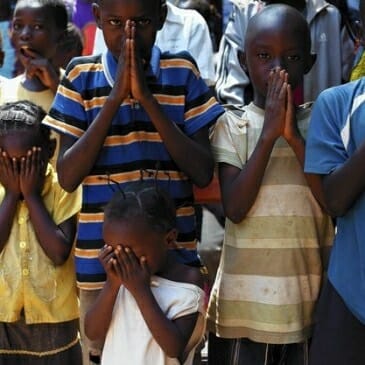 «The key perspective of this trip will be revealed in the programme and activities the Pope will undertake,» says Liliane Mugombozi, director of New City, the magazine of the Focolare Movement in Kenya. Through her we will trace the steps of a journey which is revealing to be very important. «Pope Francis chose three countries where there are big Catholic communities afflicted by various tensions which he wishes to share as the pastor of the people, and together write a new page in the history of Africa today within a global framework and walk in search of solutions to the biggest problems and concerns of the population.» And what are the expectations? «We want his message to resound in all sectors of life, from governance to the management of goods, and from politics to education, healthcare, dialogue and interreligious relationships …». And to those who object because Pope Francis knows very little of Africa, the Archbishop of Kinshasa in the Democratic Republic of Congo, Cardinal Monsengwo replied: «This is true. But the really fantastic thing is that he goes where people suffer. If it wasn’t for the Ebola outbreak, he would have come to Africa a long time ago.» Since last 19 October when the Vatican confirmed the date of the journey, innumerable analyses accompanied this announcement: «In Kenya – Lili Mugombozi wrote – the battle against Al-shabab, responsible for the violent attacks over the last few years, is one of the biggest political challenges. Mons. Rotich, president of the secretariat in charge of the visit affirmed: «During our ad limina visit in Rome, he questioned us about the massacre in Garissa and he said that he would come to comfort the Kenyan people.» In Uganda, Pope Francis will visit the Anglican and Catholic sanctuaries to honour the memory of the young martyrs: 23 Anglicans and 22 Catholics who were killed because of their faith. «For many Uganda people – Liliane explained further – Francis’s gesture is a joyful revival of the past – when in 1969 – Paul VI, the first Pope to ever set foot on African soil, canonized the first African Saints – but it is also a new commitment to dialogue with the churches.» The Focolare in Uganda wrote: «On this anniversary we feel particularly called to live the sanctity of the people.»
 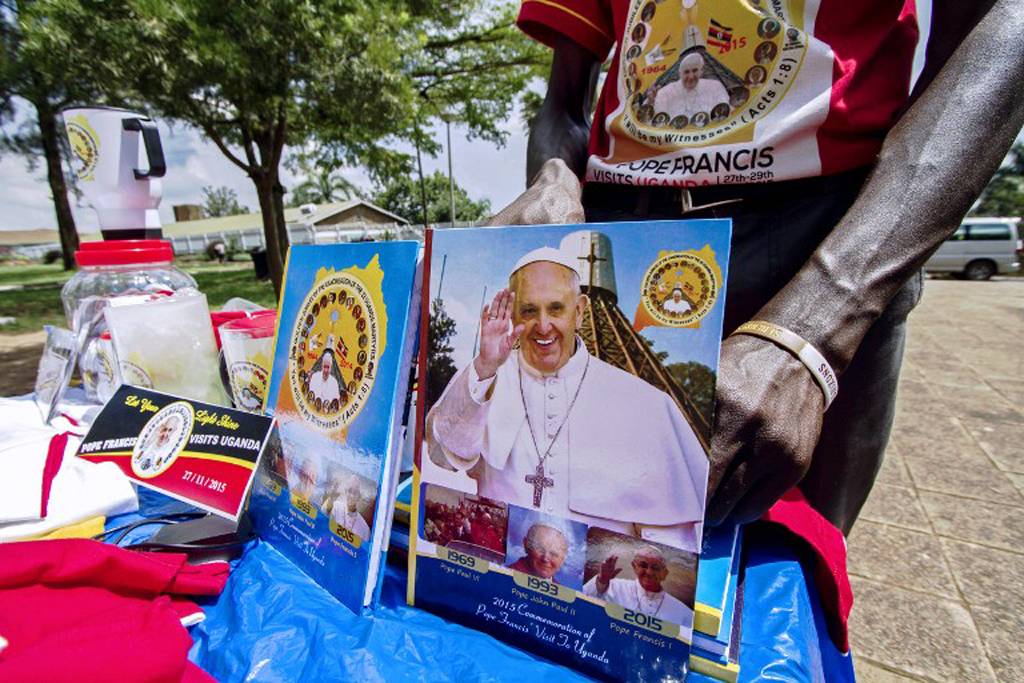 In the Central African Republic, in a tense political context which suscitates anxiety, «in order to manifest to this nation how much the Church feels and shares its afflictions, and urge all central Africans to always be testimonials of mercy and reconciliation,» on 29 November, Francis will open the holy door of the cathedral of Bangui, symbolically anticipating the start of the Jubilee Year of Mercy, and will give a very strong sign of this with his speech in the central Mosque. «In each of these countries – the New City director continued – the Pope will meet the heads of State, speak to the diplomatic corps, celebrate a public Mass where thousands of faithful will be expected, and hold various meetings with religious leaders and thousands of young people. And the poor, those who suffer will not be excluded from the meetings with him: he will meet the inhabitants of the slums of Kangemi at the outskirts of Nairobi, and the disabled in a nursing home in Nalukolongo in the Kampala district in Uganda, and in one of the refugee camps in the Central African Republic.» Also the members of the Focolare Movement will accompany the Pope’s journey to Africa with their prayers and concrete preparations. In Kenya they will be in various places: among the 10,000 volunteers of the security guards and in the delegations of universities, schools and parishes. A young woman, Mary Mutungi, will direct the choir of 600 university students during the Mass with the youth. Among the songs in the programme is also, “We can find a way to live in Peace,” written by a Filipino band on the occasion of the Genfest. In Uganda, the members of the Focolare are involved in the various preparations in the parishes. Some are in charge of the coordination activities for the Diocese. Another citizen of the Republic of Central Africa, Geneviève Sanzè, of the International Centre and a member of the Pontifical Council for the Laity, will participate in the last stage of the papal visit. Fidelia from Bangui, affirmed: «Our people so deeply hope that the Pope’s visit will help us to accomplish a deep conversion, and be predisposed towards reconciliation for an enduring peace.» Video message of the Holy Father at the Vigil of the journey to Kenya and Uganda
