
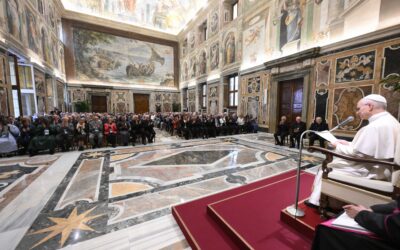
 The course was held at the impressive Vallombrosa Abbey in Italy, during July 17-30 and it concluded the second part of the course for educators which began last year. It involved seminary educators from thirteen countries (Pakistan, India, Korea, China, Venezuela, Uruguay, Argentina, Brazil, Poland, Austria, Switzerland, Portugal, and Italy). The open forum surprised the attendants with its daily motivational richness and its content. The guiding theme of the interactive course was “Prayer, Life, Thought”. Faced with the profound changes that affect a person’s life in the modern world – influenced by the digital revolution – it has become necessary to constantly update educators both on this subject and on educational approaches which can be used with candidates for the ordained ministry.
  In Novo millennio ineunte (n. 43), John Paul II had already invited the Church to become a “home and school of communion”, also in “places where ministers of the altar are formed”. The priests of the Focolare Movement have responded to this expectation by offering this Pastoral Theology Course for Educators in Seminaries, and the Congregation for Catholic Education (office of the Holy See which serves seminaries around the world) has expressed its support and appreciation ever since this course began. The undersecretary of the Congregation, Archbishop Vincenzo Zani, himself, launched this year’s course by attending and making a presentation entitled: “The Communitarian Dimension of Formation”.
 The course is structured around four residential weeks in two years. The first year presents the foundations of the paradigm of communion applied to the delicate task of training future priests. The second year moves into the practical and more complex aspects of formation, dividing it into seven main areas of concern: the gift of self and communion, dialogue and witness, prayer life and life in the “Mystical Body”, entertainment in community, study and, finally, communication at the service of communion. It is in their intertwining that these areas become a valuable approach to the formation of seminarians: one which is not fragmented but unitary, integral and harmonious. Individual participants are invited to enter into a relationship of openness; to attend group workshops exploring specific topics that relate to the main theme; to come up with concrete formation practices; and to make group presentations at a plenary session.
  The support from experts in the fields of theology, pedagogy and other human sciences was also invaluable, together with the personal contributions of the educators themselves who are experts in the field of formation. The interest shown and the need to give formation to educators suggest that this course will continue to be offered in future years. Beginning this year, the course will be held at the Sophia University Institute of Loppiano. Course members will be expected to present a dissertation and will receive academic credit. Links Priests of the Focolare Movement Vallombrosa Abbey Sophia University Institute
Learn from everyone
Learn from everyone

0 Comments