
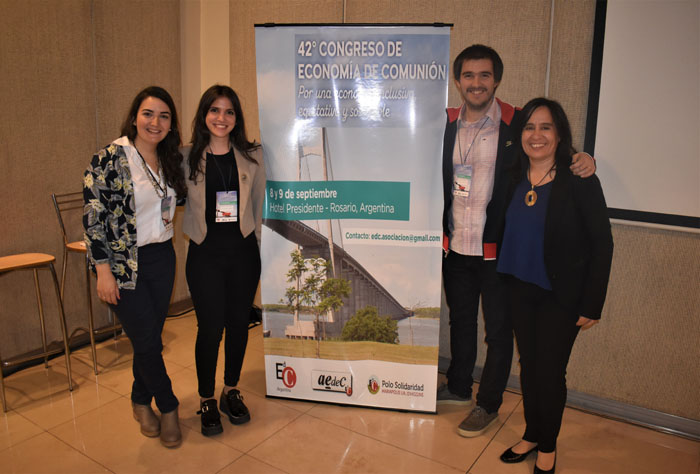
 Carolina Carbonell was one of the organisers of the Economy of Communion Congress in Rosario, a populated city in the province of Santa Fe, 300 km from Buenos Aires. She defined the event as “a marathon,” maybe because it all started with a race against time. “It was February 2018. A few months earlier, we had received the proposal to organise the Congress in our city. It was very hot. Walking along the sidewalks of the city, I came across an old university friend, today the director of a series of hotels. I immediately stopped him and told him of our dream: so we found the place for the Congress. On 6 September, 70 people, “not only a few, considering that those were the days in which the faculty was the object of a student protest,’ attended the opening event, with a conference entitled, ’What’s the Economy of Communion?’”
 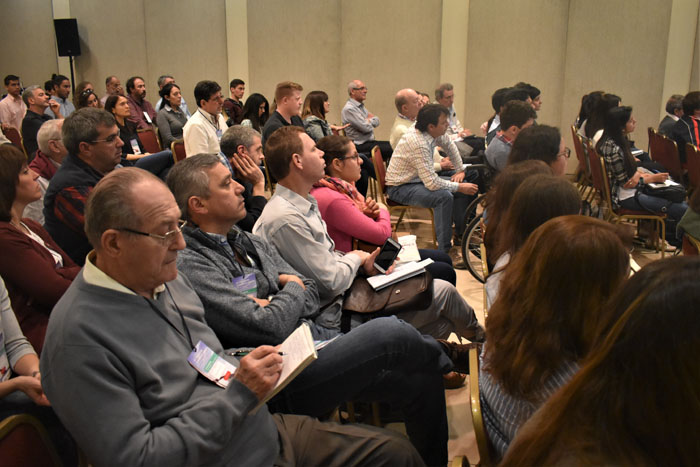 On the second day, the “marathon” continued. “The entire team” – recounted Carolina – “woke up early to meet over 300 students of the fourth and fifth year of 12 schools in Rosario, who gathered at the ‘Colegio Natividad del Señor’ to participate in a workshop. The kids put all their creativity to ‘create’ businesses and ‘make decisions’ over various situations regarding competition, crises, distribution of profits and selection of the personnel. The most important part, however, was that they subjected the EoC entrepreneurs present to a test, and who responded with their own life experiences. In the afternoon we went to the After Unplugged ‘Empresas de un solo tiempo’ session in La Maquinita Rosario. It was a co-working setting where Gonzalo Perrín, Leandro Simeoni and Lucas Longhi narrated about their own experiences as entrepreneurs for a common project. On Saturday, we welcomed the 120 participants from 30 cities of 8 provinces and 4 different countries. It was a big group, highly assorted by age and profession. The innovative presentation, tracing the present to the origins of the EoC, was followed by testimonials of the employees of some companies that were a part of the project. There were different experiences, from a family business that produces sustainable benches to a contact center with 1,200 employees, ’Nomines,’ an inclusive company which hires only disabled people.”
  After lunch, an original game, musical chairs, was proposed but in a different and even more enjoyable version: instead of eliminating those who did not find a seat, the chairs were eliminated. “It required cunningness and balance to sit on top of the others without getting hurt. The most difficult moment was when only one chair remained, and all had to sit without letting anyone fall. This same intelligence is also needed by all those who work for the elimination of poverty.” With great depth we then presented some of the saddest realities of current society, to recall the reasons for which the EoC was created. “Lastly,” Carolina concluded, “when you think that the goal is not too far away since we are always dealing with a marathon, and that nothing else could happen at that point, the unforeseeable occurred. On Sunday, some 8-year-old children recounted their experiences: a small business to earn money to share with kids of other nations at war, or the visit to a home for the aged where they learned to appreciate them. Last was the interview of Martina, 9 years old: The questions, but above all the answers show the prophesy underlying the EoC: those who have lived the culture of giving since their childhood are those who will one day be able to change the economy.” Source: www.focolare.org/conosur
Pray for pece
Pray for pece

0 Comments