
 Organized by the Umbria Diocese with the Franciscan family and the St. Egidio Community, the event gathered the religious leaders of the world, and was also attended by cultured men and women and representatives of institutions. Also the Focolare Movement was present in both the preparatory and participation phases, especially the communities in Umbria and in the persons of Rita Moussalem and Roberto Catalano, heads of the Focolare’s interreligious dialogue. With his presence on 20 September, Pope Francis continued the work of John Paul II who had felt the need in 1986 to institute a day of prayer for peace, and had foreseen the role religions could play to avoid conflicts and also contribute to resolving them. In 2011, Benedict XVI had presented peace not only as a commitment of men of faith, but also as a cultural project. But the world is no longer that of the 1980s, the bipolar world of the Cold war. The world is now globalized and multipolar, where the wars have multiplied without ever being wars of religion. Pope Francis greeted each of the leaders personally, starting from a group of refugees who represented the challenges of the world today. It was not only a formal act. There were deep moments of intense bonding that were able to establish important ties for the future. A second moment was the luncheon at the Holy Convent, to which the Pope had invited all to be by his side. Having a meal together under the same roof was in itself an act of peace, after which, a common moment of prayer followed, but not together. Each religion had a facility where members could go to pray for world peace, according to their own religious tradition. Each did so distinctly; this fact aimed to cancel the doubt that these moments were an attempt to amalgamate all religions together. The Christians prayed together to demonstrate that unity among the Churches is fundamental in giving important contribution to peace, as followers of Christ.
 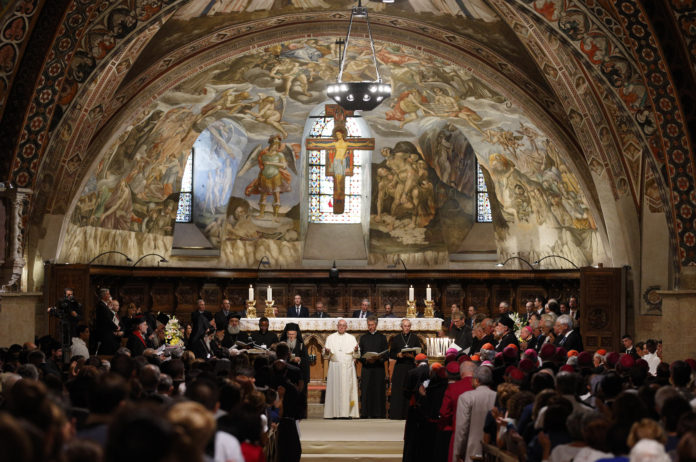 The concluding ceremony took place in the square in front of the Basilica of St. Francis. The leaders of each religion sat in a semicircle around Pope Francis, as a sign that nobody claimed superiority, notwithstanding the esteem and recognition of the Pope of Rome. His name, his example of a measured life, his words and gestures were constantly cited in the course of the 29 panels or round tables that were held during the prior two days in every corner of Assisi. The conclusion was marked by profound and vital considerations by the Christian, Buddhist and Muslim leaders, and also by moving testimonials: that of a young Syrian mother who arrived in Italy through the humanitarian corridors and that of an elderly Jewish Rabbi, who survived the Nazi concentration camps. The evening was heightened by the speech of Pope Francis who traced a peace roadmap. In fact, «Only peace is holy, not war!» The Pope expressed the meaning of peace by speaking of forgiveness, acceptance, collaboration and education as the fundamental elements to make it possible. «Our future is to live together», he affirmed. It is an idea that universalises the interpretation of the great Bauman who, in the opening ceremony, had underlined how humanity is called today to live the dimension of “we,” and forget the “they.” Once again the framework of Assisi was a decisive element. In fact, peace here is present even in the air we breathe. During these days the Franciscan family offered an example of humble, intelligent and respectful hospitality, constantly at the service of the leaders of the different faiths. It was an evident demonstration of how the humbleness of Francis of Assisi spoke out and asked his followers to make this a fundamental condition for dialogue and peace. It was a sign that peace is built by all of us together, and that each one brings a unique and indispensable gift for the processes of peace. by Roberto Catalano Source: New City
Take peace everywhere
Take peace everywhere

0 Comments