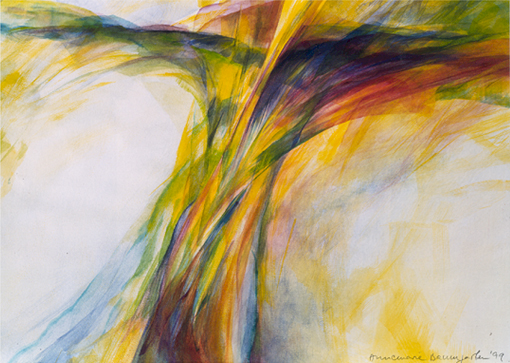
Watercolour © A.M Baumgarten
I was asked to explain who
Jesus Forsaken is for me. Since I was a child, I have experienced suffering due to the loss of my mother at the age of seven, then of my grandma who raised me up to the age of 17, and of my dad a year later. Recently I was diagnosed with a chronic disease. As
Chiara Lubich made us understand, Christ Crucified has never been only pain, misunderstanding, failure, solitude, etc., but also precious moments where I experienced the strong presence of God, like all the many personal graces and many more.
While studying in Sophia, in one of the lessons, the professor asked us:
“Do you know why Jesus Forsaken is the God of our times?” A classmate raised his hand and said: “
Because he stands for pain and must be embraced.” The professor then told us about that passage in the Gospel in which Jesus dies on the cross and the centurion exclaimed: “This man was really the Son of God!” For the Jews of his time, Jesus was cursed by God. The culture and religious beliefs had not allowed them to recognize the divinity in that man. Instead the centurion, a pagan, managed to see God where the human eyes of his contemporary fellowmen could not. «
There is no pain here – continued the professor –
here there is Light that makes us see and Wisdom which makes us understand who God really is: He who reveals himself by concealing himself, who empties out himself to make the other emerge, to make himself the other, because He is Love. So this is Jesus Forsaken.»
This new comprehension of his identity struck me like lightning and allowed me to find the sense and passion for my studies. This was in order to offer together with the others, through diverse disciplines – all expressions of that sole Wisdom– the answers to the problems of our martyred world, because Jesus Forsaken is concrete, not just a theoretical concept and not even only spiritual. I understood that the organ of thought was the heart that was pierced on the cross and that allows us to see God and be seen by Him.
Knowing him better has also helped me to understand not only who God is, but who I am: nothing. Before the Creator I cannot but be nothing since only God is. Jesus in his abandonment became the key to the interpretation of my life, my story, but also the story of my people with their miseries and wealth, along with the desire to live and commit myself for my people by exploiting the gifts He has given me.
This vision of Jesus crucified and abandoned is a gift which God, through Chiara Lubich, gave not only to the Focolare Movement, but to the Church and the entire humanity, especially there where God is absent. He has shown us that the farthest from God is closest to Him, just as what happened to the centurion. Jesus Abandoned is not only the “key” to the solution of our personal problems. This is just the first step, the premise to give Him, to look for Him and love Him in the sufferings of humanity.


0 Comments