
 With 93 million inhabitants speaking in 70 dialects, spread over an archipelago of over 7 thousand islands, the Philippines- the only catholic country in south-east Asia- is amongst the most populated in the world. In spite of the human richness and natural resources, the majority of the population lives in poverty. The social structure can be compared to a pyramid: 80% of the wealth is in the hands of 5% of the population, and the middle class is almost non-existent. The Filipinos are a very hospitable, joyful, and generous people, who know how to bear and give value to suffering, thanks to their Christian roots. As far back as 1966, they welcomed the spirit of the Focolare Movement that gradually penetrated in many sectors, both religious and civil. Today there are around 5000 close members, and over 100,000 adherents and sympathizers.
  Chiara Lubich visited the Philippines twice: in 1982, she underlined what “a wellspring of spiritual fuel” the Philippines were for the rest of Asia; and in 1997, she received from the University of Saint Thomas in Manila, the Honoris Causa degree in Theology. She was the first lady and lay person to receive such an honour. This facilitated the establishment of relationships of collaboration, particularly in the field of the Economy of Communion. The centres of the Focolare Movement are present in Manila, Cebu, and Davao and the many communities of the Movement are scattered in many of the thousands of islands, and they are linked by the same way of life, in spite of the distances, and experience a real family spirit, so much in conformity with the local character. The Mariapolis Peace of Tagaytay, one of the little towns around the world, founded by Chiara Lubich in 1982, bears witness to concrete and reciprocal love also among Muslim friends, Hindus and Buddhists. It is the seat of the School for Oriental Religions where courses are held periodically to learn to dialogue in mutual respect. Not less is the lively communion of life with brothers of other Christian churches and communities. One must underscore the participation of many priests and seminarians in the life of the Focolare, and also that of several bishops, friends of the movement, thanks to the school for priests at Tagaytay. The spirit of the Focolari is also seen as a possible solution to the many social problems. One notes the experience of 6 centres of Bukas Palad, that reach thousands of the poor, the Pag-asa Social Centre at Tagaytay, Sulyap ng Pad-asa, the Focolare carpentry shop, in Cainta, one of the major projects developed by Action for a United World in the Philippines, that has trained hundreds of youths. And also the Solidarity at a Distance project, in collaboration with the New Families Movement, that brings help more than 1800 children. The concrete actions in the towns and villages are numerous, such as help after natural disasters- as for example that after the Ondoy typhoon of 2010-and interventions to promote more just laws. This is the case in the community of Antipolo, a city of around half a million inhabitants, at the far end of the capital, where a sensitization campaign is underway to protect the family and life, in response to the decree on so called “reproductive health”.

Tagaytay, 1997
Visit the Philippines in Focolare Worldwide! From the archives:
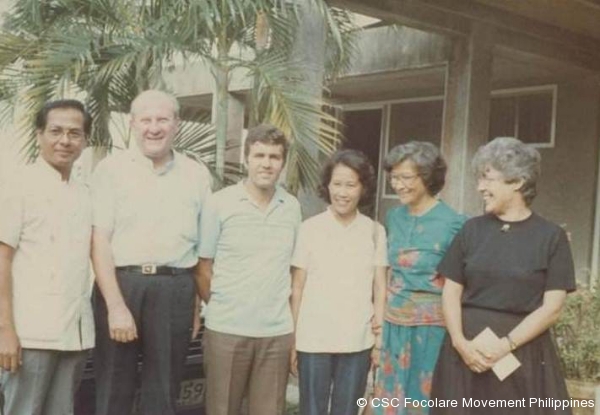
Guido Mirti (second from left) and Gio' Vernuccio (far right) with the first Focolare community of the Philippines

0 Comments