
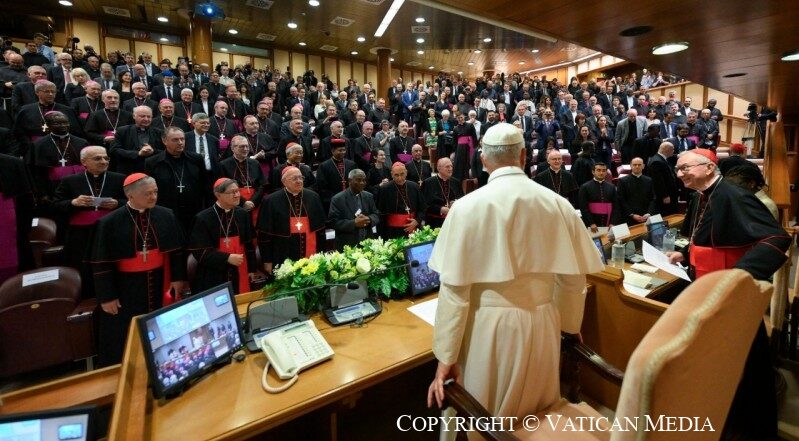
It was a morning that marked a significant moment in the history of the Church. On 25th May 2026 in the Synod Hall in the Vatican, Pope Leo XIV presented his first encyclical Magnifica Humanitas, on safeguarding the human person in the time of Artificial Intelligence. It was the first time that a Pope was present in the Hall where his magisterial document was being presented to the public.
The encyclical was signed on 15th May, the 135th anniversary of the promulgation of the encyclical letter Rerum Novarum by Pope Leo XIII, who recognized in the industrial transformations of his time a profoundly human and social issue. This encyclical defends the human person in today’s time of Artificial Intelligence (AI) and calls for new urgent reflections on the role and future of technological progress.
After the interventions of experts and theologians, the Pontiff spoke. He focused on the “gravity of the moment” we are living through, which is a cause for concern in the Church which is called to “interpret new things in the light of the Gospel and the dignity of the person”. He explained that the document was born “from listening” to scientists and engineers who “work with sincere enthusiasm on technologies capable of alleviating immense suffering; listening to political leaders and public officials who have persistently sought just regulations; listening to parents and teachers deeply concerned about the future of the young generations”. He used strong words: “Artificial Intelligence must be disarmed. The expression is strong, I know”, Leo admitted, “but it was chosen deliberately because this moment needs words capable of attracting attention, awakening consciences and indicating ways forward for humanity”.
The Pontiff recalled that for some time “the Church has worked in favour of nuclear disarmament, as a service to peace and to the dignity of the human family”. Likewise, “Artificial Intelligence today also needs to be disarmed, because like nuclear energy, it must be at the service of all and of the common good. (…) Decisions about technology must never be separated from conscience and responsibility”. “But when technology weakens our critical sense, it is peace itself that is at risk. Disarming, however, is not enough. We must build.” Together.
The encyclical
“Magnifica Humanitas is the culmination of 10 year’s work of the Holy See,” said Msgr. Paul Desmond Tighe, secretary of the Dicastery for Culture and Education during the press briefing. In 2016 a French priest began to study some topics related to communication and technology. “In San Francisco (USA) he met some experts who wanted to inform the Holy See about technological developments that could influence the future of the world, Tighe continued, “For these scientists it was important to have the perspective of wise voices, so they sought collaboration with the Holy See”, leading to a synergy based on mutual listening
Christopher Olah, Co-founder of Anthropic (USA), one of the world’s leading artificial intelligence companies, also spoke at the Vatican presentation: “We need an every larger part of the world, religious communities, civil society, scholars and governments, to do what His Holiness has done here: to take all this seriously, to carefully observe events as they unfold and help guide them in a better direction. Today is only the beginning of a long collaboration between those of us who are building this technology and those who can see what we ourselves cannot see from the inside”.
Divided into five chapters, plus an introduction and a conclusion, Magnifica Humanitas starts from a central thesis: technology is not an “antagonistic force with respect to humanity”, nor is it “in itself an evil”. The Pontiff affirms that “injustices do not arise only from the wrong choices made by individuals, but also from structures, mechanisms and from economic and cultural structures that produce inequality”. This also applies to new technologies.
Leo’s concern focuses on the power that when concentrated in a few hands, “tends to become opaque and to escape public control”, bringing with it the risk of distorted development “which generates new dependencies, exclusions, manipulations and inequalities”. Here attention is directed toward those who control platforms, infrastructures and digital data.
Pope Leo XIV reiterated once again that there is no such thing as a “just war”. He called for the use of Artificial Intelligence in warfare to be subjected to the strictest ethical constraints because “there is no algorithm that can make war morally acceptable”.
We need “a politics that does not abdicate its responsibility”. The truth must be expresses through an “ecology of communication” opposed to fake news. The Pope indicated some elements: transparency in the content-selection algorithms, protection of personal data, serious journalism based on argument and verification, a new awareness in the “correct and critical” use of AI and the integration of knowledge.
In concluding the letter, the Pontiff invited the faithful to inhabit new technologies in the light of the Gospel, following “a sober and demanding path of Christian life”, so that even in the time of AI everyone can give witness to “the beauty of a magnificent humanity inhabited by God”.
Lorenzo Russo
Photo: © Vatican Media
Click here for the full text of Pope Leo XIV’s encyclical Magnifica Humanitas



0 Comments