
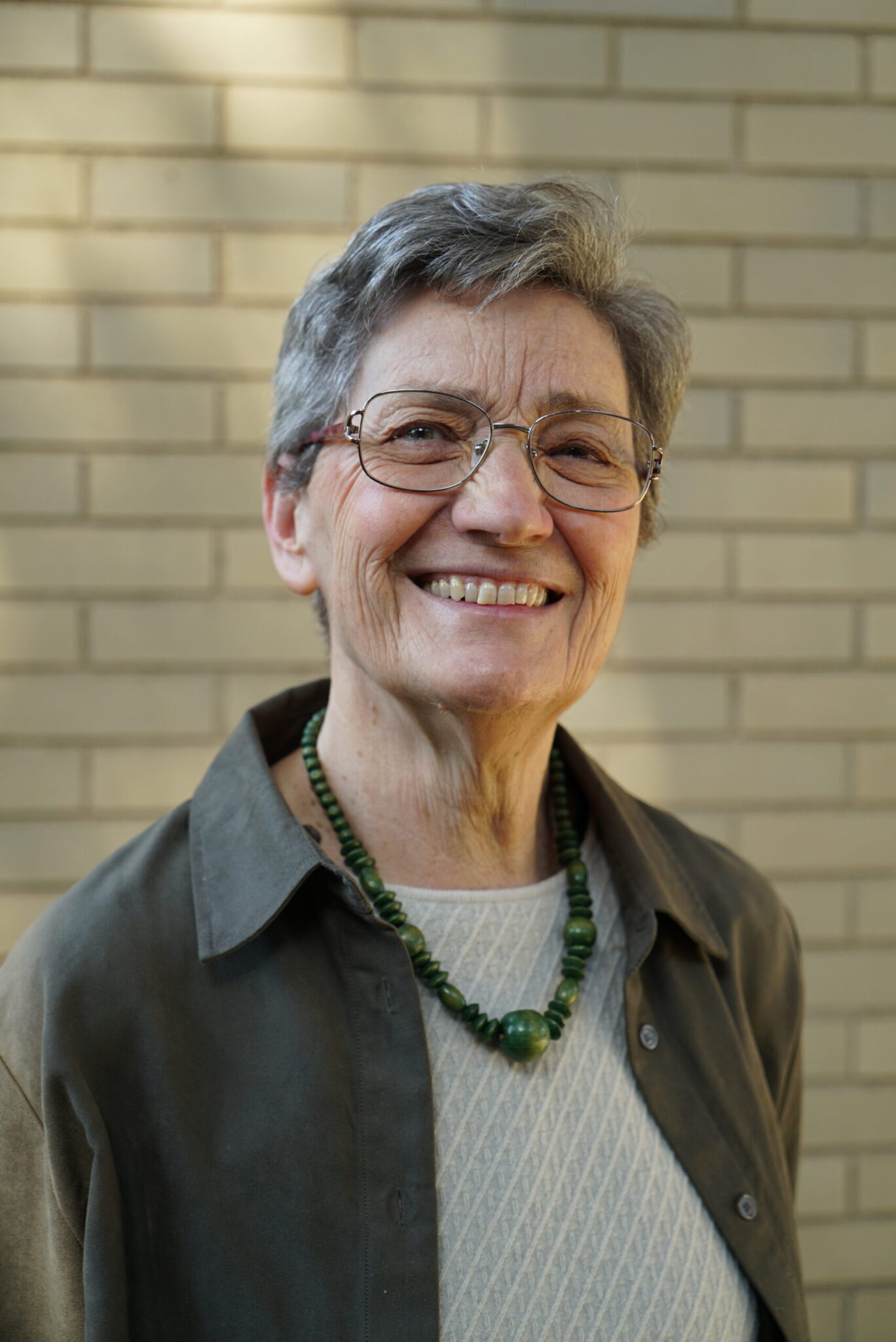
Alba Sgariglia has degrees in philosophy and theology. Since 1975, the year before she entered the focolare, she began working at the Study Centre of the Focolare Movement alongside the foundress, Chiara Lubich.
What did your work at the Study Centre consist of?
I used to go to the library in Florence to photocopy passages from the Greek Fathers, which we would then translate at home, searching through countless pages for those brief phrases that could serve Chiara Lubich to confirm her inspirations. At the time I was working with Marisa Cerini, who told me: for us, building unity means that we should enter into the thought of the Greek Fathers and from there try to understand the light of the charism that Chiara has received. In the following years I also taught religion in secondary schools in Rome. I then joined the governing body of the Movement to oversee the cultural aspect and subsequently I became part of the Abba School, which Chiara founded in 1991 to study the notes from the so-called period of Paradise ’49. Finally, in 2014, Maria Voce Emmaus, then President of the Focolare Movement, entrusted me with the Chiara Lubich Centre, which was established to preserve, study and promote the life and work of Chiara.
What does this newly published book represent?
Paradise ‘49 is a text published posthumously, since it was written, compiled and edited by Chiara Lubich during her lifetime. She wished to describe the mystical experience she had lived between 1949 and 1951, accompanying it with footnotes that would facilitate its comprehension, so as to provide the group of scholars at the Abba School with a text that was accessible and could be used for research. The text contains a mystical experience that Chiara always said she could not keep to herself. Then, urged on by many people, she realized that the text could be understood and used by others in the Movement as well.
For example, in the early 2000s, she herself explained the essence of this experience to the young people of the Movement. Then little by little, she realized that the experience recounted in the text could also be shared with people of other religions. Over the years we have held symposia with Hindus, Buddhists and Muslims, to whom Chiara offered some passages from Paradise ’49. We have also discussed the text with people with no religious affiliation, who have given reflections far deeper than we could ever have imagined, emphasizing that it is a text of great value. There are many founders of charisms who have received this possibility of understanding the work they were carrying out, through so-called “intellectual visions” in which one perceives with the intellect what God is allowing one to see.
But since it is a mystical language, isn’t it difficult for most people to understand?
Mystical language is a unique literary genre; it is neither poetry, nor theatre, nor literature, nor theology. For example, one sometimes encounters difficulties on a theological level, because the mystic seeks words they cannot find, trying to express the inexpressible: a difficult task, so much so that often Chiara herself, whilst we were re-reading these passages, would ask us: “But how could I have written these sentences? What do they mean? Why did I write this?”
This confirms that, in such situations, the founders seek to express what they “see” using the cultural categories and concepts at their disposal, which are sometimes inadequate. For example, in Paradise ’49 there are references to The Divine Comedy because Chiara was familiar with it, or to philosophers such as Kant, whom she had studied. The external setting can also have an influence: Chiara and her first companions began this experience in the mountains of Trent, in Tonadico: it is a natural setting that speaks for itself through its beauty. This, too, helped her to express things she was perceiving for the first time in her life.
Over these 18 years since Chiara’s death, you have published books that shed light on the context of the Paradise ’49 experience…
We have continued to examine the text in depth across various disciplines, using the method Chiara had left us, which is to study everything with “Jesus in our midst”. I believe that three key aspects can be identified in this volume: the first is an educational aspect, as it teaches how to live out the charism of unity and offers a vital key to understanding it; the second aspect can be described as artistic and literary, as the text encompasses many literary genres: diaries, letters, writings and notes; finally, there is the doctrinal aspect, as the text undoubtedly has a theological focus. It is, in fact, a mystical experience that helps us to understand, on the one hand, the truths of Heaven: God, the Trinity, the Word, Mary, creation, hell and paradise; and, on the other hand, the incarnation of the charism in a movement that would have been founded in the following years, that is, after 1949–51. Every time one reads these mystical texts, one understands new things. This is what happens to me too: every time I read these pages, I understand new things, both intellectually and spiritually.
When reading the text, doesn’t Chiara seem to be a bit presumptuous in certain passages?
We need to understand why Chiara says those things in that way. We could say that it is as if God, in order to express concepts that cannot be conveyed through a human being, identifies with that person, seeing things through their eyes. This is why Chiara finds herself writing: “Today I am universal fatherhood.” But she herself asks: “What does that mean?” In that moment, she identifies with that reality, so that she can express it. In the footnotes, she herself comments on and explains her amazement and her joy at seeing that other founders had experienced more or less the same thing.
What advice would you give to someone reading this text?
I would say: take this book and read it whenever and however you like, at any time. You can discuss passages that are unclear or more complex with others, or with an expert. But I suggest that you don’t let yourself be influenced by anyone, because this text speaks directly to the individual. Let’s open it at random and read whatever page we come across. We will understand what we need at that moment, because the text, despite a few difficulties, really touches us deeply. It’s a mystical experience, that can, in a certain way, be “shared”. This is the novelty, as Chiara herself explained to us. She always made sure that everyone could participate in her experience, and this book gives us that opportunity.
Giulio Meazzini
Interview originally published in Città Nuova
Photo: © Francesco Frascella

0 Comments