
On the afternoon of Friday 7 November, the Aula Magna of theSophia University Institutebegan to fill rapidly. Students—both old and new—researchers,lecturers and members of staff arrived, as well as friends, residents of Loppiano and representatives of the local authorities in the Valdarno area. There were hearty handshakes and lively conversations. A sense of eager anticipation hung in the air. Shortly after 5.00 pm, two researchers, Maria Mirandi and Francesco Patrone, kicked off the ceremony officially marking the start of the new academic year – the 19th in Sophia’s history, to be precise. And this new academic year brings with it many changes.
A new academic programme, featuring the Bachelor’s degree in Philosophy and Human Sciences at the newly opened campus in Piazza Tasso, Florence, and the Licentiate in Philosophy, Economy of Communion and the Environment at the historic campus in Loppiano. These courses lead to a dual qualification – ecclesiastical and state-recognised – thanks to the collaboration established with the University of Perugia.


As expected, the first to offer their greetings were the Grand Chancellor, Archbishop Gherardo Gambelli, Metropolitan Archbishop of Florence, and Margaret Karram, Vice-Grand Chancellor and President of the Focolare Movement.
Archbishop Gambelli observed that the new academic programme revolves around two key areas. On the one hand, ‘a philosophical and humanities-based reflection that places the greatness, beauty and dignity of the human person back at the centre of the discourse’ at a time when ‘so many things, and even people themselves, are viewed as disposable’. On the other, ‘inter- and trans disciplinarity’, which have characterised the Institute since its inception, offering students a ‘comprehensive and integral education’, which will enable them to critically interpret the political, social and economic models that characterise our present. At the end of her address, the Grand Chancellor encouraged the entire academic community to press ahead, ‘towards that wisdom which is capable of realising the desire for the “common good” that dwells in the heart of each and every one of us’, and in the commitment, ‘as a thinking community, to radiate a new culture into all spheres of life’.
Taking the floor, Margaret Karram expressed the hope that Sophia might continue to ‘cherish Chiara Lubich’s original vision’, whilst remaining a ‘home of research and formation; a place where one can experience that knowledge can generate communion and communion can open new paths to knowledge’. She also expressed the hope that, in these times “marked by such rapid change”, Sophia “may help us to understand reality more deeply and to make what we know ever more human”.
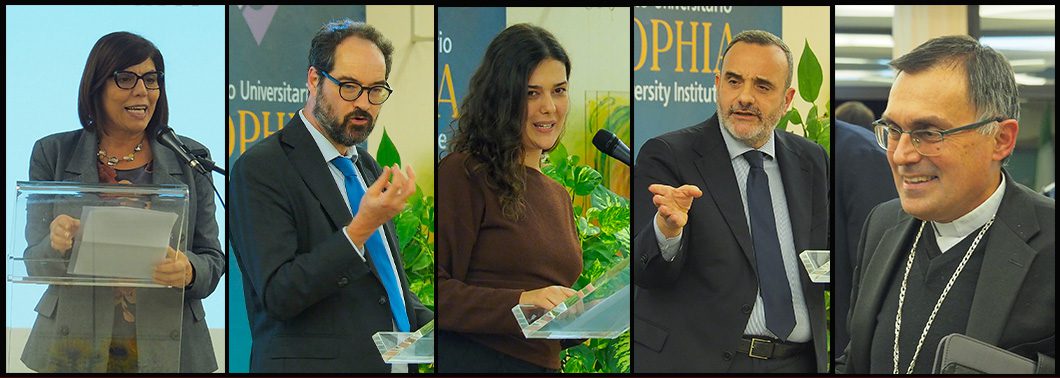
Representing the Institute’s students at the ceremony was Mariane Gonçalves Araujo, from Brazil, who, in sharing her personal experience, highlighted a fundamental aspect of university life on the Loppiano campus: ‘At Sophia, study is inseparable from life: we learn in the classroom, but also at the dinner table, by sharing life in the halls of residence and with the inhabitants of the little town. Looking back over these two years, I realise that this wealth of experiences, lessons learnt and memories has accumulated within me, and no one can take it away from me or make me forget it. It is a legacy that educates, helps us mature and teaches us to start afresh, charting a new course even in the most difficult moments.”
Finally, the Rector, Prof. Declan O’Byrne, took the floor. Introducing the new academic year, he quoted Fadi Chehadé, founder of RosettaNet and former CEO of ICANN, a visiting professor at Sophia: ‘In his view, Sophia can be understood as “an oasis of humanity”: a place where what is specifically and irreplaceably human can flourish. Together. This is the essence of our university.’ He continued, addressing the new students: ‘We ask of you, rigour and honesty in your work, and we ask for your voice: correct us when our explanations do not stand up to what you see. Together, we will build the answer to the question from which we began.’
The ceremony continued with an inaugural lecture by Alberto Lo Presti, lecturer in the History of Political Doctrines at Lumsa University in Rome, entitled ‘Communion and History. How to survive the Anthropocene without drowning in the infosphere’. “My hope,” concluded the professor, “is that Sophia will journey ever further along the path that its founder, Chiara Lubich, glimpsed on the horizon: a centre at the forefront of scientific research, capable of reading the signs of the times and anticipating their outcomes, in the direction that leads to the full realisation of unity, understood as the destiny of the cosmos.”
Tamara Pastorelli
Originally published on https://www.loppiano.it/
Photo: Archivio Cittadella Internazionale di Loppiano

0 Comments