
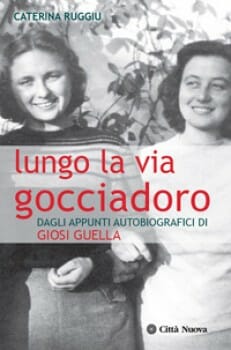
 “Chiara was pointing out the stars to me along the Gocciadoro Way. I dont’recall her words. Come to think of it, it seems like she was telling me that we had to step out of our little world in order to soar in a much vaster world.” This is how Giosi Guella records her first encounters with Chiara Lubich in the spring of 1944 in Trent. Gioccadoro Way is the street where Chiara lived with her family before the bombardment of May 13, 1944 when the family home was left uninhabitable. It is also the name of the woods – now a city park – that lapped Tentino’s chief town, and it remains one of the symbolic sites of the Focolare Movement in the city where the Movement began. This is the story behind the title of the book about her life beside the Focolare’s foundress with whom she shared moments of light and of trial that accompanied the birth and the development of this new spiritual family in the Church. Amongst the first group that joined Chiara Lubich, Giosi Guella stood out for her simplicity, sincerity and concreteness. She was already living with Chiara Lubich in the autumn of 1944 at the small flat at piazza Cappuccini 2. That is where the first cell of the Focolare Movement began to form. In all the places she lived, Giosi embraced and lightened the sufferings of others, offered insightful advice, helped to find homes, employment and trust. She was the impulse for the consolidation of many focolare communities, seeing to it that joys and sorrows were shared amongst all, challenges and victories, unexpected donations that were then used to respond to requests for help. Everything contributed to the “capital of God’ that was being formed, composed of material goods, but also of needs. Giosi was the generous adminstrator of that capital. Because of her eye for the least amongst the community she was well suited to setting up the communion of goods of the first group in Trent, beginning in 1948. The communion of goods was a practice which then spread thoughout the Focolare Movement around the world. It was inspired by the early Christian communities who put their goods in common so that no one amongst them would be in need. Afterwards, as the Movement spread to other countries and different kinds of social action became necessary, Giosi continued to follow those developments. She also accompanied the early stages of the Economy of Communion project that was launched by Chiara Lubich in Brazil (1991).
 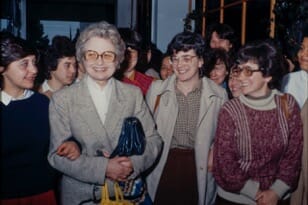 A biography has now been published, twenty years after her death. It is certainly not an exhastuve account, drawing upon a few writings and recorded speeches. Actually, she was not very fond of writing; she preferred to be “doing”. These pages are therefore quite precious, extraordinarily frank and disarmingly simple. I entrusted myself to those writings, on the edge between news and history, letting her speak. When the recount was interrupted, I was able to interview several people who had shared the journey of a Work of God with her, a Work “written in Heaven” that gradually unfolded on earth, following mysterious and up until then unexplored paths. Their testimonies permitted me to trace several passage of this simple, “too simple” life yet strongly interwoven with that of the Focolare to which Giosi had given all of herself, with her own particular touch. Caterina Ruggiu Lungo la via Gocciadoro, Città Nuova editrice
Live fraternity
Live fraternity


0 Comments