
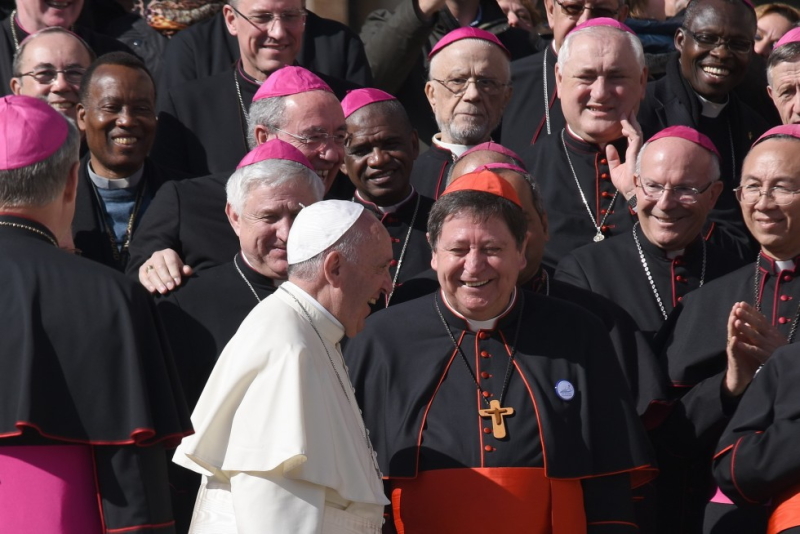
 60 Bishop-friends of the Focolare Movement, representing 31 countries (Iraq, Lebanon, Syria, Bénin, Cameroon, Ivory Coast, Ethiopia, Madagascar, Democratic Rep.of Congo, Tanzania, Thailand, India, Pakistan, Brazil, Venezuela, Panama, U.S.A., Uruguay, Austria, Spain, France, Great Britain, Ireland, Italy, Portugal, Czech Rep., Latvia, the Rep.of Moldova, Romania, Ukraine, Hungary.), are presently gathered at Castelgandolfo (22-26 February). The participation at the General Audience held by Pope Francis at St. Peter’s Square has been the central point of this meeting. In his address the Pope urged the Bishops “to always keep alive the charism of unity in the apostolic ministry, in communion with the successor of Peter”. “A synodal Church is a Church that listens, that realizes that listening ‘is more than simply hearing’. It is a mutual listening in which everyone has something to learn.” This type of Church, as defined by the Pope during the ceremony commemorating the 50th anniversary of the institution of the Synod of Bishops, indicates the track to be followed during this conference. The choice of the title “A Church which generates unity” stems from the belief that, at a time marked by tensions and increasing disintegration, the people of God are called to contribute in a vital manner towards building relationships at all levels and in all environments. This has to be lived, first of all, within the Church itself and its source must be in the heart of a merciful God. The core of this theme lies in understanding Jesus’ prayer to the Father for unity (Jn 17), as “ gift, commitment and achievement”. Maria Voce, president of the Focolare Movement and Jesús Morán, co-president spoke about this approach in the light of Chiara Lubich’s charism.
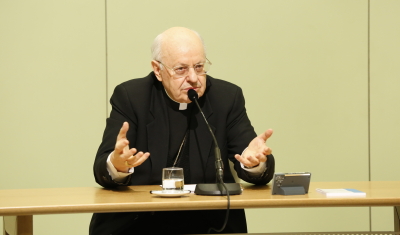
Cardinal Lorenzo Baldisseri


0 Comments