
From the Secretary of State in the Vatican
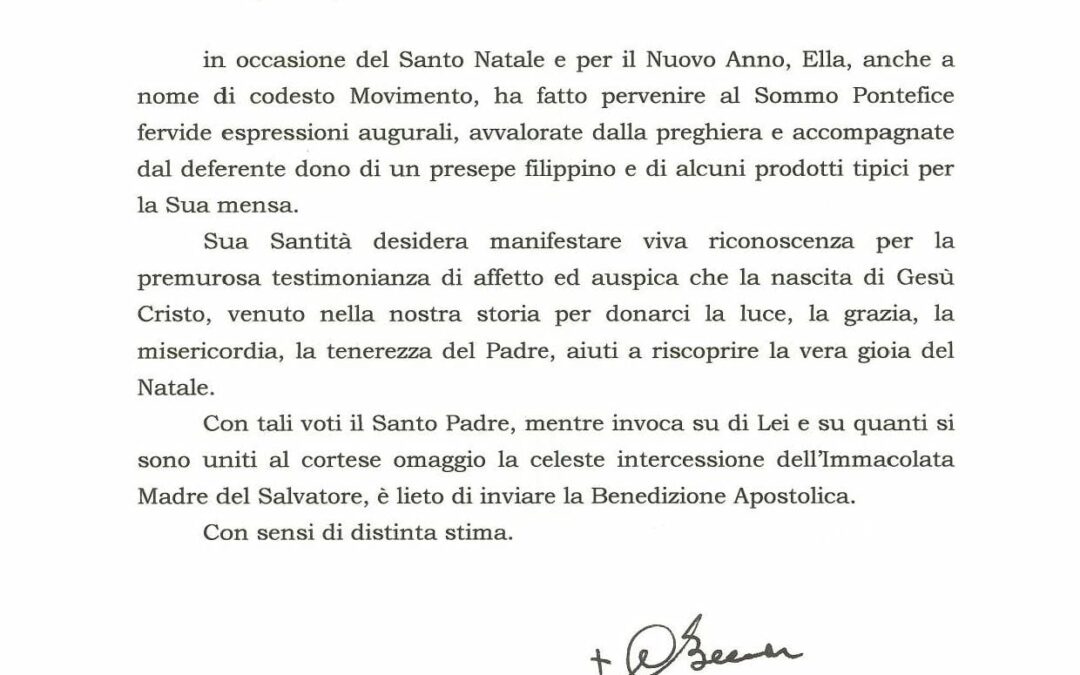
TRANSLATION OF LETTER IN ITALIAN (see below) SECRETARY OF STATE
Vatican City, 10 January 2015
Dear Madam, On the occasion of Christmas and New Year, you sent greetings to the Holy Father on behalf of your Movement, assuring prayers and bestowing upon him the gift of a Filippino Christmas crib and some traditional food products. His Holiness wishes to extend his gratitude for your show of affection and hopes that the birth of Christ, who came on earth to give us light, grace, mercy and the tenderness of the Father, may help us all rediscover the true joy of Christmas. Together with these sentiments, the Holy Father, while invoking upon yourself, and all those united with you in this courteous homage, the celestial intercession of the Our Lady, Immaculate Mother of Our Saviour, joyfully imparts his Apostolic Blessing Angelo Becciu Substitute

The European economy needs charisms
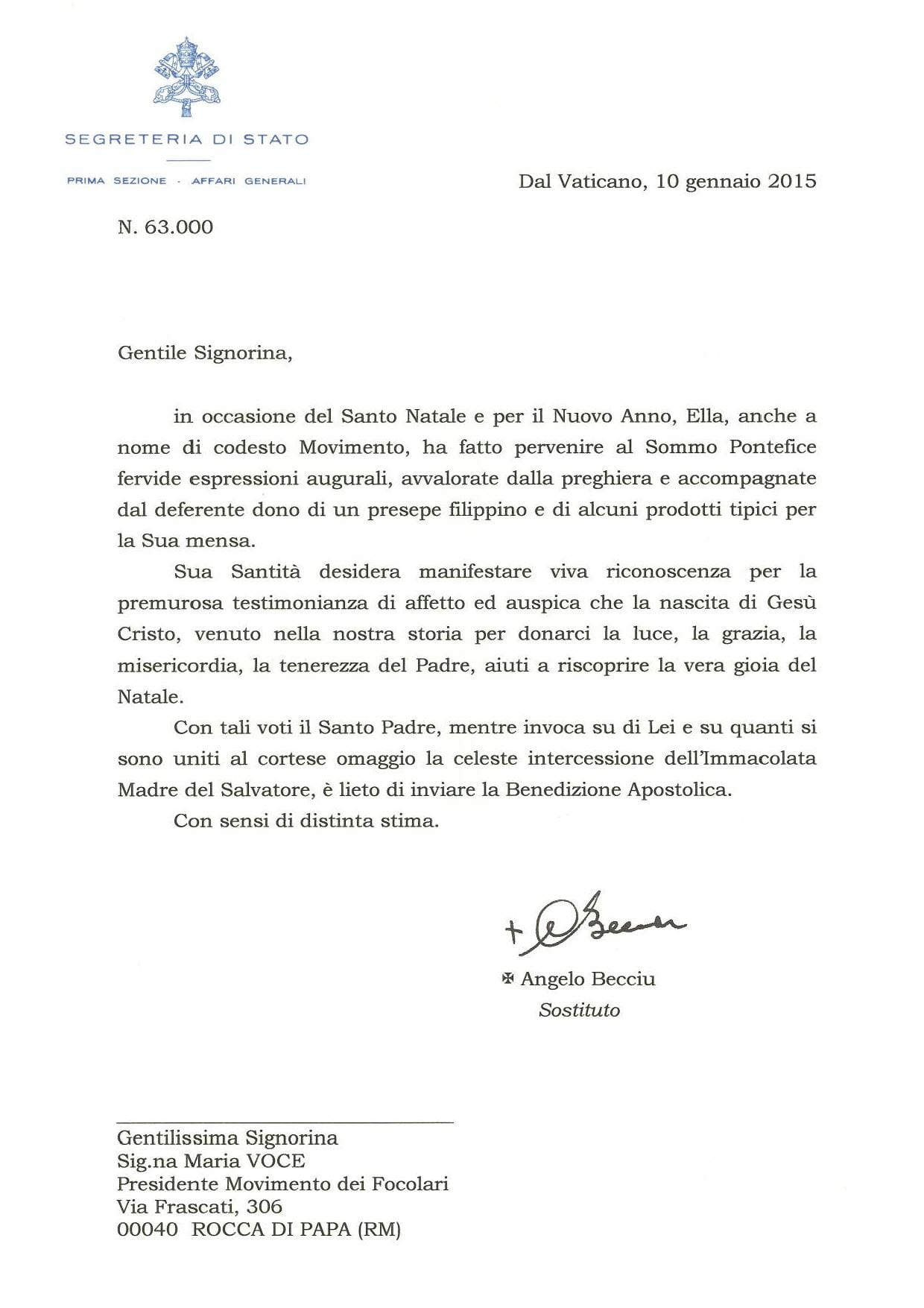
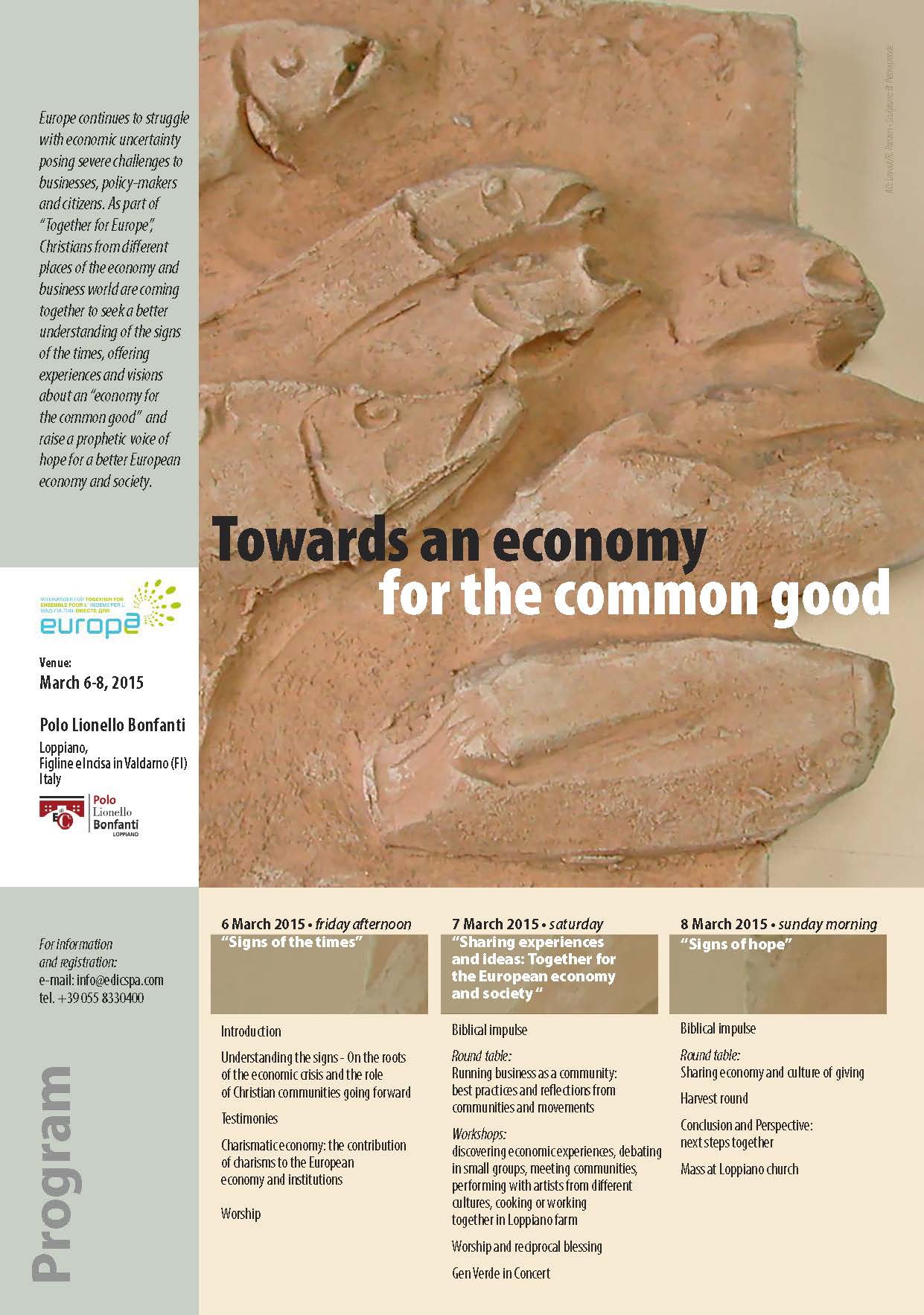 Europe continues to battle with economic uncertainty which is a real challenge for all enterprises, experts of economic policies and citizens. Christians from various economic fields and the entrepreneurial world will meet in Loppiano (close to Florence) from 6 to 8 March, to share their experiences and outlooks, so as to contribute to the diffusion of a prophetic message of hope. «Up to now, in Europe, only the institutions have stated their opinions – affirmed Prof. Luigino Bruni. Our dream is that in the ministries for economy, there may also be Franciscans, Focolarini and people who have chosen to stand by the side of the poorest of peoples… There is need for gratuitousness. Over the last ten years these voices have been silenced. An economy without a heart, without charisms that are able to include also the poor, is an economy without a future. What do all Christian movements have to say today, about the economic plan? At the start of the millennium we set out on our journey, “Together for Europe,” with Chiara Lubich. After 15 years of working together at the level of gaining knowledge, it seems that this journey has become a working together for a different kind of economy, a different type of politics. The time has come for us to voice out our opinions. » The idea of a convention was conceived on November 2012 in Munich, Bavaria, during the Together for Europe meeting. On that occasion, economy experts of some movements and communities of different countries and churches, made an appointment to hold a session for in-depth reflection, with the aim of giving a specific contribution in the field of economy, starting off from their own charisms. The programme provided for a moment of reflection on the “signs of the times” we are all witnessing, with the sharing of experiences. The moments of reflection on the “signs of hope” were shared in a round table on the economy of sharing and “culture of giving.” The programme also included an experimentation work lab «of manual and not only mental work,» at the “Loppiano Prima Farm,” and an artistic workshop with the Gen Verde music group. The convention, entitled “Towards an economy for the common good” will be laid out in three work groups regarding poverty, enterprises and institutions. An expo will be installed with the works produced by each community. Not only banks, markets and finance will be involved – Bruni continues – but contributions from the lower sectors of society, starting from from solidarity, so as to allow the involvement of the poor and excluded people. We shall attempt to pursue this path with some Catholics and Evangelicals (John XXIII, Schönstatt, Focolare, Ymca and Vineyard) acting as the preparatory committee, and with the specific aim of allowing the charisms to voice their opinions on the economic crisis Europe is undergoing.». The idea, therefore, is to give a perspective to Europe starting from the economy of reciprocity and as a gift and not only in terms of interests and profits. It will be an economy which arises from cooperatives, and the social and civic sectors. «Europe’s economy –Prof. Bruni explains – was also created by Saints Benedict, Dominic and Francis (if we considered the the institution of the Pawnshops), not to mention the social charisms that invented the schools, hospitals, simultaneously with the world of commerce which progressed with the enterprises and the merchants. The new Europe will arise from this crisis, and to achieve a good Europe, it still needs today, the contribution of the charisms, modern charisms that speak the language of economy: there is a wealth of life in the European Christian movements that still have something to say that differs from that of the European Central Bank. We shall start with modesty, but our objective is to go to Brussels to address the institutions with our specific contribution. »
“Our Africa” in Taiwan: Solidarity with the Ebola outbreak victims
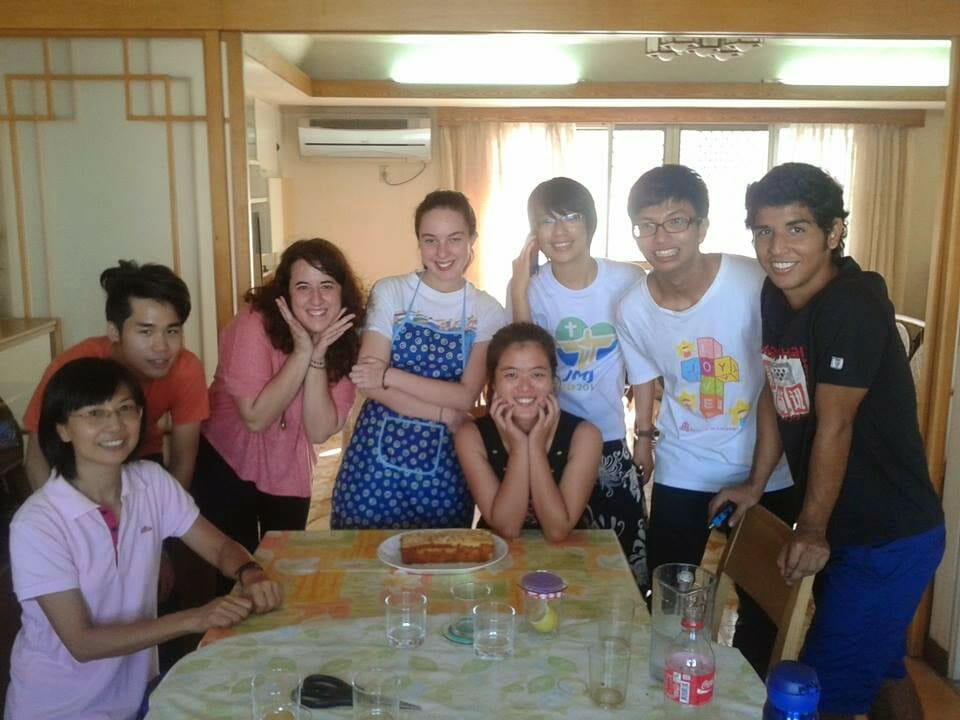 “Here in Taiwan there has not been much news about the Ebola outbreak, apart from when there seemed to be some danger that it might spread outside of Africa. For most people, it is a distant problem that has nothing to do with them. But we Youth for a United World (Y4UW) – both from Taiwan and some international students who are studying Chinese here – felt differently because we feel that every person in this world is part of the same human family.
Thanks to a friend who had been in Sierra Leone, we were able to get in touch with John who lives there and who belongs to Y4UW. He told us about the terrible situation that everybody is living: shortage of food, people who are dying, and a government that doesn’t have enough resources to help, and also about the efforts that he and others were making to provide some assistance to people in need.
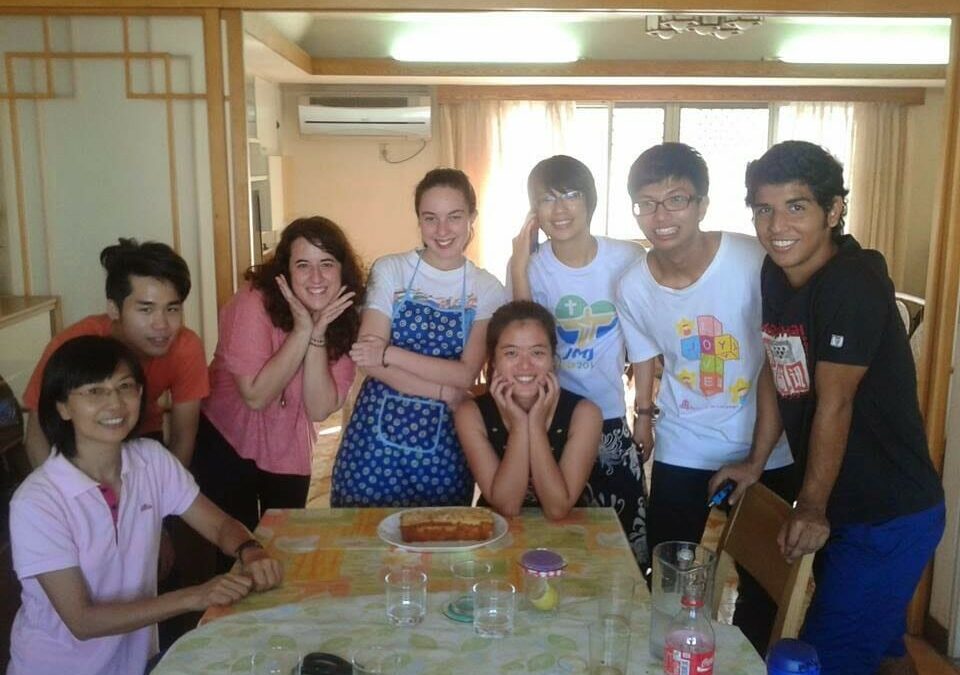
So, we decided we had to take action, and set about organising a cake sale. Although it was only a small thing we all felt so happy because at least we were no longer helpless and passive in facing such a huge suffering. Spending time together baking the cakes also helped us to strengthen our friendship and gave us a renewed impulse to promote peace and unity in our everyday lives. There were also moments of doubt about whether we could really sell all the cakes that we had made, but we decided to go ahead, trusting that if we did it out of love then everything would work out.
On the day of the sale it was really amazing because we sold everything, and some people even donated extra money so that we made far more than we expected. Even more important, lots of people became more aware of the terrible suffering that Ebola is causing, and saw how Y4UW is truly living for the whole human family. By chance, three Africans happened to pass by and thanked us for what we were doing for “our Africa”. But one of us answered, “not your Africa, our Africa”, which really summed up the spirit of the whole occasion.
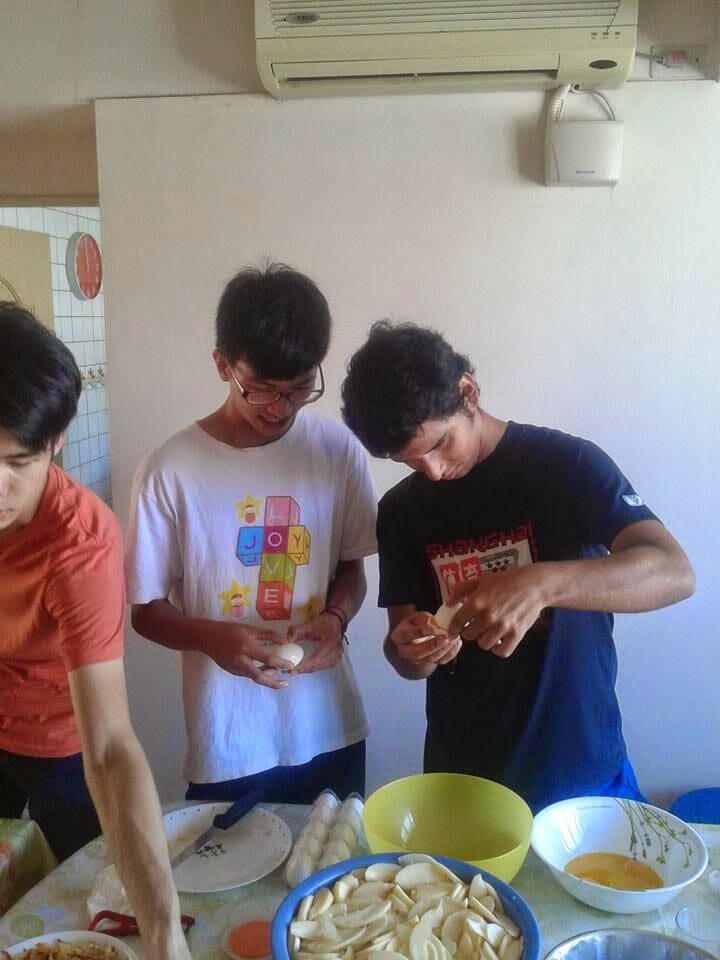 Two impressions from our friends: “When I heard about the Ebola epidemic,” Chung Hao says, “I didn’t know how to help them, but this charity event, even though it was something small, made me realise that when we young people are united, we are a potent force, not only in helping concretely, but also because in awakening the concern of friends around us.” And Xin Ci commented: “The cake sale was an important occasion to contribute something for those who are suffering because of Ebola. When I arrived and saw the tables covered in beautiful, tasty cakes I saw how much effort people had put into it and I was really moved. I always wanted to do something for the world, and these small acts, done with the infinite love of everyone can be communicated to every corner of the world. I really felt happy to take part in this event with my friends.”
“Since this article was written, the experience has continued,” Brian from Taiwan says, “as we had another sale involving students from Fu Jen University. We are now planning a further activity – making greeting cards so as to raise more funds. Apart from the important achievement of raising money for a very important cause, this activity has energised us and brought about a stronger sense of what it means to bring about a united world.
Thailand has a new cardinal
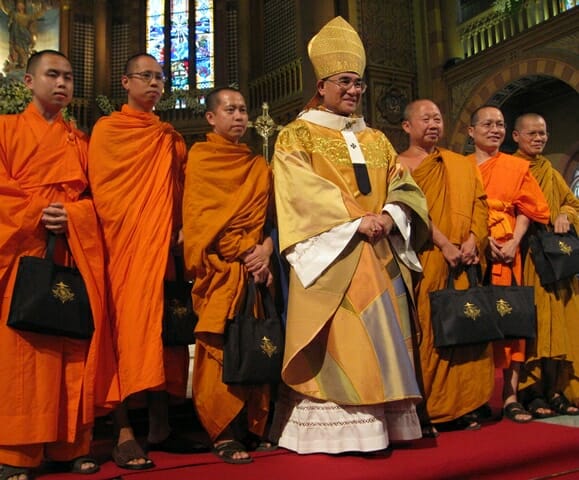
What is a cardinal and what does he do? These are questions the common folk,, mostly Buddhists may ask, upon hearing about the naming of Bangkok’s Archbishop Francis Xavier Kriengsak Kovithavanij. He is the second Thai Cardinal after Michael Michai Kitbunchu, instated more than 30 years ago in 1983. Also other two new Asian Cardinals: Mons. Charles Bo of Myanmar and Mons. Pierre Nguyen Van Nhon from Vietnam will be named in the next consistory set for 14 February.
To respond to the interest aroused by the nomination, the local Church promoted a press conference that gathered about 30 journalists and local Thai media operators, including some well known Asian newspapers.
One of the most frequent questions the new Cardinal had to answer was: “Does this nomination reflect the Catholic Church’s desire to diffuse Christianity more in Thailand?” Thirty years ago in fact, there were rumours diffused by a group of Buddhist fundamentalists, of a Vatican “conspiracy” to undermine Thai Buddhism. This is an issue which no one believes any longer. The Thai people are renowned for their tolerance and friendliness. Christianity is not deterred, even if the Christians constitute less than 1% of the population.
Mons. Kriengsak of Bangkok thinks that with these nominees, Pope Francis wishes to underline the universality of the Church, and in answering the many questions of the Buddhist journalists, narrated with simplicity that God is Love, and took flesh in Jesus who brought the life of the Trinity on earth – and that mutual love makes us brothers and sisters. He also stressed that all religions hold common values, such as the “golden rule” (Do unto others as you would have them do unto you“) and continued by stating that the Catholic Church promotes dialogue in all fields and, particularly interreligious dialogue in Thailand. Those who know the new Cardinal well, are aware that he has a deep friendship with a good number of Buddhist monks, along with lay people, always open to followers of all faiths. We are surprised by the fact that the person who had sent us a copy of the Thai newspaper with the photo and promotion of Archbishop Kriengsak on the first page was precisely a famous monk of the Buddhist monastery at the outskirts of Bangkok! “Together – Archbishop. Kriengsak said – we work for the good of society, peace in the world and unity of humanity.” He invited all, whatever faith they profess, to pray daily for peace in the world, and observe a minute of silence at six every afternoon for this purpose.
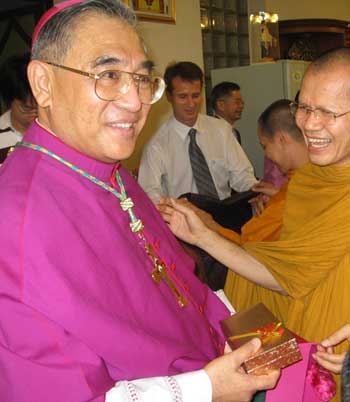 In answering the question on education for which the Thai Church is highly esteemed, he sustained that it has to be open to everyone, of all walks of life. He repeated Pope Francis’s appeal to “go out towards the outskirts of society,” citing the many charitable works the Church undertakes, highlighting the various initiatives to face a rather recent phenomenon: the flux of many refugees in Thailand. With regard to the challenges of the Church: “Secularism is a challenge for all religions. Also due to this, all religions have to cooperate to imbue society with positive values.” “The Church in our continent, though small, can give its contribution in promoting unity in Asia, in the perspective of a more united world.”
In answering the last question we posed on how this news is to be interpreted, he said that he was very surprised and had accepted the nomination to say yes to God’s will, entrusting himself to His grace, like Mary. He asked us to pray for him, confiding that he was counting on the spirituality of unity which he had embraced ever since he was a seminarian. He will keep his motto: “Verbum crucis dei virtus est”(The language of the Cross is the power of God).
C,B. Tay
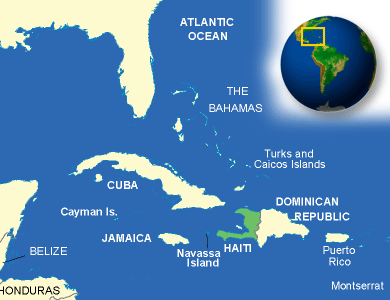
Haiti: always in our hearts
It was a tragedy «that caused death, destruction and also desperation» and where «a lot has been done to rebuild the country » but where a lot of work still remains to be done.» This was what Pope Francis said to the participants at the meeting promoted for the 5th anniversary of the 12 January earthquake.
Though part of a very poor society, also the Focolare Movement’s community in Savanette (Mont-Organisé in the North-East) immediately expressed its willingness to receive and help the evacuees arriving from Port-au-Prince, the capital which was immensely devastated. The local association, PACNE (Action Contre la Pauvreté du Nord-Est), thought of creating a centre to host the evacuees and with the contribution of many communities from various parts of the world and the assistance of the AFN associations (Action for New Families) and AMU (Action for a United World), was able to set up the community centre, “Maison de la Providence,” which offered employment and accommodation to evacuee families. On the whole, in its first two years of activities this centre supported about 500 people.
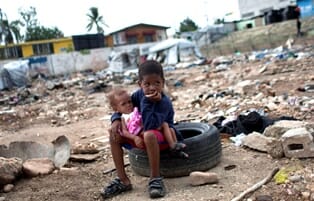
Foto: Dieu Nalio Chery/AP
At Port-au-Prince, two projects were conducted by AMU in close collaboration with the Scalabriniani Missionaries, as a sign of that “ecclesiastical communion” which has characterised the reconstruction of Haiti, in which many ecclesiastics or lay organisations were involved. The first, related to an urbanization plan for families who were without homes, consisted of the creation of a new electric line to service two villages, by which 41 families were able to connect to the electric power grid. Furthermore, to help complete the construction of the “Montebelluna-Bassano” village composed of 27 housing units for the benefit of 135 people, the contribution of AMU went to the laying of the village’s water and sewerage system and the electrical equipment of each house. The power grid was boosted through a production pole with a powerful generator, in such a way that many small enterprises in the area (cement blocks, carpenter workshops, a bakery, an industrial kitchen and a poultry farm) managed to increase their own production. Lastly, AMU supported the start-up of a poultry farm – with job opportunities for 10 people – through the construction of a water reserve tank, indispensable for the water supply of the 3,000 animals and slaughtering activities.
A community centre – school, recreation centre and big sports ground – was the second project AMU supported. Through AMU the Focolare Movement also supported other social activities for the Haiti population: at Carice (always in the North East), for many years a professional nurse was employed in the small clinic of the Sisters of Mary Immaculate, while waiting for one of the religious to complete her specialization and be able to work in the clinic, one of the few healthcare centres at the service of the population. Lastly, with PACNE and the specific contribution of the Youth for United World, a study scholarship program was launched for around ten Haitian youth, to allow them to pursue their university studies in Haiti, and for others to acquire good professional skills in the Dominican Republic close by, to be placed at the disposal of their own country.
Related AMU project: www.amu-it.eu