30 Jan 2015 | Focolare Worldwide
Natalia Dallapiccola, Peppuccio Zanghì, Luce Ardente
«When Luce Ardente started to bear witness to the Ideal of unity among the Buddhist monks, Giuseppe Maria Zanghì, or Peppuccio as many called him, and who passed away a few days ago, said that he was “a new St. Paul for Buddhism”.
Knowing how difficult it is for a monk to take part in a Christian and foreign movement, I had doubts about how this affirmation could concretely come about. Now, after precisely 20 years, I must say that those words are coming true.
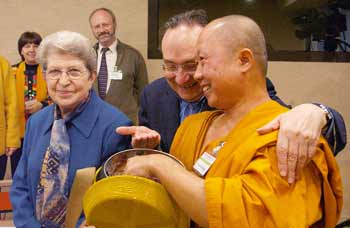
It all began in 1995, when a Buddhist monk set foot for the very first time in the centre of the Focolare Movement: his name then was, Phramaha Thongrattana Thavorn. He had arrived in Rome to accompany one of his disciples, Somjit, who, for a short period before his marriage, was living an experience of monastery life, in line with tradition of all Buddhist youths. On that occasion, Phramaha Thongrattana Thavorn, translated as ‘fine gold,’ met Chiara Lubich and was very impressed. She was also struck by him, and on his request, gave him a new name: Luce Ardente (Ardent Light).
In all those years of acquaintance I had never noted in him, such a impelling force and enthusiasm as in those days, in announcing universal brotherhood, “mother Chiara’s ideal” (as he still calls her today). Today, while participating in an important ceremony as Luce Ardente’s guest, before the 120 monks and the highest Buddhist authorities of the region, he took the floor to spontaneously but very clearly give a testimonial of his experience with Chiara Lubich and the Focolare, and openly declared that he is a member of Chiara’s huge family diffused in more than 120 counties with millions of members.
Unperturbed, the monks listened: some were amused, others interested, and a few were perplexed as would be expected in any “religious community.” Before, during and after the ceremony Luce Ardente, often breaking the rules, greeted those present one by one, manifesting great respect and affection towards the elderly monks.
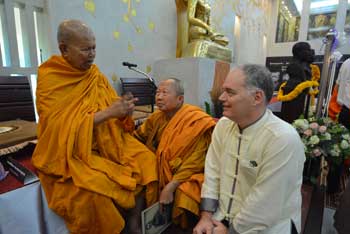 Luce Ardente continues to repeat even now: “The time has come for me to tell everyone how much good Mother Chiara has done to my life as a monk. I feel that she continues to give me an interior impulse and strength to bring the ideal of brotherhood to all.”
The death of Peppuccio – who did so much for interreligious dialogue – and the opening of the cause for the beatification of Chiara, are strong and important moments not only for us Christians but for all the members of the Movement.
The day after Chiara passed from earthly life to heaven, on 14 March 2008, Luce Ardente remarked: “Chiara no longer pertains only to you Christians, but she and her ideal are now a legacy for all of humanity.” In these really special days, these facts testify that Peppuccio’s words are becoming a reality before our eyes.
While he participated via live streaming in the opening ceremony of the cause for the beatification of Chiara Lubich, Luce Ardente commented: “Now, more than ever, we must testify to the sanctity of Chiara together.”
23 Jan 2015 | Focolare Worldwide
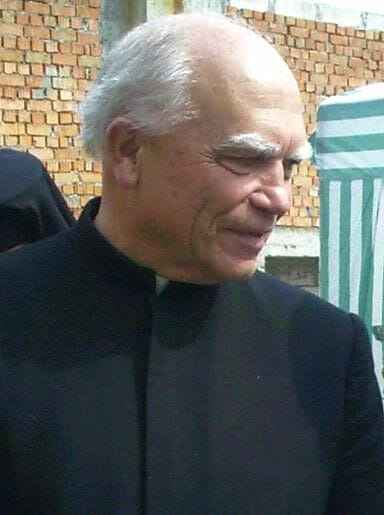 In line with the hopes of Vatican II for many new ecumenical initiatives, towards the end of the 1960s the German Bishops felt the need to strengthen relationships with the Orthodox Church. Bishop Graber of Regensburg – assigned to intensify this dialogue – knew he could count on a highly competent person to carry out this task successfully: Albert Rauch. Ordained as a priest, Albert Rausch completed his theological studies at the Gregorian University of Rome and due to his outstanding sensitivity towards the Greek Orthodox rites, Albert decided to also achieve a Doctorate at the Russicum College, where he took up– among others – Modern Greek and Russian. During his stay in Rome he met the Focolare Movement and embraced its spirituality, and discovered its deep ecumenical dimension . He soon asked to be a member as priest focolarino. To further deepen his knowledge of the Eastern countries, Albert travelled to Greece, Turkey, the Lebanon, Syria and Israel. And to also be part of an official delegation he went to Constantinople, Sophia and Belgrade: and these were the first and important steps that helped the sister Churches to get closer to one another. Patriarch Athenagoras underlined that it was also important for the Eastern youth to go to the West to enrich this mutual acquaintance. This made it possible for many young people of many Orthodox Churches to travel to Germany.. He was entrusted with the newborn Ostkirchliches Institut [Istitute of the Eastern Churches] in Regensburg, role which he accepted humbly and with love. The Bishop asked Chiara Lubich to open a women’s focolare also in Regensburg to help him carry out this task.
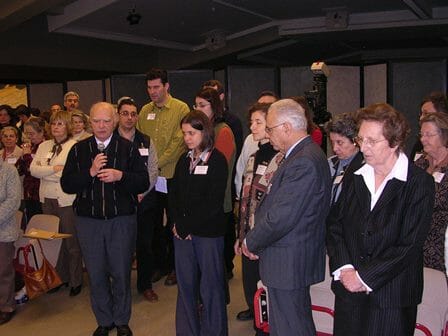
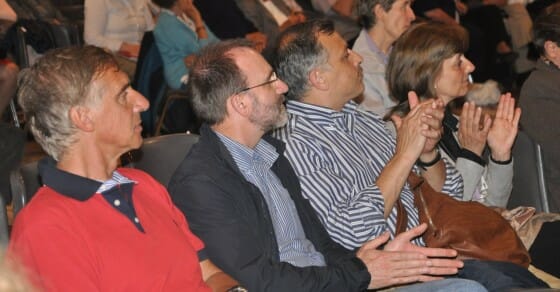
Centro Internazionale dei Focolari, Castel Gandolfo (Roma) 2003- Conduce una preghiera alla scuola ecumenica
22 Jan 2015 | Focolare Worldwide
 The city of Cannes is the winner of the 7th Chiara Lubich Brotherhood Award, because of its Vivere insieme a Cannes Project (Living together in Cannes), which involves laity and Religious from different faiths in projects and initiatives that promote peaceful coexistence. The Mayor put his signature to the candidate application on January 7, the day of the Charlie Hebdo attack in Paris. Cistercian Abbot, Vladimir Gaudrat, member of the French delegation at the award ceremony, remarked: “There’s a symbol of hatred and there’s a symbol of peace, and we are here because we want to demonstrate the symbol of peace.” The ceremony was held in Rome, Italy, on January 17, 2015 during a conference on dialogue, community and brotherhood, which had been organised by the promoter of the award, the Associazione Città per la Fraternità (Cities for Brotherhood Association). Campidoglio was chosen as the venue for the award ceremony because of its connection to the person after whom the award was named. On January 22, 2000, her 80th birthday, Chiara Lubich was honoured by the citizens of Rome. Already in 1949, just arrived in the capital where she later lived for ten years, she wrote an article titled “Resurrection of Rome” in which she described the city that had been torn by war and misery. In that article she manifested her desire to bring light and love to its homes, streets, centres of learning, workplaces, Parliament and everywhere. She made those wishes again on January 22, 2000, indicating some paths that could incarnate her vision: the Art of Loving, so in line with the name of the capital city. In Italian, “Rome” is written “Roma.” By reversing the word you have “Amor,” which means “Love”. The Art of Loving emerges from values found in the Gospel. These few thoughts reveal Chiara’s vision of a city, and they inspire the Association that includes 140 Italian comunes. She sees the city as a place inhabited by a community which, in weaving relations between citizens and between citizens and its institutions, can widen its internal and external borders. “Cities,” explains Pasquale Ferrara, General Secretary of the European Institute of Florence, are forever places of pluralism and diversity, where diverse associations collaborate with local institutions for the solution of problems.” Cardinal João Braz de Aviz, Prefect of the Congregation for the Institutes of Consecrated Life, also offered his testimony on the importance of brotherhood in relation to cities, by recalling his experiences in Brazil. “I learned from the Focolare Movement,” the Cardinal recalled, “I learned openness to diversity, which I then experienced in Brasilia. Until I arrived in Rome, where, for me, brotherhood means open contact with everyone.” Lina Ciampi, Secretary of Città per la Fraternità said to the microphone of Vatican Radio: “In this moment that is seeing so many open conflicts – reflecting on brotherhood and dialogue in a community that is changing, with so many feelings, dedicating an entire afternoon to this topic and how to come up with a new cohesion, seems very important to me. Cannes has presented a multi-cultural and interreligious project, in which Buddhists, Jews and Muslims interface. . . It seems to me that it reflects very well what the Association proposes we should do.” Besides the French city of Cannes, awards were also given to the comunes of San Severino and Tolentino nelle Marche for their projects which were directed towards their most vulnerable citizens; Honorary Mention was given to the Comune of Trieste for its Educating For Peace project, which led to the installation of a Cube of Peace in one of its public parks.
21 Jan 2015 | Focolare Worldwide
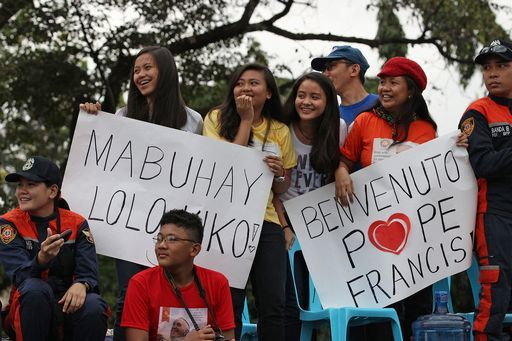
The images of the recent trip of the Pope to Sri Lanka, first, and then to the Philippines, after, have circled the globe. His talks, gestures, phrases, were relaunched by many newspapers in numerous languages and by the social networks that have become powerful multipliers of his message of “mercy and compassion”, the central themes chosen by him for this historical trip.
«We made history again – they wrote us from Manila – surpassing the biggest gathering recorded in history in the inforgettable World Youth Day of 1995 with John Paul II. In fact, in the mass in Luneta Park, the almost 7 million present showed once more their faith in and love for the Holy Father».
On the second day, 40,000 participants at the meeting with the families at the Mall of Asia, along Manila Bay. Francis encouraged the Filipino families to “serve as sanctuaries where life is respected” and to proclaim the sacredness of life from birth to death.
«I expected a celebrity – Nidj, a youth of the Focolare said– instead, I saw a “servant”. I felt pure, simple, and authentic love as he spoke. He managed to stay humble and be himself in spite of all the attention directed towards him».
And Loli Funk: «There has been much wisdom like a blinding light with the novelty of the call to live an authentic Christian life but one does not even have to be a Catholic to appreciate his messages: they hit us right into the heart of where it hurts and touches us the most. If we are a family, a community that looks after one another, but each one integrally whole, we have better chances of making it».
Romé Vital: «When Pope Francis spoke to the young people yesterday at the University of Santo Tomas, he urged us to live in reciprocity not only to give and give but also to allow ourselves to receive love from God and from others. This is something new to highlight the value of reciprocity in our Christian life».
And still more, Jan Co Chua: «Reflecting on the events with Pope Francis these days, I feel like the apostles on the road to Emmaus… They asked each other, “Were not our hearts burning within us while he talked with us on the road and opened the Scriptures to us?” (Lk 24,32)».
The most moving part of his trip was the visit to the survivors of the zones struck by typhoons, in Tacloban. «we are still in the euphoria of joy brought to us by the historical visit if our Holy Father Pope Francis», the members of the local community of the Focolare wrote to us.
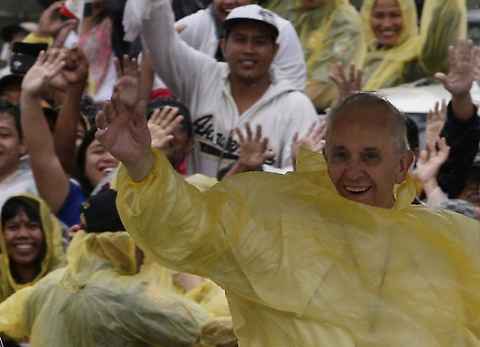 «Francisc is the first Pope to come and visit Tacloban. His visit made us feel the maternal love of God through the Church. We felt understood, consoled, after having suffered so much in the past. We were surprised by his spontaneity in loving: his decision, inspite of the typhoon, to celebrate the mass out in the open with winds that blew strongly. We were touched by his homily, by his humility, when he said that he had no words to say in front of these sufferings and when he asked our forgiveness since he arrived a little bit late …».
The community of the Focolare was fully involved in the preparations: «The local Church entrusted to us the preparation of the venue where the mass would be celebrated: the vast open field that could contain 120 thousand people, In front of this very demanding task we asked the help of adherents, sympathizers, friends, relatives, also coming from the other provinces, and we organized a plan which we had prepared for the past three months».
Von, confessed that for many years now he had not been going to mass: «When I was invited to work for the event, I put all my efforts into it. I found my faith once again and also the family of the Focolare».
Some women Volunteers who were in charge of organizing the places for the people, wrote us: «We could have chosen the best places for us to be able to see the Pope. But we chose the farthest places so as to give way to the others. But in the end we were able to greet the Pope up close just the same!».
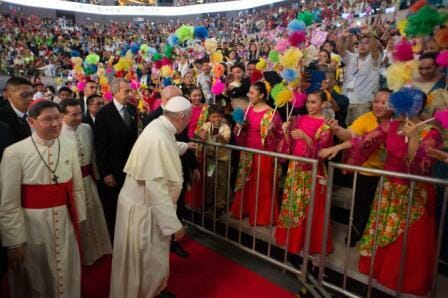 The young Gen worked in the sector of crowd control: «We tried to make love reign above everything else: giving preference to the elderly, to those who had come from faraway (walking for many kilometers) … We were very moved by the words of the Holy Father. We greeted him up close and he smiled at us. What a great joy we felt at this encounter with him!».
«The visit of Pope Francis – they concluded – was a unique experience: to be there with all the people, working together for 24 hours under the rain, the strong wind and many other discomforts. His words and the experience we lived will never be erased from our heart!».
18 Jan 2015 | Focolare Worldwide
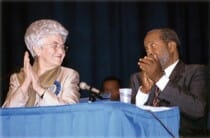
Chiara Lubich – Imam W.D. Mohammed
In the face of such a great tragedy and absurdity, beyond our understanding, we are in search of meaning. What is the answer to so much fear and anguish?
« As I watched those towers crumbling, hardly believing my eyes, and thought of this appalling tragedy, the shock of a superpower that suddenly discovers its vulnerability and personally experiences the crumbling of many certainties, as well as the threat of a war with unpredictable consequences, it was like reliving in Trent beneath the bombings of World War II. Everything was crumbling then and we felt impelled to ask ourselves if there was anything that no bomb could destroy. The answer was: Yes, there is. It is God. God whom we discovered as Love. It was a luminous discovery that gave us the certainty that he cannot abandon us, that he is never absent from history. On the contrary, he is able to direct the course of anything that happens towards good. I personally lived this experience in a surprising way.
And I asked myself: couldn’t it be that right now, at the beginning of this twenty-first century, God wants to repeat this great lesson and to give us the opportunity to put him in the first place in our lives, compelling us to put everything else in second place? This thought gives me hope for the future.»
But we can’t deny that there is also a growing anti-Islamic sentiment. What can be done to avoid these sentiments which criminalize the whole Muslim world?
«For some time now in our Movement – but not only in our Movement – we have established a profound unity in God with Muslims, and precisely in the United States with a vast African American Muslim Movement. I learned that in this moment they feel greatly helped by the fact that they are united with us Christians in the commitment to bring universal brotherhood in the world.
We must recognize one another as brothers and sisters, Christians and Muslims. We are all children of God. So we Christians must act accordingly.»
How can there be, in your opinion, so much hate on the part of some Muslim fundamentalists? What can we do?
« In my opinion, we are dealing here with Evil with a capital E. This is why I feel one thing very deeply, which is perhaps a little original: now people are mobilizing all the forces, on the political level, heads of State, and so on. But the religious world must also be mobilized for the sake of good. All the forces of good must unite. This is already being done. For example, last Sunday the Holy Father spoke very forcefully – and I saw that all the newspapers reported it – asking America not to allow itself to be tempted by hatred. He continually repeats his appeals for peace.
Our own Movement, in its more political expression, the “Movement for Unity in Politics,” promotes this idea of brotherhood, which is the harbinger of peace, through municipalities, through parliaments, in many parts of the world.»
18 Jan 2015 | Focolare Worldwide
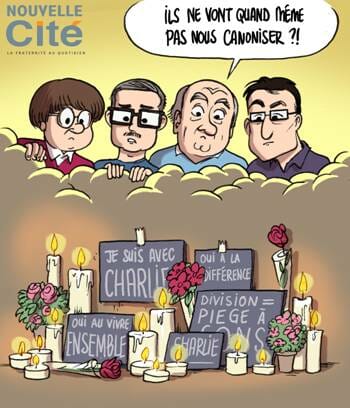
The director of the French magazine, “Nouvelle Cité,” Dominique Bonnet, wrote: «Like all the French, we were shocked by last week’s events, a tragedy that led about four million people to rally in solidarity, on Sunday, 11 January 2015. «As a publishing house – he continued – we felt it was our duty to react to the attack and murder of the cartoonists of Charlie Hebdo, but to also give a positive message, that is, underlining the “coexistence” we want to build with all people and all religions. Because of this we chose to express our ideas through a cartoon that does not repeat the slogan, “Je suis Charlie,” but “Je suis avec Charlie” [I am with Charlie]. In fact we do not share the editorial policy of that paper. The four cartoonists who were killed appear on the top of our cartoon. Out of respect for their motivations as atheists, we thought that the phrase “Il ne vont quand même pas nous canoniser” [“They are not trying to make us saints are they?!”], as very fitting. The slogan at the bottom of the cartoon expresses our view of that idea of “coexistence.”» The cartoon was published on 10 January on the site of “Nouvelle Cité” and relaunched on Facebook and Twitter. The massive participation in the peace march in Paris was amazing, and reverberated across the globe. «The TV channels broadcasted many interviews of people in the crowd and some testimonials were really moving. [Like that Muslim woman with a veil, whose son, a military, had been killed by terrorists in the south of France, and who tried to console the Rabbi who had come from Tunisia to verify the death of his son. The Rabbi talked about how his son was afraid to wear the kippah, while the woman spoke about how her veil aroused the looks and comments from others. “Be strong – the Muslim woman said to the Rabbi – you have to muster all your courage, but we must stand firm. I am French and proud to be one, but we must overcome.” It seemed that the future lies in this painful dialogue.»] «The lights of “this togetherness” have been dimmed. Tomorrow we will have to coexist. But in the various interviews this term takes on different hues. In France people are seriously wondering: has religiosity been relegated to a strictly private sphere? To what extent can the freedom of expression be pushed? For three hours in Paris, under a winter sun, thousands of hearts warmed themselves by speaking to one another.» The members of the Focolare in France not only declare their commitment to remain faithful to the Time-out for peace action, that is done throughout the world at 12 noon every day, but also to take part in doubling our efforts in interreligious dialogue with actions of all sorts, like “Vivre ensemble a Cannes,” now at its fourth edition. The city of Cannes won the “2015 Chiara Lubich Award for fraternity.” The awarding ceremony was held in Capitol Hill in Rome, on 17 January: and the prize was received by a delegation of 15 representatives of interreligious dialogue.
