16 Mar 2016 | Focolare Worldwide, Senza categoria
“This soiree should have been held here three months ago. Instead, the folly of men changed our direction.” These were the opening words of Noufissa Boulif, Muslim, organiser of the event: after the attack in Paris on 13 November 2015, Brussels lost its identity. This is where some of the terrorists involved were based, and for security reasons the concert had been cancelled and moved to 20 February 2016. The encounter between music, and Muslim and Christian cultures, became a platform for the encounter between Muslims, Christians and also agnostics who believe in dialogue and who, knowing they were welcome, were able to receive the others and discover their hidden qualities and values. But wasn’t it highly risky, for an Islamic-Christian event right in the heart of Brussels? We asked Noufissa.”If the concert was able to go through, it was thanks to the incredible solidarity between Muslims and Christians, and certainly due to divine protection. Luckily the entire programme came about without accidents or tensions.” The concert was dedicated to all the children who suffer, giving the soiree the theme «of children and the youth, but also under the auspices of diversity which characterises our country.» For more than 20 years, Noufissa has known and lived Chiara Lubich’s spirituality of unity. She wants to testify before all that fraternity between Christians and Muslims, often antagonists, is possible. In this perspective she organized the first Islam-Christina concert in October 2014. https://vimeo.com/114676421 “I have been working on it for a long time”, Noufissa recounted. “Together with my husband and children, we are involved in interreligious dialogue, which has by now become part of my life. For me, as a Muslim wearing a veil, living in harmony with others is not to be taken for granted, because I feel that people look at you with curiosity or evident signs of diffidence. But every time, I try to approach them without prejudice, and with a smile. The Golden Rule which all great religions advocate, helps me a lot. “None of you really believes if you do not wish for your neighbor what you wish for yourself” (Mohammed, Hadith 13 de al-Nawawi). The islamophobic reactions and influence of the mass media are not always constructive or comprehensible, but the essential thing is to overcome them. The prophet, Mohammed, in a hadith stresses that “A smile is an alm” (meaning, a free gift for the other).” Going back to 20 February this year. Various choirs appeared on stage: children, youth, Christians and Muslims, blacks and whites. Speaking Neerlandish or French – also this is one of Belgium’s challenges, the participants were Rissala, the small choir singers, the voices of the dei 4 Horizons, and the ‘TOUCH,’ a group of disabled Muslim girls. Towards the end, also the rappers – Mc ‘Youns, and Antis et Mamz-I – with their incisive words, invited everyone not to give up, but to continue believing in life. The “light of the heart” association was formed after 25 years of Noufissa’s interreligious dialogues, and 10 years of the service of one of her Muslim friends involved in palliative treatments: together they visit the sick at their homes, trying to meet the thirst for relationships in their particular phases of life. With this association, after a year of hard work to prepare “Fraternity choir,” they are already working on a next Islam-Christian event to be held on 23 April entitled, “Together with Mary,” in the Saint Michel Cathedral in Brussels.
14 Mar 2016 | Focolare Worldwide
Cristina Montoya
14 Mar 2016 | Focolare Worldwide
With the fall of the Berlin Wall everything seemed resolved. No one imagined that the walls of mistrust, hatred and prejudice stood on in the former Yugoslavia, impeding what for so many years the Focolare communities had been trying to build: unity among all, differences of differences ethnicity, language and religion. They saw the diversity as enrichment. The announcement of the conflict was a real shock to them, but also an incentive to continue believing that despite the absurdity of fratricidal war, God’s love had not diminshed. Minka Fabjan, expert in administration and active in the field of the Economy of Communion, reports on behalf of the community in Zagabria: “It was August 1991 and, amidst a thousand hardships, a group of us went to Katowice, Poland, because we learned that Chiara Lubich was going to be there. She invited us to testify to the Gospel in every possible way, to ‘shout it from the rooftops’. There were already the first rumblings of war in Croatia: closed schools, blocked highways . . . Amidst winds of war, it was striking to hear our messages of peace which, at the urging of Chiara, we sent to various public broadcasters. Nevertheless, her messages became more intense: “Demonstrate with your life that love conquers all.” She had been the one to suggest that we collect signatures for peace: “in schools, in front of churches, on public squares, in Slovenia, Serbia and everywhere. Because of the air raids, in Croatia we even gathered signatures in the air raid shelters. Within a few days we sent them off to several Heads of State, 65,000 signatures.” “Meanwhile our houses filled up with refugees: they were relatives and friends, but also strangers. Therefore, Chiara invited the Movement around the world to become involved in sending help. The first truckload arrived in autumn. It contained foodstuffs and basic necessities, and that continued for years. Red Cross centres, conference halls, houses in the middle of construction and cellars were transformed into storerooms, so that the goods could be shared with neighbours and refugees both Serbian, Muslim and Christian. We prepared up to 300 packages a day. With this humanitarian aid we managed to provide relgular help to 7000 people.” “We were already feeling tired when, in 1993, Pope John Paul II asked us to open our hearts and homes to the Bosnian women who were arriving from Zagabria, following the unspeakable cruelties suffered in the camps. We felt like Chiara was beside us and so we all got to work. During the 1993 Familyfest, we launched a fundraising campaign that allowed us to give homes to 50 refugee families and to help more than 150 women. Through adoption at a distance, thousands of children were provided for. Several rape victims found the heroic strength to carry the pregnancy to term. In Serbia 700 men – including members of the Movement – were drafted into the federal army. When Chiara heard of it she invited all of us to pray for them, that they would find the courage to oppose violence and not fire their weapons. And those prayers were quickly answered because all of our men were given civil service duties.” The war had also involved Kosovo and Belgrade. Nevertheless, Chiara wanted to visit an area near Croatia. When Večernji list journalist, Ottone Novosel, asked her if she had any words for the people, Chiara didn’t hesitate: “Show that the miracle of unity is possible even among different ways of thinking, different ethnic groups, and different religions. This war could provoke another reaction, a great flowing of love that could become a model for many other populations. God is the one who guides history ” (April 12, 1999). Her words continue to be timely as we consider the many conflicts that still plague our planet and dishonour our common humanity.
12 Mar 2016 | Focolare Worldwide
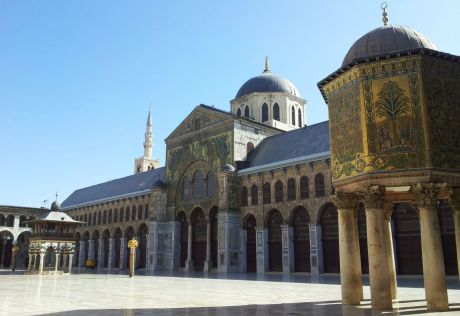 Aleppo, March 8, 2016. I woke up at four in the morning to the sound of bombs and wasn’t able to go back to sleep. I tried not to believe my ears. No, it can’t be true, Lord! More bombings! Just as we were beginning to hope things would get better, that the electricity had returned after 5 months and the water after 45 days! Why? This ceasefire was supposed to last and become permanent! My pleadings rose from the depths of my soul to the Lord of History, asking that this truce which was announced a week ago for all Syria would become permanent. But the sound of fighting on the frontlines that divide the city of Aleppo in two only increased, with the sound of loud explosions that are easily heard at night. While waiting for the sun to rise and for calm to return, as I continued praying I thought: “Of course, we all want Peace, but do we really believe or think that it is achieved at such a high price? There are people who think that war is the path to follow! They’re prepared to sacrifice not only their own lives, but also those of others because they believe this. And there are powers that make a profit on everything that’s happening, so they don’t want the war to end and; indeed, they continue to pour gas on the fire.
 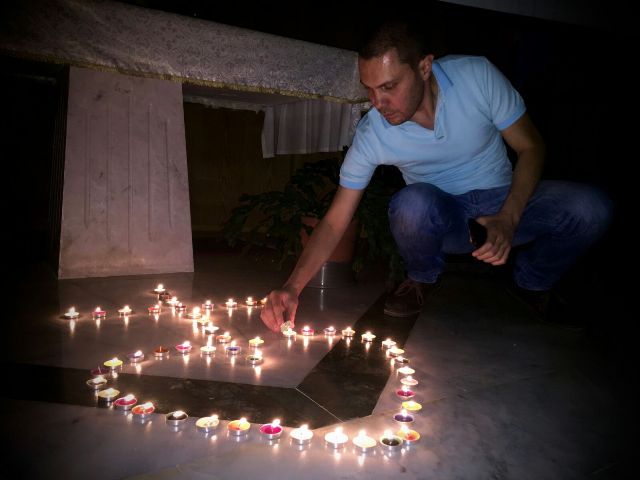 And we, the ones who believe in great ideals, in living peaceful and civil lives with respect for other cultures – do we truly believe it? And what price are we ready to pay? Frankly, the war in Syria is not a small matter. Who would have the courage to destroy a country that 6 years ago was growing with life and hope, where Muslims and Christians of different confessions and many other ethnic groups lived at peace with each other? Surely these destroyers are not single individuals. An answer by Chiara Lubich to some of our Muslim friends in 2002 came to mind. They had asked her about the hope that love and peace would win out over the war. She answered by citing the September 11th attacks: “Terrorism is a fruit of Evil (with a capital E) against which human strength will not suffice [. . .]. The forces of Good (with a capital G” are required [. . .] the forces of God’s Love. And so, what do we have to do? Prayer! We have to unite . . . all of us who are for universal brotherhood . . . unite to pray that terrorism will be overcome. And we can do it, because Jesus says that wherever two or more are gathered in His name, in His love, whatever they ask, will be done for them. And we are far more than two or three [. . .] Let us leave here with one idea: We are together, let us unite to pray. But that’s not enough. The main cause of terrorism is this indifference in front of a world that is half rich and half poor. They would like – and they’re not wrong in this – for there to be some communion of goods [. . .] some solidarity. We have to change hearts. Only if we carry out the work of universal brotherhood will we be able to convince ourselves and others that we should also put together our goods. We’ll begin amongst ourselves, but then the ideas begin to rise all the way to the Heads of State. We need to have this certainty: that with God, impossible things become possible; that with God – beginning with the brotherhood amongst us – we’ll reach the great goal: to make humanity one family [. . .]. This is our objective.”
  We shouldn’t delude ourselves. We shouldn’t wait for others to do something. We’re also responsible! If we truly believe that God can overcome Evil and that He listens to us, then we have to pray to the Father without ceasing, with the faith that He will help us; otherwise, we commit a sin of omission. Everybody remembers the time the bombings stopped over Syria, thanks to the influence of the prayer and fasting of the Pope and many others. And God heard us! And so He can hear us again. Let’s do it then – and always – until the reign of Peace comes not only in Syria, but in the whole world. See: Chiara Lubich, Castel Gandolfo, Italy, November 3, 2002, questions and answers with Muslim friends of the Focolare.
10 Mar 2016 | Focolare Worldwide
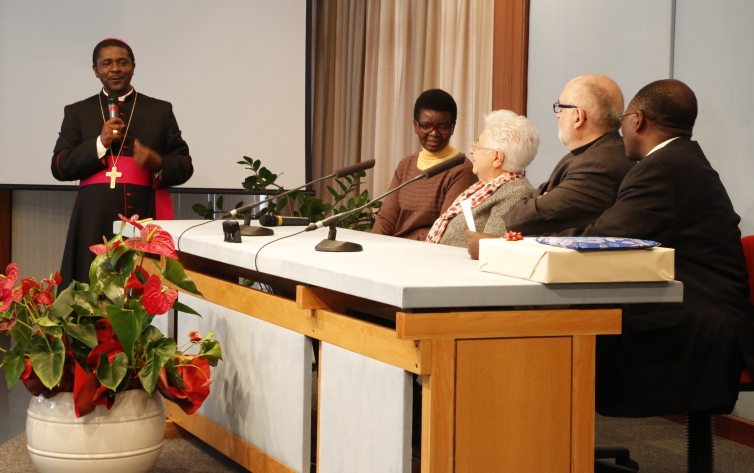 “We cannot talk about evangelization in Fontem without the Focolare Movement,” said Bishop Nkea standing in front of the television cameras during his visit to the International Centre in Rocca di Papa, Italy, on March 8. “Chiara Lubich went to Fontem 50 years ago, and she brought the Ideal [spirituality of unity]. That is why we have come here: to thank Chiara and the Movement for everything it has done for us in these 50 years. This is a pilgrimage of thanksgiving.” “The Diocese of Mamfe did not exist 50 years ago and Fontem was a lost village in the Cameroonian forest that was difficult to reach.” We cannot understand the Bishop’s words without returning to the history of an event that has been called the “miracle in the forest”. Fontem was the first permanent Mariapolis on the African continent. In 1966, several focolarini, doctors, went to help the Bangwa people who were being decimated with an infant mortality rate of 98%. A few months later, Chiara herself visited them: “That huge crowd of people gathered on the vast plane in front of the home of their Fon,” she would say in 1995, “appeared so united and so anxious to be elevated [. . .] that it seemed to me long prepared by Mary to embrace the Christian faith in its most integral and genuine form.” “The focolarini were believed because they did to Jesus what they did to the Bangwa, offering, above all, a witness of the love amongst themselves and towards everyone.”
 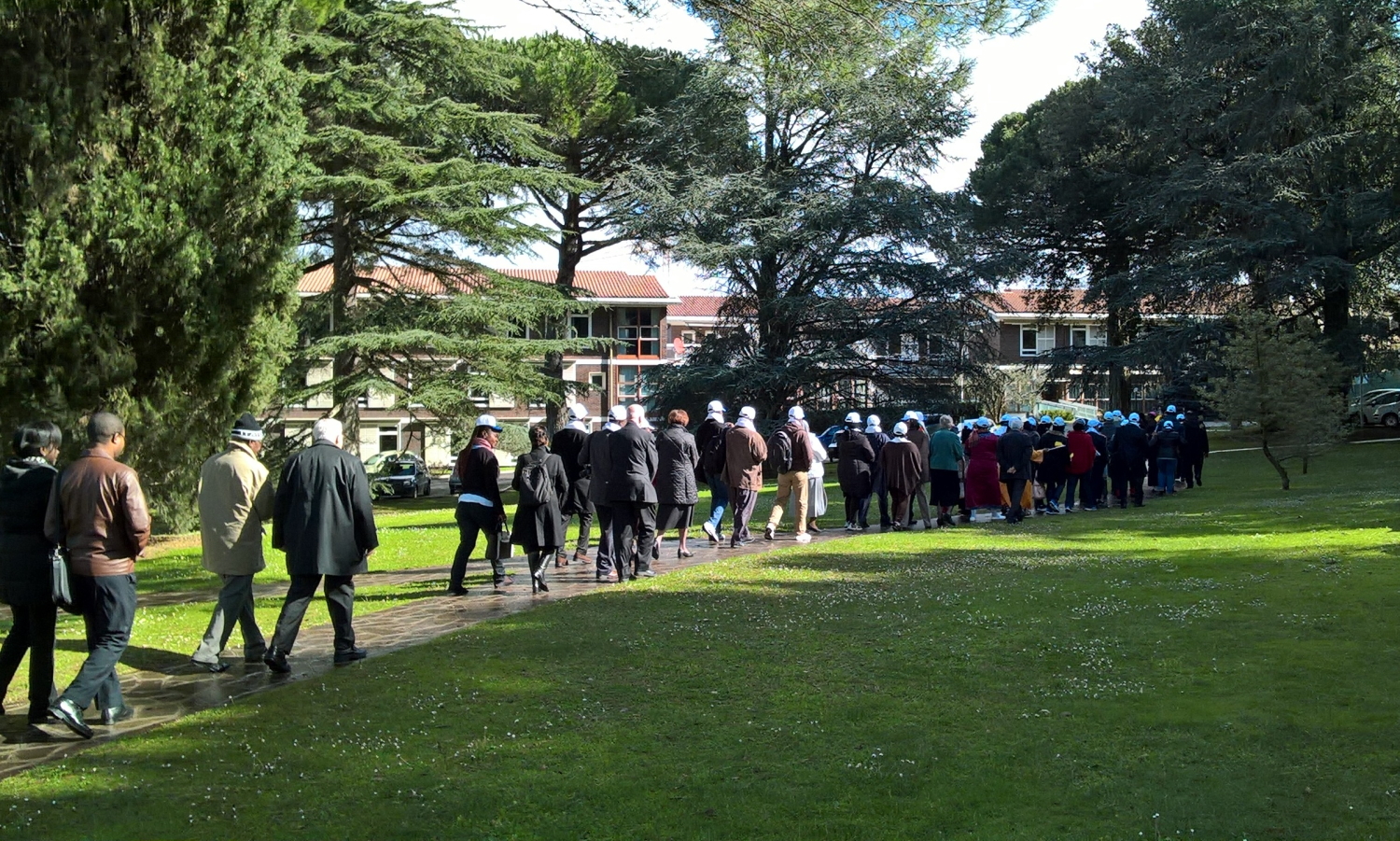 Today there is a hospital in Fontem, Mary Health of Africa, which serves a large part of the region; and a college, Mary Seat of Wisdom, which prepares students for university. With the help of focolarini priests, parishes have been opened in Menji, Fotabong, Fonjumetaw. Bishop Nkea declared: “Mainly, we learned mutual love and unity. I’m also Bangwa, so I’m speaking in the name of my people.” “We learned interreligious dialogue: What is important for us now is that we love one another, whether we are Christian or not, to live in this unity with each other.”
 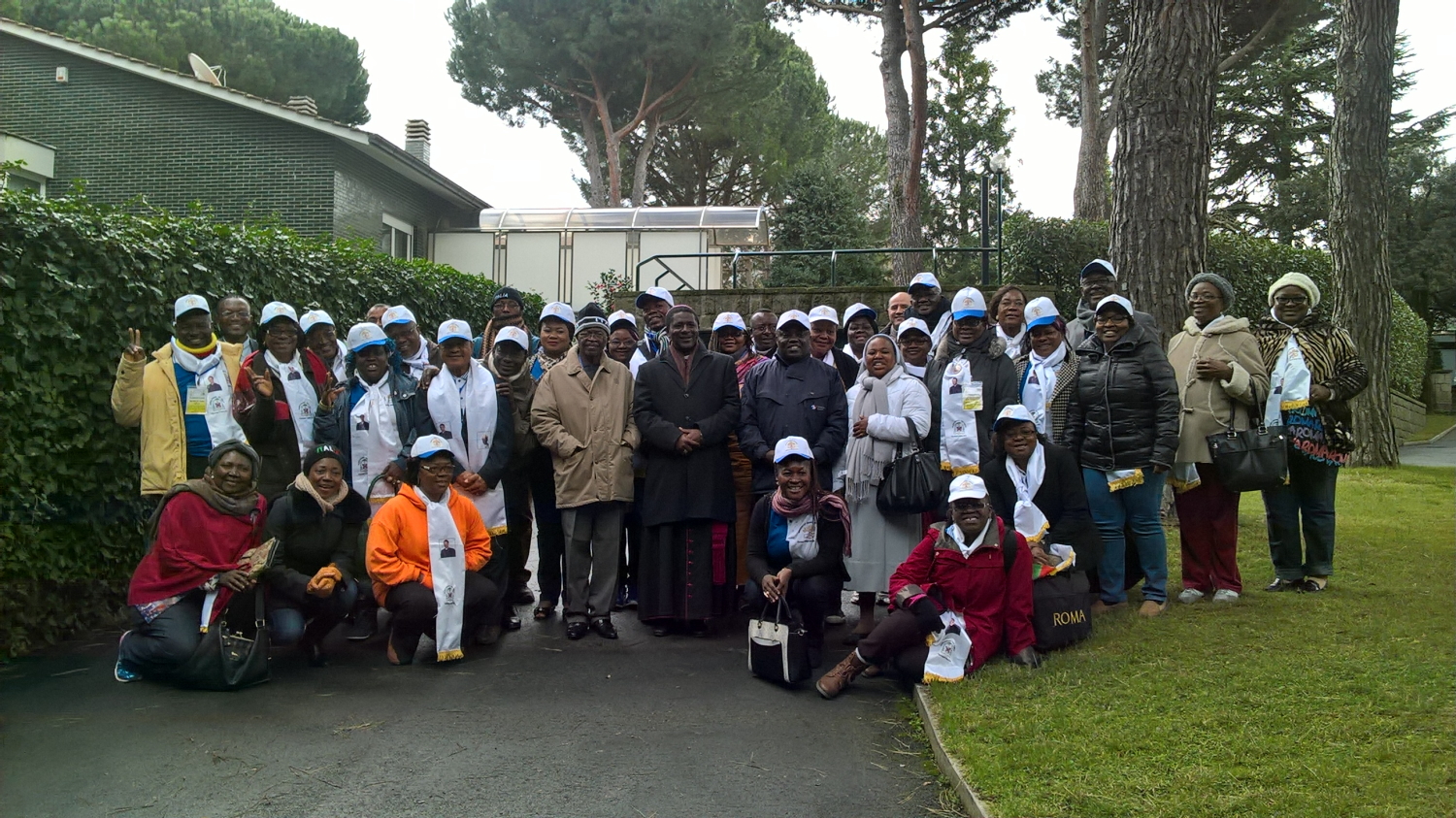 The delegation that had come to render homage to Chiara Lubich included bishops – Bishop Nkea and Emeritus Bishop Lysinge who was celebrating the 50th anniversary of his ordination to the priesthood – priests, women religious and many lay people. They are a living testimony to the communion in the diocese. They were welcomed at the International Centre of the Focolare by the Movement’s president, Maria Voce – who first visited Fontem in January 2009 – and the Movement’s co-president, Jesús Morán, who will visit Fontem this coming December. The visit of the delegation marked the opening of the 50th anniversary celebrations of the arrival of the spirituality of unity in Fontem (1966-2016) and will continue through the year. The visit to Chiara’s house was particularly moving. The day concluded with a solemn Mass in the chapel where Chiara rests. “Your pilgrimage here today bears witness to the fruits produced by that first visit of Chiara, which launched a Divine adventure that no one ever imagined,” Maria Voce said as she welcomed them. “You are the fruit of the life of these 50 years. It is a great joy for us and shows us the vitality of Africa. Fifty years have gone by and our wish to each other now is that we begin a new period, hopefully a long period for offering to God trees covered with fruits and with blossoms.” Jesús Morán commented: “There is an exchange of gifts between Africa and us. The charism of unity is a gift for Africa, and Africa is a gift for the whole Movement.”
Leer more: 50th anniversary of the Focolare in Africa
The personal witness of the Fon of Fontem Lucas Njifua https://vimeo.com/91709757

7 Mar 2016 | Focolare Worldwide
“We got to know a family from Burundi who in the current terrible situation in their country, about which we hear very little, have left the country like many other families and come to Kampala where we live,”write us from Uganda. “The husband went back to Burundi so as not to lose his job and to be able to pay the rent on the house in Uganda and buy food for their children, including a three week old baby. “His wife had not been able to stay in Burundi when shooting began again in their city, as she had too vivid memories of all that had happened in the 1990s during the civil war. Then she had miraculously escaped death because the Headmaster of the school she attended had twice paid off soldiers who had come to the school on two consecutive days to look for her and the other girls. So, when the first signs of trouble began, the family had decided to go, leaving all they had behind in Bujumbura. They had brought other relatives with them, so there were 8 of them in all. “We heard that the rent did not cover furniture and that they had only 4 chairs in the living room: what could we do? We thought that four of our folding chairs, used occasionally when many people come to our house, would be made better use of in their house, so that at least everyone could sit and eat comfortably. “As we left we cut two pumpkins from the garden to take with us. We had planted a number of them almost by chance a few months earlier and they had picked up after the dry season and had been extremely useful in recent weeks! Moreover, just the day before we had received some food supplies. Providence has never been lacking over the last few months and it is truly by sharing it that the Gospel promise “give and gifts will be given to you” comes true. So we took two kilos of sugar, two of rice, one kilo of salt and a litre of oil and went to see the family. “Their house was new and clean and there were some unusual trimmings on the ceiling as well as a nice light fitting. But there were no beds in the bedrooms, only mattresses. In the living room there was a small round plastic table and four chairs, a little television in the corner on the floor with an antenna hanging over visitors’ heads. We could not see any toys or other furniture. “We went in with the chairs and spent two very happy hours with the family getting to know them better and sharing past memories and hopes for the future. The children are not going to school at the moment. The older ones want to go to university but it is much more expensive in Uganda than Burundi so it is not possible for now. Finding work is difficult too, as many people are unemployed and it is almost impossible for foreigners if you don’t know someone. What is more they don’t speak luganda, the local language, and English is not their mother tongue either. But they said “… We trust in God!”. “It was already 7.30 in the evening and we needed to go home. We all said goodbye. They were so happy we had come but as soon as we asked them to keep the chairs, and return them when they left that house, their faces lit up and they thanked us again and again! Before getting into the car they wanted to give us their blessing! On the way home I thought that four ordinary chairs and two pumpkins, once given, can fill the hearts, both of those who receive and those who give, with joy…” (S.M. Uganda)
