14 Dec 2015 | Focolare Worldwide, Senza categoria
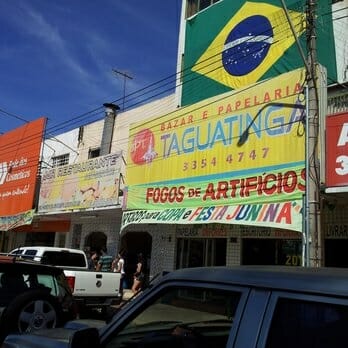
It is impressive to discover that not only is there no exploitation and unfair competition, but also no play on interest rates. These entrepreneurs, like those who have signed up for an Economy of Communion (EoC) – about a thousand throughout the world – pursue the objective of profits that ensure vitality and continuity to their businesses, and wish to live the ”culture of giving” according to the finalities of the project itself: to help the formation and education of the young generations towards this new mentality. Thus they freely and concretely place a part of their turnover at the service of the project. Socoro and Gomes, Brazilians live in Taguantinga City, in the Federal District. They already had six children when he lost his job because he was an alcoholic. To maintain the family, she worked as a household helper, but earned very little. Left by themselves, the children became so disoriented to the point that the eldest, an adolescent, got involved in drugs. The Focolare came to their aid and offered the boy a job in the Fazenda da Esperança, a rehab community inspired by the spirituality of the Focolare. The family also had to shoulder serious housing problems, since their house was not only a makeshift one but also too small for such a big family. They also risked losing the house since they had stopped paying the person who had given them a loan. They presented this problem to the EoC Commission of their region. After a careful analysis, they were offered a loan to cover the late payments, to be paid back according to their capacity to do so. Meanwhile, Gomes started a small business with gas bottles, but because of his alcoholism was unable to keep up with it. Those were really difficult times for them. In addition to their serious economic difficulties, there were squabbles and lack of dialogue. Amid all this, Gomes suffered a heart attack. Unexpectedly, Socoro was offered a permanent job, as a household helper to a Cardinal, who employed her with a regular contract and a just salary. One day when he went to visit the family, he had an important chat with Gomes, who decided to give up his addiction and change his lifestyle. Later on the EoC Commission also visited them to verify their housing situation, and on that occasion offered to insert them in the Habitaçao project within the EoC framework, which provides for the restructuring or renovation of houses for extremely poor families. «When I was told about this– confided Socoro – I was really moved. I had the sensation that God himself was giving us this possibility.» The renovation work was mostly done by members of the Focolare community, some of them worked from 5.30 am to 7 pm. Now the house has a living room, bathroom, master’s bedroom and one for the boys and another for the girls. Living in a house with these requisites helps its inhabitants to regain their personal dignity. Gomes is completely rehabilitated, and has become another person altogether. The couple’s older daughters are now in university, thanks to a scholarship. «Seeing our daughters so committed to their studies– says Gomes – made me also feel the urge to enroll in a course for adults to obtain a diploma.» Even though he had not studied for 38 years, it was a challenge he wanted to meet. In the class, he learned to overcome his shame for being the oldest among the students. His kindness helped him to achieve his goal. When the results of the exams for the Bank of Brasilia and the Ministry of Tourism were given, he managed to classify among the top 200 and was employed in the bank as a clerk.
12 Dec 2015 | Focolare Worldwide
Antonio Diana
(Photo Sergio Siano)
Antonio Diana
(Photo Sergio Siano)
11 Dec 2015 | Focolare Worldwide
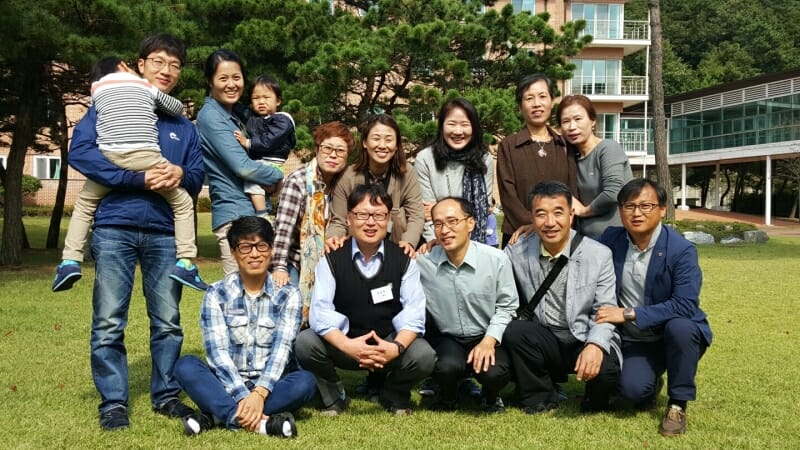 In 2015, in conjunction with the Synod on the Family, the activities certainly could not have gone by without some exclusive event organised by the Focolare families that are very active in South Korea. In this time of crisis in family relationships, in the Chong Hasang Education Center of Seoul, and simultaneously in Pohang, the 2-4 October weekend was dedicated to a ”School of forgiveness for couples” held for 120 couples. In the end, the couples all agreed on the need for true dialogue between spouses. “Instead of burying pettiness and hurt feelings – a couple said – we have to face the situation with courage, discuss it, and ask and receive pardon.” It was a dialogue we experimented on and which they now believe to be essential to renew, and be able to communicate to each other, the things they are unable to say.
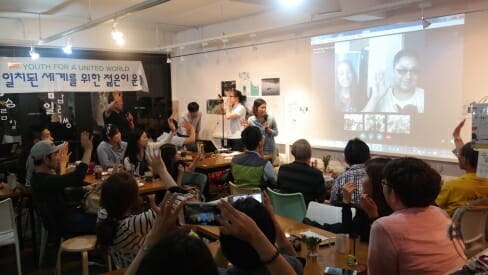
 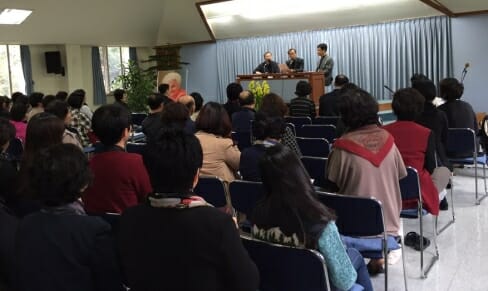 Also the people involved in the parish – 119 of them from all the dioceses of South Korea – had their moment of growth. Accompanied by 18 priests and five religious, on 26 October they reflected on the ”Parish, home of friendship, school of communion.” It was a day lived in the spirituality of unity to contribute to the quality of service to the parish, in full communion of the laity amongst themselves and with the priests, beyond all differences in roles, age, and viewpoints. The testimonials confirmed that misunderstanding and conflicts can be overcome through mutual charity, and unity be reached through reconciliation. All of this was to the benefit of the parish community. “A day at the cafe for Nepal.” Objective: to raise funds for Ramjung where there had been that terrible earthquake last April. This was the invitation launched by the Youth for a united world on Saturday, 5 September, in a bar in Seoul. The key moment was the video-connection with three other Asian cities, Katmandu, Mumbai and precisely India, from which came the story of those who managed to send aid to Nepal: doing part-time jobs, and organizing dinners and concerts. One of them was Natasha who despite being jobless donated 5,000 rupees, and after that experienced the gospel’s hundredfold: three days later she was hired by a company. It has now become a tradition. In a dining hall reserved for the deputies of the Korean parliament, the Focolare held, for those who wished to attend, the monthly Social Forum for unity that reached its 32nd edition on 17 September. In that session they presented the “Rainbow Dream Project,” an educational, recreational program for schools that started out from an integral vision of the person (white, as the colour of light) intercepting the seven main educational aspects (corresponding to the seven colours of the rainbow). Each colour was matched with a behavioural attitude which in turn embraced multifaceted dimensions, while keeping a unitary focus that adjusts to the specific situations the student has to face. The project also provided a community reading session of a phrase from the Gospel at the start of each month, which alternated with the sharing of concrete experiences on this phrase, broadcasted on radio. This project has been ongoing in the Maegoe High School of Chungbuk since 2009. At that time, someone who was worried about the new assignment as Dean, had suggested to Fr. Matteo Park to introduce the spirituality of unity in the school syllabus. Saturday, 28 November saw the launch of the “Bring carbon” Project of the Youth for a united world. Carbon and fuel were donated to the elderly abandoned people living alone, to heat up their homes. But it is just an excuse to touch base, and to arouse awareness in the youth. “Open the taps – one of them surprisingly wrote – and there is abundant hot water running; press a button and the heater warms up the whole house, and you can stretch out under a comforter and watch TV. This was what I used to consider as an ordinary winter day. And I thought that it was but natural for everyone … but now I know that there is someone next to me who needs my love…..”
9 Dec 2015 | Focolare Worldwide
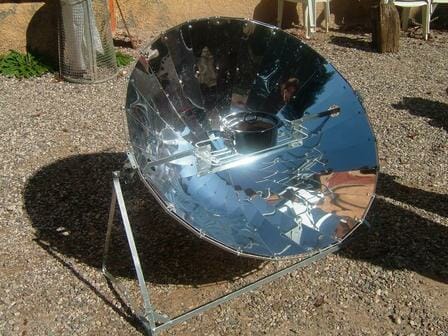
The Solar kitchen project for Mont-Organisé (Haiti) «was conceived due to the desire to help Haiti counter its social and environmental crisis related to deforestation, through the introduction of kitchens powered by solar energy. This device is based on solar energy concentration that generates thermal energy from the sunlight passed through a lens. The energy is amassed in a thermal “battery” that can withhold the heat for 20 hours, thus enabling cooking to be done also at night. The materials chosen to make the kitchens are sustainable and biodegradable, and the device obviously does not require fuel, explained the report drafted in view of the climate conference in Paris (30 November – 11 December 2015). It is dedicated to a series of excellent experiences in the Italian electrical supply chain to produce or optimise energy without emissions. The project, in fact, was singled out from the “100 Italian energy stories” of Enel and the Symbola Foundation. The Solar Kitchens project for Mont-Organisé (Haiti) was presented last 4 July at the Expo 2015 in Milan by AFNonlus, in collaboration with the National Microcredit Agency, the Federico II University of the Agricultural Dept. of Naples, Tesla IA Ltd. and PACNE ONG. It has now landed in the World Climate Conference (Cop21) of Paris, where political leaders and experts of 190 countries are involved in delineating a programme that can save the planet. «The climate challenge which from 30 November to 11 December will see the world gathered in Paris for the COP21, does not only regard the environment,» the Report underlined, but «is a geopolitical, technological, economic and social challenge. It is a challenge for the future, which we can overcome if we firmly undertake a green economy, and clean and efficient energy.” Enel and Symbola recount a new course consisting of innovation and quality, and research and competitiveness in the search for the ”100 Italian Energy Stories.” It is a programme for sustainable energy undertaken in our country [Italy] by enterprises, research agencies and associations.» AFNonlus (Association of Action for New Families non-profit org.) was inspired by the principles of the Focolare Movement which has been operating for over 30 years in 50 countries to support the disadvantaged families and children through projects of cooperation for development.

5 Dec 2015 | Focolare Worldwide
What pushed you to become a priest? A 13-year-old girl asked Don Marco, during an informal interview on the many “anecdotes” that have dotted his life and priesthood. «I was not counting on becoming a priest. I had only asked some advice from the people who were older and had more worldly experience than me, so as to see what humanity needs most today. I could have become a teacher or an engineer. I also liked architecture, or travelling. I liked so many things, and was doing well in school. Those were the years of the economic boom and I had all the possibilities. I was uncertain since I had received a university scholarship, but I wanted to be useful. So I booked an appointment with the Bishop. I wanted to ask him what he thought, about what humanity needs most. He was so busy that he did not have time to talk to me, and I was alone for hours, so much so that I thought: “surely humanity doesn’t need me, but perhaps not even the church needs me, and whoever said that you are so important? Perhaps I am not worth anything… but I love Jesus and will love him always, even if I turned out to be useless.” Finally, when the Bishop found time to speak with me, and asked me what I wanted, I didn’t want anything anymore! And so I told him that I could probably collaborate… He was surprised, undecided, but in the end he said: “Yesterday I laid the cornerstone of a church. When this church, will be finished six years from now, it will have no priest. Would you like to be the parish priest of that church?” But my first experience had been a choice of God, first of all, and not that of becoming a priest, but to follow God and love Jesus, even if I was useless, since Jesus in the end, will make you do something. » (Fr. Marco – Italy)
2 Dec 2015 | Focolare Worldwide, Senza categoria
(C) CSC Audiovisivi
