
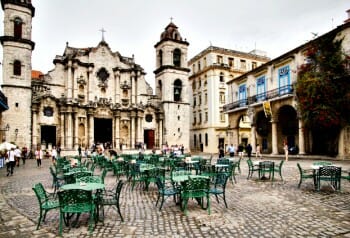
 “We received the news that Pope Francis will visit our country from September 19th to 22nd with great joy. The Holy Father wants to show us his affinity in a time in which, thanks in part to his mediation, we breathe the air of hope in our national life before the new possibility of dialogue in progress between the United States and Cuba. What he is doing as universal Pastor of the Church is very, very important in the search for reconciliation and peace among all peoples of the earth!” So write the Catholic bishops of Cuba in a message to all Cubans. While the Caribbean island prepares to receive the first pope from Latin America, we spoke in Avana with José Andrés Sardina Pereira, a Spanish architect with a specialization in sacred art and liturgy, who is also a Cuban culture enthusiast. “The project we are bringing ahead,” explains Sardina Pereira, “aims to be a contribution of the archbishopric of Santiago to the work started by civil institutions; that is, to seek to have the historic center of Santiago (with the complex of its colonial churches and parts of the surrounding area) included in the UNESCO world heritage list, as are already the historic centers of Avana, Trinidad, Camagüey, and Cienfuegos.” Having a Cuban father, Sardina Pereira in addition to being an architect is a Cuban history enthusiast. This nation, also known as the “Big Island,” was also, “one of the last Spanish colonies to obtain independence (1898), therefore the process of ‘transculturation’ has been the most prolonged. Studies on the origin of Cuban culture, as opposed to that of Spain, place its solidification in the course of the 18th century, a time in which social, economic and cultural apprehensions, with a certain antagonism in respect to Spanish models and interests, were reawakened, all of which distinguish the island natives (the Creoles) from those arriving from the other side of the Atlantic.” Sardina Pereira clarifies that, “in the ethnic and cultural processes that give origin to the ‘cubanía’ (the essence of being Cuban), the Spanish and the Africans who arrived on the island brought with them cultures that were much more complex than those that are traditionally associated with ‘Spanish’ and ‘African’ concepts.” “Men and women from different linguistic, social, and religious groups, with different levels of economic development, coming from countries known today as: Senegal, Gambia, Mali, Guinea, Ivory Coast, Benin, Nigeria, Congo, and Angola, arrived in Cuba.” Also people from other European countries, from Asia, and from the American continent itself. “Just think of the presence of the French in Cienfuegos or of the coffee fields on the east of the Island.” It is in this coexistence of a “rich and multi-coloured range of individuals from different geographical locations that the Cuban culture is born, one of the last cultures generated by humanity: audacious, integral, creative, and at the same time open, welcoming and respectful of diversity.”
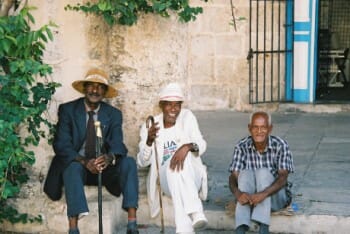 Sardina Pereira stresses how the Gospel message has been key to this genesis, as “this new country was founded thanks to the coexistence of individuals who were very different from each other: whites, coloured, and of mixed race, slaves and free people; many of them united by the love that Jesus came to teach us, a love that goes so far as to lay down one’s life. Just think of the heroism, the consistency, and the love of many fathers of the Cuban nation and of the many men and women who, following their example, generated it with their own lives.” People united by their faith who “travel together on a new ship in the tempestuous sea of history.” At this point in the conversation, our expert adds another element which he holds to be essential. Cubans are: “A people blessed by an extraordinary encounter with the mother of Jesus.” Such an affirmation alludes to that which tradition remembers as “the finding.” It is said that in the year 1612, three salt seekers (one of mixed race, one black and one white, three ethnicities who were up until that moment in conflict) found a small wooden board that was floating on the sea and upon which was the image of the Madonna with the inscription: “I am the Madonna of Charity.” “And this encounter with a Mother,” continued the architect with conviction, “is one of the elements which permits the Cuban people to discover true fraternity, which will be converted into an identifying symbol of this nationality. Mother of all, of sailors of every land, colour and creed.” Sardina Pereira likes to compare this hybridization to a typical dish of the center of the Island, made with a variety of ingredients called “ajiaco.” “In a globalized and ever-more interdependent world,” continues the architect, “many times intolerance of ethnic, cultural, and religious diversity continues to be the primordial cause of grave conflicts. Chiara Lubich, a great personality of the Catholic Church, in her discourse to the United Nations in 1997, affirms that to build a world more united and in peace today, it is necessary to love the homeland of the other as one’s own, and the culture of the other as one’s own.” Sardina Pereira concludes with a personal confession: “Fulfiling this work I realised how much the knowledge and the diffusion of the Cuban culture can be a contribution to peace in the world, as long as we are able to redeem its historical memory and its deep Christian roots and keep them genuine.” By Gustavo Clariá
Give generously
Give generously
0 Comments