
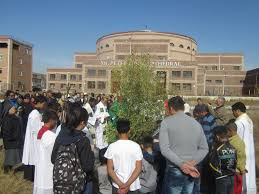
 It is more than ten hours by plane from the Mongolian capital, Ulan Bator, to Daejeon, South Korea, but both cities belong to a single diocese. Outside the capital, the population density of Mongolia is two inhabitants per square kilometre. Christians comprise 2% of the population in a land with a Buddhist tradition of thousands of years (53%) and widespread atheism (29%).
As the local church was wondering how it would care for the few Christians, it turned to the New Famlies of the Focolare Movement for help, finding that several Korean families were willing to share the Gospel message along with their witness to the spirituality of unity as it is lived in families. The parish of Ulan Bator has a social centre that welcomes children and teenagers for after-school programmes, a community farm and a free clinic. This is where the Focolare carries out its main mission. Let’s see what that mission is.
Two or three couples from Korea travel regularly to Mongolia, to visit parishes and meet with families. The main topic is families and how they apply the Gospel to their daily lives. This has brought about the transformation of couples and families in that land as well. They also meet with young people.
“Once, we brought medicines,” Cedam recounts. “The joy of the reverend sister was indescribable when we handed her the package: they were exactly the medicines she had been looking for, since her own had run out. Winter lasts for half the year in Mongolia. For months the temperature reaches -40°C, and so it is quite difficult to leave one’s home in search of the necessities. As the day approaches for our visit to Mongolia, the other families in the community gather provisions that can be taken along. One time we thought of taking footballs and basketballs so that the boys could play on the wide plains, but we needed to buy them and then there was the problem of geting them on the plane. . . One family had placed a money box in its shop to collect funds for the Mongolian families, and so we were able to buy not only balls, but also the equipment for inflating them.”
“The bishop is our driver,” Andrea continues. “He welcomes us at the bishop’s house, drives us to the parishes and encourages us to give with open hands our experiences as Christian families. We find that this is what families are most waiting to hear. The more we visit them, the more affection they express when we go back again. They also want to share how they have been living the Gospel. During one homily, in the presence of several congregations of sisters, the bishop said that we had been sent by God as misionaries and, calling us each by name, he described us as: my friends. Whenver we leave Mongolia, we feel like we are leaving a piece of our hearts behind. Because every time it’s like an experience of what the first Christian communities must have been like.”

0 Comments