
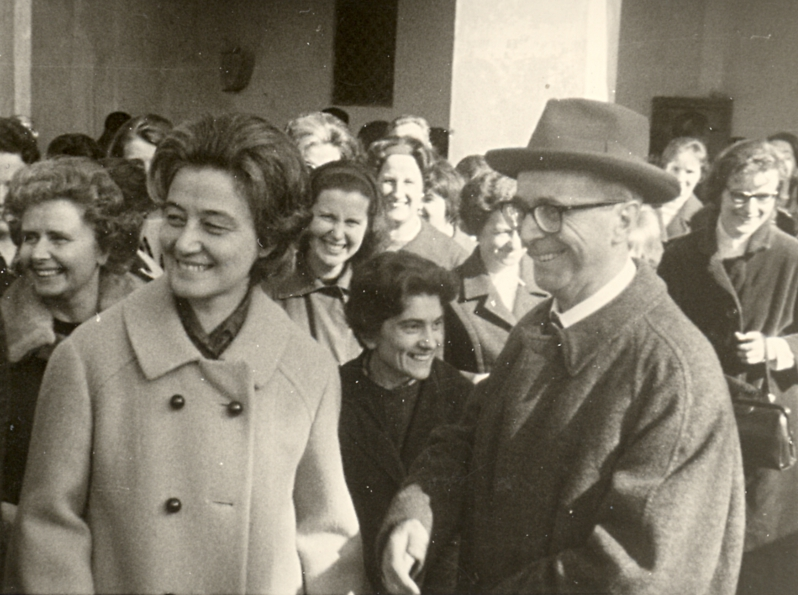
 “This event, like all things of God, began from a humble seed. Silvia Lubich was the daughter of a wine merchant who the economic crisis of the Second World War had reduced to being a modest city worker. He was the husband of a housewife from Trent who, as a young woman, had worked in the print shop of Cesare Battisti. They were a Catholic couple like many others from Trent: simple and direct, without a lot of pretensions. They brought four children into the world, a boy, the firstborn, and three girls. The eldest daughter, Silvia, was born on January 22, 1920. They raised them all in the Catholic faith which since her infancy had shaped Silvia in a straightforward piety. It was straightforward in the sense that it did not allow any compromises: it didn’t allow her to divide her desire between God and the world; to think about good and evil; to show one thing while hiding another. There was God, and God was everything: so one had to belong totally to Him; to do His will like a ray of sun that leaped down from heaven to rest upon earth.” So begins the Story of Light, the story of Chiara Lubich written by one of the main protagonists of the events it describes: Igino Giordani, an eminent figure in Italian politics and culture, and also co-founder of the Focolare Movement. “It is never easy for a work to become a masterpiece,” Director of the Igino Giordani Centre, Alberto Lo Presti writes in the introduction to the first installment. “What then of a book that would contend for this position with a hundred other books written by Giordani? But Story of Light never saw the light. Not only that: it remained unknown even to those who have preserved it over the years. Giordani himself had asked them to wait – whereas most authors would have preferred the opposite; that is, to be recognized especially for their best works.” “Story of Light is not based on historiographic research. It could be described as a recounting of the miraculous intervention brought about by the Holy Spirit – visible in the person and actions of Chiara Lubich – in twentieth century history. In other words, it is comprised of a series of narrative portraits in which Chiara’s biographical sketch is intertwined with God’s plan for humankind, whose ideals had been afflicted and social systems divided and devastated by world wars. This is why, in the subtle interweaving of events in Story of Light, we recognize some of the basic elements in Giordani’s own complex personality. He experienced first-hand all the main dramatic events of the twentieth century, having been wounded in the war, having undergone exclusion because of his ideas, and having had to accept exclusion from civil society. He was a man of faith who worked both in Church and culture, aware that the radical evil would be defeated by a new Christian spirit that he set out to discover. He met Chiara Lubich in September 1948 and found in her the light he had been looking for. He followed her, placing at the disposal of the Focolare founder all of his intelligence and will. He never had doubts about the strength and pre-eminence of the figure of Chiara for the Church, society, current history, and the future. Therefore, even had he have wanted to, Giordani could never have written a complete, objective, methodologically flawless story of Chiara Lubich. His human and spiritual involvement could not allow him that.” “The author had written many volumes on great spiritual figures: Catherine of Siena, Ignatius of Loyola, Magdalene of Canossa, Contardo Ferrini, Francis of Paola, Vincent de Paul, Francis de Sales, Francis of Assisi, to mention a few of his works. They formed a gallery of extraordinary people from diverse times and backgrounds. The place of honor in this rich array was assigned to Chiara Lubich, whose story Giordani called his “masterpiece.” At the age of fifty four when history called him to meet Chiara, he did not enter into the relationship without a spiritual preparation. He knew how to measure the religious greatness of an ideal, just as he had the tools for testing the spiritual size and strength of a mystical intuition. For this reason . . .it is likely that Giordani felt a paramount duty of attesting to who Chiara really was. Moreover, he took on this particular role from the first moments of his visits with Chiara and the first small group of focolarine. With his learning, he was well able to reveal the importance and newness of the figure of Chiara to the young men and women who were her followers.” “Giordani lived through difficult moments during which Chiara Lubich and the Focolare were under the magnifying glass of the Congregation of the Holy Office. From that period – the 1950s – and for many years to come, a widespread attitude of prudent discretion was maintained around the figure of Chiara. It may have been necessary to hold back any sentiments of esteem and affection for Chiara, but for Giordani there was never any doubt that the truth about her had to be put in writing and handed on. Hence, Story of Light, his masterpiece.” Introduction to Story of Light (complete text) – Published by Nuova Umanità, gennaio-marzo 2015
Attentive to the little things
Attentive to the little things


0 Comments