
 He has been a civil court judge of the Marion Court in Indianapolis since 1999, and in 2007 he was declared Judge of the Year because of his work among prisoners and drug defendants. David Shaheed is African-American and Muslim. He he shares his passion for law and interreligious dialogue. Since 2019 he has presided over the Interfaith Alliance of Indianapolis. His resume can leave us awestruck, but Dr Shaheed immediately puts us at ease with his simplicity and freedom as he talks about his faith and of the relationship that linked him and continues to link him to Chiara Lubich. She gave me the courage to step beyond our faiths, to help the other and to understand them. But this didn’t remain an abstract concept, because Chiara gave me the means by which to live and show it.” The judge drew inspiration from the experience of destruction of the Second World War that Chiara Lubich went through, to come up with a reform of his court. “The world was under the pressure of this enormous war. And yet this young woman from Trent overcame her personal fears in order to seek out the sufferings of others: Her witness gave me the courage to establish in my workplace on the bench a special tribunal for people with psychological or drug addiction problems.” Breaking a judicial tradition that entrusted the ordinary tribunals with the treatment of defendants with psychic or alcohol and drug dependence, with consequent convictions that do not provide for the rehabilitation of the person, Dr Shaheed asked his colleagues to take note of the impact the prison or probation had on the life of the condemned. In fact many of these returned to court or prison for new crimes without receiving adequate treatment for themselves or for their handicaps. After an initial scepticism and embarrassment, the challenge of “serving the least” has become the common goal of the other judges of the local court which, overcoming the tradition of Common Law that assigns to the courts of appeal expertise on the matter, last year launched a special section for “special” people. In this way the defendants are assisted in accessing cures and specialized advice both in prison and in court, so that the entire judicial system are oriented to the needs of the person and not to conviction and punishment for petty crimes.
 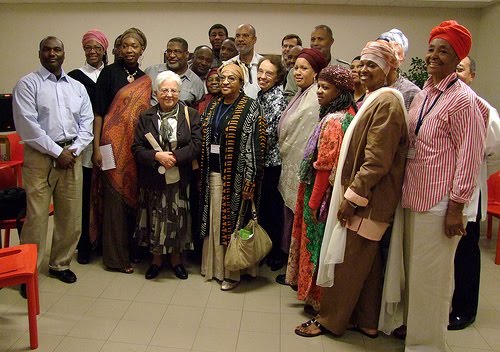 “I grew up in America where there has been a strong history of racism until now, but meeting the Focolare has helped me to realize that not all the whites and their European ancestors held the same hostility toward Afro-Americans. So it was a liberating experience for me, because I was living under the influence of this mentality and for the first time I had brothers of European descent. I learned from the Focolare that Jesus’s life consisted in showing mercy and compassion to others. I learned to live that way as a judge and to experience compassion. For me, being part of the Focolare community means giving the best proof of how to live the attributes of God as written in the Koran; that is, love, mercy and compassion.” Looking at the Movement’s mission ten years on from the death of Chiara Lubich, the judge from Indiana wishes that “the dialogue goes forward, because the Focolare’s model is one of the best models for encounter among people of different religions, ethnic groups or nationalities. In an atmosphere of strong nationalism such as we are living, where one’s own interests take priority over everything else, our experience is a counter-narrative because it shows that the word of God leads people to encounter one another and not to isolate themselves from each another – and this is an example not only for the faith and the religion: but it is an example of life that can serve our country.” Source: Città Nuova no.6., June 6, 2018
Know how to ask for help
Know how to ask for help

0 Comments