
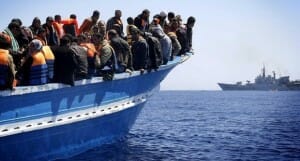
 “When it comes to migrations, the numbers say more than the words. In one report published in October 2014, it was estimated that there were 7,124,000,000 people in the world. If the wealth were equally distributed, every person would have a median annual income of 14 thousand USA dollars. In reality, the income of 2,700,000,000 people is two USA dollars per day. Now, this economic inequality, which is a social inequality, has a very strong impact on migration. Entire populations pick up and move toward wealthier countries.” What is a migrant? In 2013, the United Nations claimed that there were 232 million married people in the world. And it defined a migrant as “a person who leaves his or her own country for reasons of employment and settles in another place for a period of more than twelve months.” That’s the only definition that you find, Flavia Cerino stressed. In fact, there are the refugees (the ones who are in need of political asylum in another country); the refugees fleeing from war situations, the so-called “illegals” (who move without having a document that makes them eligible to enter another country). And the reasons vary: war, poverty, studies, cultural interest, natural disasters . . .
  What were the most repeated words in the reports from the workshops at the New Humanity international training course where this topic was discussed? A few things stood out in the workshops. “The first was “fear,” fear of anything that is different from me,” continued Cerino. In reality, diversity is a great enrichment. We see that in nature where biological diversity is very enriching. If we lost it we’d be heading for extinction. We obviously have to consider the fear that is born of uncertainty; and this brings us to the topic of public order, national security. One thing is public order, and another thing is fear of diversity. Another topic that was frequently raised was the family. A migrant who travels alone, leaving the family behind, finds it difficult to describe the hardships he or she faces, in order not to worry their loved ones. But actually it would be important to tell one’s family what the real life situation is like, so that they will have a real understanding of what migration entails also in terms of reuniting the family, since families generally look forward to staying together. Another word that came up was interculturalism. That is the capacity to overcome the fear of diversity in order to create an environment of encounter and understanding. And it’s not only cultural understanding, but existential understanding, sharing problems. The migrant should be placed in a position of giving, but he and she believe that they have nothing to give when they are not recognized as persons who can act as active citizens, and therefore they are excluded from the start.
 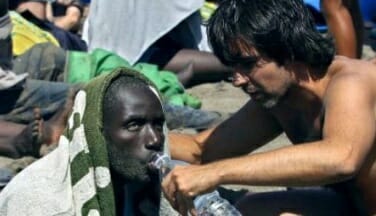 Flavia Cerino cited a question posed by Igino Giordani many years ago: “What do I do for him?, referring to an immigrant. “That’s the question we’re asking ourselves now. What do we do? There are countless experiences, great projects. My experience is the same as many of you. It turns on two elements: the first is that everything depends on a personal sensitivity. As a human being I feel called, and my and put into question right where I live, by a problem that I see in my next door neighbor. And I try to figure out what I should do, turning to the people and institutions who have the authority to act. Because it’s a matter of alleviating, making the presence of a migrant easier in my city. Actually, to the question of “What can I do?” we can answer by acting and doing what is within our power; so, getting together with others who share this desire, beginning with small gestures, we can weave together a network right where we are: simple gestures that generate a renewal of humanity right around us.” Source: “Reflections on migrations and interculturalism,” intervention during the New Humanity international training course (February 2015), coordinated by immigration expert Flavia Cerino. www.umanitanuova.org
Wanting to give
Wanting to give
0 Comments