
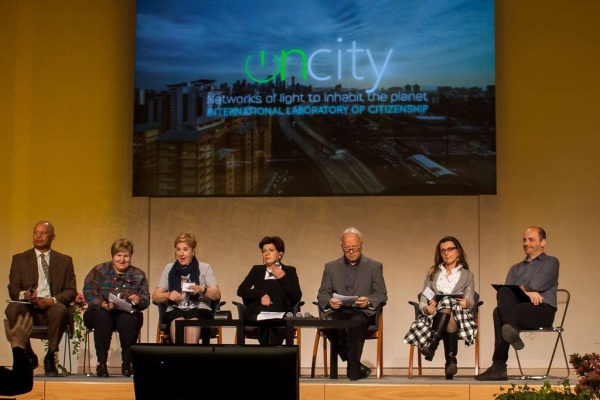
 Nasri studied in Milan (Italy), to then specialise in Urban Sciences in Venice. Upon returning to his homeland 20 years ago, he was introduced to the Focolare Movement. According to him, this meeting changed his life. He now has three daughters who are 17, 15 and 13 years old. We met him on the occasion of the international OnCity, on public heritage assets (Castel Gandolfo 1-3 April). What challenges do you have to face daily in your homeland? “I work in the constructions sector. For political reasons we have a hard time renewing the 1970 town planning schemes. To open a new road or modify a route, we need permits, but the Israeli military authorities refuse to issue them.” Is it really possible to “love your enemy?” “It is not easy to be a real Christian in Palestine. In this sector the real enemy is the Israeli military authority, not the Jews! I respect the Jewish religion because we are all brothers, sons of God. But how can I love an Israeli soldier who kills me? And destroys our cities? Who occupies our territory? How can I live Christianity? I tried to discuss this with other Christians. I understood that if we are unable to love, we can at least try not to hate, and slowly, love will come. I stuck the words “do not hate” in my mind and heart and started to live them in my world. They have often been of help, for example, in smiling at a soldier, especially at the check point, since unfortunately, we Palestinians cannot move around freely. We are surrounded, like in a prison. Once, a captain asked me why I had smiled at him, though I was a Palestinian Arab. I answered: Jesus said “we have to love everyone,” and I love you. He was impressed, and did not know what to say. He let me pass without checking me too much! Love exists, also in the heart of the Israeli occupiers as in the heart of every human being on earth. I do not blame them, because they are soldiers and have to obey orders. We leave the conflicts to the governments, and we as peoples can live together. But the youth find this difficult to accept, especially today where through the internet they see how the world is outside Palestine.” How do you manage with the Focolare Movement in the Holy Land? “I am a volunteer and active in the New Families. We promote activities in the various churches with the Christian Community in Bethlehem. I am a Greek-Orthodox and my wife is Catholic. We go to those in need: the elderly, abandoned children or the mentally ill who need to be loved. We try to do our best…” Are there Jews among those who are in contact with the Movement? “Many Jewish families are friends of ours. We hold meetings together. One of my daughters plays soccer. Through the Peres Center for Peace her team, along with the Israeli team, was invited by the Real Madrid. This was her first contact with Jewish peers, and it was a new experience. When she returned she said: «All the Jewish players are my friends.» We keep in touch also with many Muslim families: in Palestine, 99% are Muslim, and 1% is Christian. As members of the Focolare Movement, we have a very good relationship with the Muslims and also the Jews. This proves that it is possible to live together.” If you could give a m”ssage to the world, what do you desire most for your land? «Please remember us. There are Christian Palestinians who are suffering. We once formed 10% of the population, but the emigration of Christian Families has increased a lot. I fear that one day, there will not even be a Christian. Help us to solve this Palestinian problem. If peace is created in the Middle East, there will be peace for the whole world. We know what God’s will is, but we also need the will of human beings. It is a strategic point, rich in spirituality. We only need unity. If unity exists among these three religions, the Middle East would be in peace and be a model. This is the only message I want to give: let us live the words of Jesus to create peace and love, because we really need it.” Maria Chiara De Lorenzo
Be the first to love
Be the first to love
0 Comments