
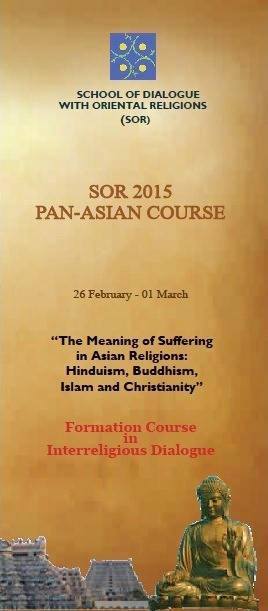
 SOR is the acronym for “School for Oriental Religions.” In his blog Roberto Catalano, co-director of the Focolare Movement’s Centre for Interreligious Dialogue wrote: “It was one of those ideas so typical of the brilliance of Chiara Lubich’s charism.»
Towards the end of her first trip to Asia in January 1982, the founder of the Focolare launched an idea which seemed almost like a dream. It entailed the startup in Tagaytay City in the Philippines, of a central reference point for the Focolare in Asia, with educational courses in which duly trained Catholics could open a dialogue with the faithful of other religions. Chiara Lubich had come from Japan where she had met Rev. Nikkyo Niwano, founder of the Rissho Kosei-kai, a Buddhist renewal movement, and had spoken before thousands of Buddhists about her Christian experience. The event had a strong impact not only on the Buddhists who had listened to a Catholic woman for the first time in their Sacred Hall in front of the giant statue of Buddha, but also on Chiara. Upon arriving in the Philippines, Asia’s only catholic country, she felt the need to launch the Focolare Movement in that continent, particularly to dialogue with the Buddhists, Muslims and Hindus. But she already saw the need to prepare herself adequately for a difficult task which should not undermine the religion of each one. After confiding her dream to some of the leaders of the Movement, a person offered a house that could host professors and small courses.
And thus the SOR was formed, which through these three decades, has carried out educational courses for Asian Christians on themes regarding the various religions. From 2009 onwards, with the spreading of religious tension and fundamentalism, they decided to deal with specific transversal themes: God in Asian traditions, the commandment of love, the role of the Sacred Scriptures, and this year, the role and meaning of suffering.
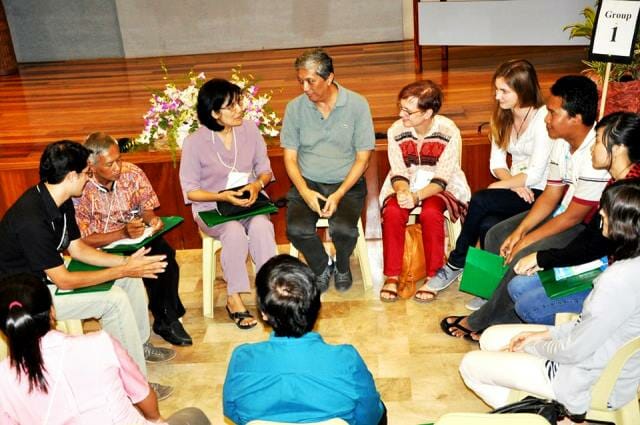 From 26th February to 1st March the Pace Citadel (Tagaytay) hosted about 300 people, mostly from the Philippines but with delegations also from Pakistan, India, Myanmar, Thailand, Vietnam, Hong Kong, Taiwan, Indonesia, Japan and Korea. The majority were mostly Catholics, but among them were three Buddhists, active members of the Focolare from Japan and Thailand. The theme was The meaning of suffering in the Asian religions: Hinduism, Buddhism, Islam and Christianity. The objective was to highlight the value and meaning that the respective religions give to pain in general, whether physical, spiritual, psychic, or caused by natural disasters.
The lecturers of the various sectors, in the presence of three bishops (Roberto Mallari, from S. José, Nueva Ecija, Philippines, Brenan Leahy, from Limerick, Ireland, and Felix Anthony Machado from Vasai, India) and an American professor, expert in Buddhism (Donald Mitchell of Purdue University) connected via skype. The school also offered the occasion to share experiences of dialogue in countries where Christians are but a minority as in India, Thailand, Japan, and Taiwan.
«I came to learn to dialogue with the other religions, but what I discovered is Christianity in its deepest sense, and at the same time its openness to all peoples and creeds.» concluded Catalano. Chiara understood the need to train Christians to dialogue in a continent that is a kaleidoscope of faiths, dialogue which does not diminish or level out, but where all have to be genuine and in meeting the others, discover their own roots.


0 Comments