
 “The principle of fraternity from a judge’s point of view – he said –can be applied under two aspects: it relates strongly to the interpretation of the norm, and also to concrete behaviour” “We are faced… everyday with the living reality of man. Before us there are no folders or papers but dramatic personal and family situations.” This was the statement by the President of the National Association of Magistrates, Dr. Ciro Riviezzo, during his greeting on Sunday 20 November, expressing his view of the judge’s work in the light of fraternity.
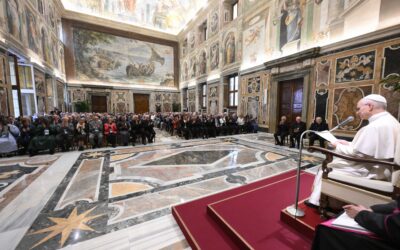
“The steps forward must be taken together and not in isolation”. This was the realization that emerged in the conclusions presented by the members of the central commission “Communion and Law”, presided over by the magistrate Giovanni Caso, ex judge of the Supreme Court of Cassation, to the 1st International Conference “Relationships in law: is there a place for fraternity?” The Conference was organized by “Communion and Law”, on 18-20 November 2005, in Castelgandolfo (Rome), and it provided the opportunity for a rich and lively exchange of reflections and experiences on the various areas in the field of Law. Fraternity and law. A proposal that has old roots. We find traces of it in Roman law, later developments in the Middle Ages – with the institution of the “fraternization” – and it finds its way into the famous “liberty, equality, fraternity” of the French Revolution, as Prof. Fausto Goria, of Turin University points out in his opening speech. Which fraternity? Chiara Lubich opens a wide horizon. The founder and president of the Focolare Movement says – in a message read at the beginning of the Conference: “Fraternity is inscribed in each man’s DNA, it constitutes every man’s ultimate vocation. It is part of God’s plan, which is the total fulfilment of man and humanity” and it can be accomplished by introducing the evangelical commandment of mutual love also in the juridical world.
 All different sectors in the world of law and justice were examined in this light
International law:it emerged that the principle of fraternity can inspire concrete models for action, and methods of analysis in the present process of growing interdependence among nations. Administrative law: in the relationship between public administration and citizens, this principle can become a catalyst to “accelerate” democratic participation, as Dr. Nino Gentile pointed out and as clearly shown by the transformation of a depressed area in Gela, Sicily, and the resolution of a serious conflict between farmers and mining companies in Perú. Private law: both the sectors of family law – with developments such as the introduction of new figures like the family mediator, who acts as a support for the family and helps resolve controversies -, and that of business law were dealt with. The latter showed how fraternity can moderate the profit motive and lead to the birth of companies ran on the principles of the Economy of communion. In criminal law, Prof. Adriana Cosseddu, of the University of Sassari, highlighted the fact that crime is considered today essentially as a violation of the law, rather than as an offence to the victim and an injury to the tissue of social relationships. That is why – she said – we cannot limit ourselves to “retributive justice”; what is needed is a justice that restores relationships – “restorative justice”. It is a new style of juridical action, which goes “beyond” what is “formally correct” without, however, straining procedures: situations that seemed to be at a dead end, find an unexpected way out to recovery. The bond of fraternity among the participants has created a network of relationships, which will continue its activity even at a distance, through the exchange of experiences, reflections, and cultural elaborations, working for a kind of justice which responds always more to the needs of humanity.


0 Comments