
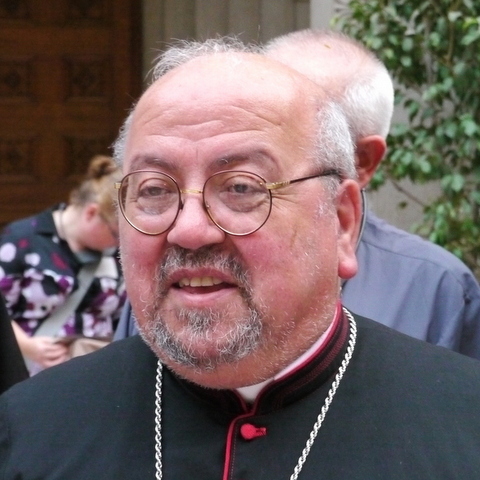
 It’s been six years since the beginning of the war in your country. What do you think have been the worst effects on society? Six years of war have shaken the very bulwark of Syrian society: the family, the basic cell that has absorbed the blows and the disgrace of this unending violence. The family was the safeguard of the country and of the Church up until 2014. But the insecurity, intolerance, violence and chaotic destruction have now completely uprooted more than two million families. Without houses and scattered all over the world, how could they have gone on under the weight of such a heavy Calvary? It was common at the beginning of the war – March 15, 2011 – to see the family gathered around a mother. The men go to war and often die. The saying now is: ‘An orphan without a father is not an orphan’. The family is left gathered around its mother who ensures the unity and the survival of the hearth. In the midst of this long and burdensome suffering these heroic mothers live in poverty and in tears. They have honoured their calling, living in tents and dying drowned. Is there any greater suffering? The destruction of the basic cell of society, and the youth? Can we count on them to look towards the future? The general mobilization that was decreed in October 2015 invited all men under the age of 45 to enter military service. It was a decision that also distressed other family members who couldn’t leave and had to stay where they were, waiting for a conclusion to this endless war. This age group that vanished had once comprised the backbone of economic activity that was still being carried out. Some reached the barracks and others chose to flee on the trail of illegal immigrants that is often irreversible. This destabilized the job market and the modest family life that found itself even more deprived of resources. What future is there for a community without young people? How has the war affected the Church? These things have weakened the Church. Families often decide to get up and go to their son who has left the country. Hence, you have the exodus of families resulting in the dizzying drop in the number of the faithful in parishes. There is the demographic imbalance: in the absence of young men, our young women who find themselves alone often marry Muslim polygamists. With fewer marriages, there are fewer baptisms. For the first time the Church finds itself facing another crucial problem as well: one in three priests in Damascus have decided to move to another more peaceful country. What can be done to keep priests in Damascus? What will come of the Church without priests? What do you think is the challenge and the hope of the Christians living in Syria today? The dead cities in the north of Syria are an unsettling photograph of what we could become. How are we to avoid becoming the guardians of brick and stone? It remains to the Christians of the East to reconsider their calling and to live along the lines of the small primitive Church that lived without protection or guarantee. Will we be capable of responding to this apostolic challenge? The Gospel encourages: ‘Fear not, little flock” (Lk 12:32).
A precious legacy: Chiara Lubich’s ‘Paradise ’49’
The first presentation of Chiara Lubich’s book ‘Paradise ’49’ took place on the 22nd of May 2026 in the Paul VI Hall at the Pontifical Lateran University in Rome. The book is a collection of writings in which the Foundress of the Focolare Movement bears witness to and shares her mystical experience from the years 1949 to 1951.

0 Comments