
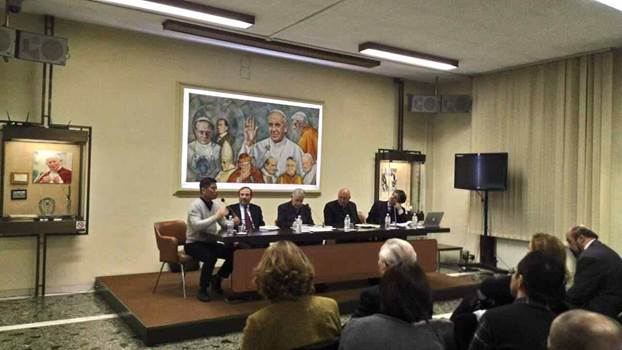
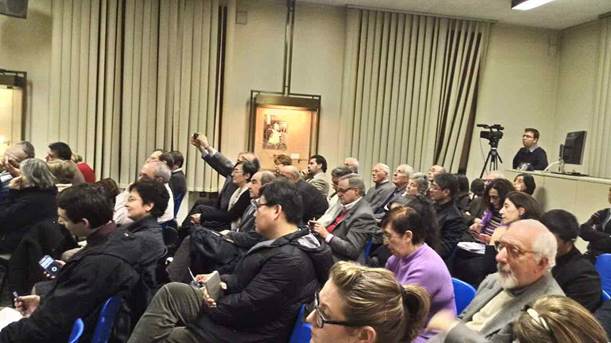
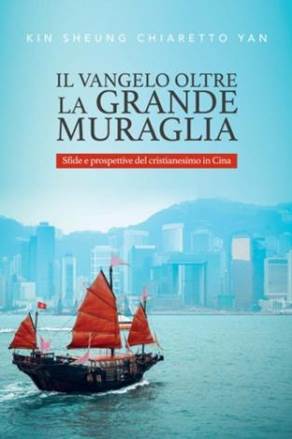
 Last 8 January, the presentation of the Italian edition of the book by the Chinese scholar who has worked on this topic for years and is now terminating his Research Doctorate program at the SUI, could not go unobserved due to the location of the presentation – the Vatican Radio Headquarters in Rome. The speeches of the guests aroused great interest and among the guests were: Claudio Maria Celli, President of the Pontifical Council for Social Communications, Fr. Federico Lombardi, the Press Office Director of the Holy See, and of the Vatican Radio, Agostino Giovagnoli, the historian, and Gianni Valente, Vatican expert. But what especially was underlined in the numerous articles released subsequently in the media and network was the theme on the development of Christianity in China, and Chiaretto Yan’s vision in the book, “The Gospel Beyond the Great Wall. Challenges and perspectives of Christianity in China” (Emi 2015), which interpreted the progress of the relationships with the Holy See in the light of fidelity and openness to dialogue. This interpretation was also confirmed by Fr. Lombardi in recalling some very significant expressions of Pope Francis, who publicly stressed on several occasions “his desire to go to China,” saying that “we can freely say that dialogue is being pursued with the authorities” to find solutions to issues that are still open, and that “there is a great desire to make progress.”
  A substantial continuity of perspectives is evident in the actions of the last three Popes, from John Paul II to Francis. Among the cues offered by Bishop Celli was an episode he personally experienced, which conveys more than the many affirmations on the deep attention and participation with which John Paul II had always supported the life of Christians in China. “He was already confined to the wheelchair when he said to me: ‘Do you think I will be able to go to China?” Bishop Celli further affirmed that “Dialogue is not easy – but the pathway is absolutely that of going ahead.” The historian, Agostino Giovagnoli, underlined “the novelty in continuity” consisting in the more liberal approach of Francis in speaking about China. “The Chinese perceive his determination in wanting to change the relationships between China and the Holy See – he observed. This is a source of security that sweeps away the uncertainties of the past.” Also the journalist, Gianni Valente listed a series of recent openings.
  Chiaretto Yan’s study highlights the transition of various phases, which along with unforeseeable and at times dramatic hitches, reopened old wounds, but also evidenced a progressive slackening of the tensions and the perception of dialogue that is maturing also because of the better means of direct communication after the blackout that had marked the years of persecution. Over the last 20 years, the most felt request has been that of putting an end to the gaps between the various ecclesial communities, in the name of a “sole Church and more communities.” Dating back to 2007 is Benedict XVI’s historical letter to the Chinese Catholics, a top magisterial declaration that requested to end the internal and external conflicts to enhance dialogue. Pope Francis’s full recognition of this document again confirms the intent to pursue this path. “The Challenge the Church is facing – concluded Chiaretto Yan in answering a journalist’s question – remains the same: testifying to unity while remaining distinct. This perspective may also mean giving support to the life of various ecclesial communities within the same solid experience of communion.” Source: www.iu-sophia.org
Peace starts within our hearts
Peace starts within our hearts

0 Comments