
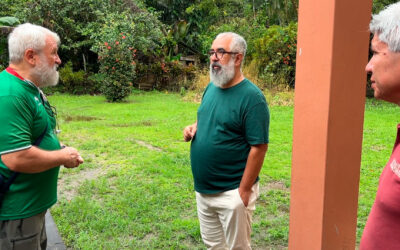
 On 6 March the Revd John Mann, Dean of St Anne’s Cathedral in Belfast, the heart of the Church of Ireland, visited the Centre of the Focolare Movement in Rocca di Papa, near Rome.
In June 2012 Maria Voce, President of the Focolare Movement, went to Ireland for the International Eucharistic Congress. On that occasion, accepting an invitation from the Revd John Mann, she went to Northern Ireland and to Belfast for an ecumenical meeting. It was a historic day, one of great intensity and, also, a day of bright sunshine. The leaders of the four largest churches in the area made a solemn pact of mutual love with one another.
At Rocca di Papa it was raining, a chilly and windy day that felt like a constant spur to renewal. This weather had been dogging the Revd John Mann’s steps for the several days around Italy. We interviewed him in relation to his meeting with Maria Voce.
Revd Mr Mann, what made you come to Italy and, in particular, to the Focolare Centre?
‘When Maria Voce came to Northern Ireland in 2012, it was a fundamental moment for our community, I would say for the whole of our Church. It was on that occasion that Maria Voce invited me to Rome. This visit was necessary to get to know better people who have a special place in our hearts and who live, work, pray and are involved with us.’
 In the light of your contacts with the Focolare Movement, do you think that the charism of unity can give a particular contribution to the Church of Ireland today?
‘I think we can learn a great deal from the spirituality of communion, which is a foretaste of the unity we are all working for. I strongly believe that the figure of Jesus Forsaken in a special way can be a help for us. He died on the cross to redeem us all, to unite us all. I think that in this particular point of the spirituality, many in Northern Ireland can recognize precisely what they are living. Understanding this mystery always more deeply, we could find together a way of reconciliation, of building unity.’
What would you wish for the Movement in this particular moment of history?
I hope the Focolare Movement can continue to live its spirituality fully, in all its expressions, offering it to all, so that it can contribute to creating that atmosphere of trust and unity we need so much, also in our country.
Article by Paolo Balduzzi and Centro Uno


0 Comments