28 Jun 2011 | Focolare Worldwide
“Politics is made for the people – not people for politics. It is a means, not an end. First there should be morals, the person, the collective and then the party, tabling of questions and the theory of governing. Politics – in the most dignified Christian sense – is a servant, and should never become the master: it shouldn’t be the abuser, nor dominate or be dogmatic. Here lies its purpose and dignity: to be of social service, charity in action: the first form of national charity. […] Newspapers spread disrespect for politics and the political parties. We know about this from what they say and from reading what the write about us. To many it seems that politics is a base activity, confusing, leaving us to cope: and they don’t understand that if politics drifts away from honest people, it will be invaded by dishonest people: politics draws to itself all of our life, both physical and moral. Politics with dishonest leaders is drawn to war, financial instability, to the ruin of public and private wealth, to depravity, disprespect for religion, family breakdown…. If politics is dirty, then, it should be cleaned up, not deserted. […] In wheeling and dealing, a consequence of the deals made on human dignity, we cannot be free unless each one of us regains an awareness of their own self worth – their own immense value – those in politics, should decide not to allow themselves either to be pushed or lead, but to work with their own head, with their personality, defend their moral reasoning. Defending these, then, defending also their professional reasoning, reasoning on taxation: as excessive taxation results in no longer seeing people who need help but simply milking the system. Those who are to be in politics are there for the citizens, not as slaves. From such a position democracy is born. The awareness of ones own values can turn into pride, and therefore twist into antisocial attitudes of exploitation and domination: it can turn upside down. Amongst those values, above all, there is the call to be charitable, and the desire to fulfill is in service to one’s brother. Without this, every value is worthless, every victory turns into slavery: its a waste of time.” Igino Giordani From: The Moral Revolution, 1945 www.iginogiordani.info
![Algeria: Learning to live together]()
25 Jun 2011 | Focolare Worldwide, Senza categoria
 Six days, in beautiful Tlemcen, Capital of Islamic Culture 2011, helped to make the discovery that it is possible to live in harmony and unity with a group of believers of different religions. In an atomsphere of unity lived amongst they came from Europe and the Middle East and met from 2nd – 7th June 2011 with the Algerian community of the Focolare Movement who have been living the spirit of unity for more than 45 years. Both the recorded talks of Chiara Lubich shown and the live contributions from the various experts present at the meeting clarified and answered many questions on how to live according to the charism of Chiara Lubich. A variety of experiences followed which enriched group discussions where participants spoke with great freedom and openess and felt even more part of the big Focolare family. The programme also included a visit to the city of Tlemcen and Orano, allowing the possibility of discovering their unique cultural and religious patrimony that they hold. One comment from the many, at the end of the meeting: “This is just the beginning of a new step in our life towards an ever deeper unity.”
![Algeria: Learning to live together]()
23 Jun 2011 | Non categorizzato
 To be “the builders of new cities” was the wish of Maria Voce, President of the Focolare, for the 20th of June encounter, in Naples, commemorating the birth of the Political Movement for Unity (PMU). “In the present context of the general disenchantment of the citizenry concerning public institutions,” stated Maria Voce in her message, the achievements offered by the PMU – small perhaps, but significant – “make us hope in the season of “new politics” made of dialogue and mutual acceptance. The roots: May 2, 1996, in Naples, Italy. A group of politicians posed a question to Chiara Lubich: How is it possible for those who are active in different parties on opposite sides of the aisle, to live out the fraternity which she proposes, in the field of politics?”. In her answer, she called for new determination, for unity around shared core values must come before the legitimate affiliation to a political party, and the common good can only be reached with the contribution of all. The PMU was born from these basic ideas, which were also wholeheartedly supported by the politicians in attendance. Fifteen years later on 20 June 2011, a conference entitled: “Brotherhood: A Challenge for Politics” was held at the public auditorium of the Regional Council for the purpose of acknowledging the entrance of Chiara Lubich’s charism in civil history. More than 150 attended – among them parliamentarians and administrators from other regions as well. The first presentation was given by Eli Folonari who spent fifty years at Chiara’s side and is now director of the Chiara Lubich Centre. She offered her listeners an outline that traced the excursus of this journey: from interpersonal love to a social love for the commonwealth. Today, the PMU operates in every region of Italy, various European nations, Latin America, and Asia. The various experiences that develop over the years converge in the spirituality of unity, beginning with the paradigm offered by Igino Giordani. The basic lines of the PMU were presented by Marco Fatuzzo, president of the International Centre, beginning with the definition offered by Chiara herself: “an international laboratory of common political work, between government officials, scholars, and politicians at various levels, from different party lines, who place fraternity at the basis of their life.” Within this same framework, some significant examples were offered: the laboratory of dialogue and policy design that is animated by the PMU in some of the parliaments of various countries – in Italy, for example, Brazil, Argentina, and South Korea – the international network of political training schools, in which youths can experience a politics of communion. Cities have also joined the network: “To date, more than 100 have joined the “City for Fraternity Association,” said the mayor of Rocca di Papa, Italy, Pasquale Boccia, who is also the association’s current president. And why not the Regions? It was truly emblematic, therefore, that in the context of a more inclusive vision of Italy, just at the conclusion of the conference, the president of the Regional Council of Campania, Italy, Paolo Romano, announced the unanimous membership of the assembly in the City for Fraternity Association, signing the memorandum of understanding. Published by the Movement for Unity in Politics
![Algeria: Learning to live together]()
22 Jun 2011 | Non categorizzato
 A sports coach from Saxony, East Germany describes how a long friendship with a Catholic priest began, in spite of the fact that the coach had no religious faith. “After the revolution of 1989 in the German Democratic Republic (GDR) sport club membership was no longer free due to cuts in subsidies, and many young people went over to neo-Nazi environments. And nobody did anything. In desperation I even approached a Catholic priest with whom I had never had anything to do before, to complain to him: Why doesn’t the Church do something?” Change of scene. An ex-officer in the people’s army and professor at the superior institute of state security – the GDR secret service – attended his 50th high school reunion where he met a classmate who had chosen a different path. His friend was now a priest. But their differing paths were not an obastacle to their being friends; indeed, it helped. During the final years of the German Democratic Republic (DDR) the professor had begun some research and for this reason was removed from his work post. His conception of socialist society was not compatible with the interests of the power system. Like others, these two characters – the coach and the professor from state security – have found a new perspective in the gatherings of the Focolare Movement. So it was that last May they attended meetings between Christians and people without a religious reference, at the Mariapolis Centre in Zwochau near Leipzig (5 – 9 May 2011).

The Mariapolis Centre in Zwochau
![Algeria: Learning to live together]()
20 Jun 2011 | Focolare Worldwide
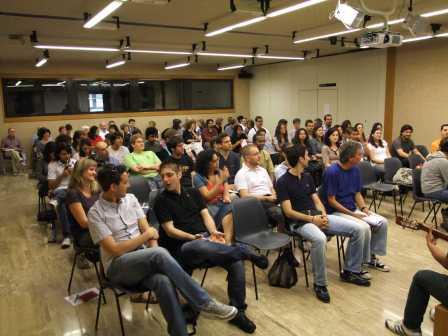 On the weekend of 18 and 19 June almost 100 young and less young people got together in the Mariapolis Centre, Castelgandolfo (Rome) to establish the main points of the event. This planning group working came from a wide range of nations including: Brasil, the Philipinnes, China and Madagascar. The wonderful cultural mix enabled the content of the programme to have a truly ‘global’ vision, reaching beyond the boundaries of the performance arena: in fact the idea and suggestion from the youth in Hungary was to involve the whole city, having events in the streets, squares and above all, given their significance for the Hungarian capital – the bridges of Budapest. The basic plan for the remaining preparation is not just to work out the detail but to also involve other young people and get ready for an event that won’t be an end in itself but, be the culmination of a journey in mutual love that doesn’t end there: that work now needs to start in each nation. As we don’t want to spoil the surprise we won’t divulge any more details, the note to put in your diary reads: Youth for a United World hope to see you in Budapest from 31st august to 2nd September 2012. http://giovaniperunmondounito.blogspot.com/ [nggallery id=55]
