![Igino Giordani: From Montecitorio to the World]()
16 Jun 2011 | Non categorizzato
 “Politics is made for the people, not the people for politics. It is a means, not an end. Morality first, the human person first, collectivity first – then the party, then the tables of the programme, then the theories of governing.” With these words of Giordani, The Hon. Gianfranco Fini, President of of the Italian House of Parliament, opened the meeting dedicated to the popular deputy, who knew so well the difficult times of Fascist persecution, the atrocity of war, the uncertainty of reconstruction.
 The gathering took place in Lupa Hall, on the 14th of June, in the presence of two-hundred people. Fini focused on three cornerstones of Giordani’s actions in politics: the dignity of the human person, liberty, and work. Battles he led that at times anticipated the times, and at a great risk of being misunderstood as in the case of the conscientious objector law. the President of the House also recalled one of his personal battles that came to nothing: the request that the European Parliament would not refuse to acknowledge the role of Christianity in Europe’s roots. Political defeat and misunderstanding have a bitter taste, of course, but Giordani, at critical moments in Parliament’s history, amid the screams and strong ideological contrasts, managed to make reason prevail, humanism, and a Christian spirit that even convinced the Marxists. Alberto Lo Presti, director of the Igino Giordani Centre described Giordani during various phases of his life, offering a picture of the man through short film clips.
“From Montecitorio to the World” was the title chosen for the moment of remembrance, expressing the universality of Giordani’s message, but also the singularity of a particular encounter which happened precisely at Montecitorio, one which literally overturned his life, making him no longer recognizable even by the members of his own party.
 The particulars of this encounter with Chiara Lubich, founder of the Focolare Movement, who transmitted to Giordani the passion for unity and for the Gospel which enters into history and resolves even the most complex problems of society, were described by Maria Voce, the current president of the Focolare Movement. “(Chiara) drew God near: she made feel that he was Father, Brother, Friend, present to humankind,” Maria Voce quotes. And this explains to us the political vision of Chiara Lubich, focused on the principle of fraternity which “allows one to understand and make ones’ own the viewpoint of the other, so that no interest and no human need is alien to me. There is need of a pact of fraternity for Italy.” This is the hope of the president of the Focolare, “because the good of the country requires the efforts of all.”
The legacy of Lubich and Giordani, which has been embraced by the Movement for Unity in Politics proposes to parliamentarians, politicians, administrators, political officials, and scholars from around the world to describe the principle of fraternity within the framework of political action. How to apply it in practical terms has been shown by two Italian parliaments, of opposing political parties that have accepted the challenge.
Giacomo Santini, Senator of the Popolo della Libertà, admits the difficulty in “considering the person on the other side of the aisle as your brother when he has just insulted you a few minutes before, as Lubich provocatively invites you to do.” However, it is possible and Giordani showed it by remaining in the political trenches, amid contrasting ideologies, but with respect for diversity. Letizia De Torre, a deputy of the Democratic Party recalls a Giordani who was “secure in his convictions, but not entrenched; able to see the positive, capable of dialogue” For De Torre, gathering his legacy now means “rebuilding a democracy of the community and not of the fifty-per-cent-plus-one, a democracy of reciprocity within Parliament and in the country.”

 The word then went to students of participating schools from the world which are animated by the Movement for Unity in Politics. They open horizons of hope and renewal, starting from situations of extreme crisis such as in Argentina. Carlos, from Italy, to do a specialization in labor law says that during the crisis of 2000, when his country was bankrupt, the decision to invest in education policy seemed utopian, and certainly not conclusive for the daily dramas. Today it has yielded 200 local administrators who, from the perspective of fraternity are trying to respond to their country’s problems; meanwhile schools have multiplied to the Tierra del Fuego.
In Brazil, the denunciation of oppressive social inequalities and poverty has not been deemed sufficient by Daniel, a journalist who is studying for a Master in Political Science at Sophia University Institute in Loppiano. A return to the logic of service, of forming consciences to the common good, bending down to meet the problems of the country were the guiding force for his own choice of commitment which he gleaned from the experience of the Political Movement for Unity and the thought of Giordani, who, from the small hall in Montecitorio, in a way he may never have imagined, is now a teacher of life and commitment for the whole world.
15 Jun 2011 | Focolare Worldwide
Here is what Silvano Lancerotto said during his closing remarks at a gathering in April 2011,promoted by the Focolare’s centre for dialogue with persons of non-religious convictions. «My grandfather was with one of his small sons at a strike by agriculture workers in the countryside of Bassa Veneto, northern Italy, in the early twenties. While standing under a big oak tree that still exists, he was killed by a bullet shot by a fierce landowner. My grandmother Maria, whom they called “curly”, now found herself alone to care for seven children in extreme poverty. She went through a long period of suffering and sacrifice, but managed to never convey to her children any sentiments of revenge. At the end of the First World War, one of her sons, my uncle Libero was moved by the spirit of revenge which had built up in him during all those years of suffering. He searched for his father’s murderer and one day found him. But he took pity on the man when he saw how is family was poor and in disarray. He spared his life and went away. As I now try to imagine that decision made under such unique circumstances, and such a long time ago, I find myself transferring it from the personal choice of an individual person to the choices made by states and politics concerning certain conflict situations today: the Middle East, the Far East, Africa, etc. It would certainly be a big step forward if my uncle’s choice, a choice that grew and matured in his human conscience, were to be practiced by the collective conscience of society today.» Lancerotto goes on to say that this “small story” points in the same direction as Chiara Lubich’s message. “It’s a message,” he says, “ that acts on consciences, looks to the transformation of society, beginning with the transformation of individuals. I share the path she showed to us when she said that dialogue requires each one of us – individuals, movements and states – to give up something in order to see, to read and, above all, to listen to the complexity and the plurality of values found in the modern world, in order enter into relationship with them, to discover their merit, to work for common projects while respecting the legitimate diversity that motivates each one.”
![Igino Giordani: From Montecitorio to the World]()
15 Jun 2011 | Focolare Worldwide

Video recordings of the meeting (WebTV Parliament House) – Italian only
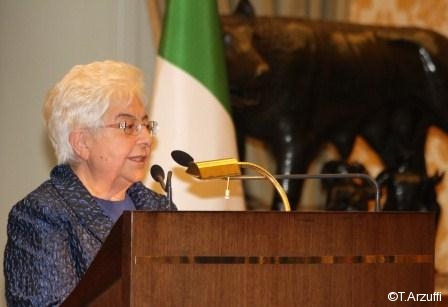 The meeting on 14f June 1011, in memory of Igino Giordani (1884-1980), was sponsored by the President of the House. Giordani was remembered as a multi-faceted personality of the twentieth century, deputy of the Italian Parliament from 1946 to 1953, writer, journalist, ecumenist and patrologist. Igino Giordani left a deep imprint and opened prophetic perspectives at cultural, political, ecclesial, and social levels. President of the Chamber, Gianfranco Fini, presided over the proceedings. Among the presentations, Alberto Lo Presti, Director of the Igino Giordani Centre presented Giordani the politician and his actions in Parliament. Parliamentarians, young people, Italians and people from other lands spoke of how they have been influenced by Giordani’s thought and actions. Below is the full text of the speech presented by Maria Voce.
“I thank the Honourable President of the Chamber of Deputies, Gianfranco Fini, for having given me the opportunity of addressing a greeting to this gathering in honour of Igino Giordani, who is one of the founding fathers of the Republic and whom we consider one of the co-founders of the Focolare Movement which I represent before you today.
I extend personal greetings to the Honourable Senators and Deputies, to all the authorities, and to everyone present here today.
It was on 17 September of 1948 when, right here in the Chamber of Deputies, Igino Giordani met Chiara Lubich for the first time. She was a young woman of twenty-eight years, visiting from Trent, and accompanied by a group of consecrated religious.
For Giordani the meeting was as extraordinary as it was surprising. From that moment he was no longer the same. What did Chiara Lubich say, what words did she use to get so deep into the soul of the eclectic politician of those times. Something of it we know. In fact, at the end of their conversation, the Hon. Giordani, very impressed by what he had heard, invited Chiara to write down what she said so that it could be published in a magazine that he directed. The following month the article was published, which begins with the story of how the ideal of unity was born beneath falling bombs:
‘It was wartime. Everything was crumbling before the eyes of us young women, who were attached to our future dreams: a house, an education, loved ones, a career. […] From the complete destruction of that war, our Ideal was born. It seemed that there was only one true ideal that was true and everlasting: God.
Surrounded by the destruction caused by so much hate, God suddenly appeared to our minds as the one who doesn’t die.
And we saw and loved him in his true essence: God is love.’
‘It was wartime. . . ‘. Igino Giordani could claim to be a true expert on the subject. He had firsthand experience, in the trenches of World War I. He saw the atrocities, the massacres, and he was also seriously wounded. He was convinced of the absurdity of armed conflict and he gained a name for himself in Italian culture as a defender of peace.
But Chiara’s words did not have the horror of the war as their theme. Chiara spoke of how, years before, in the bombed-out city of Trent, in the midst of ruin, she caught sight of an indestructible ideal: God. He revealed himself to her eyes not as a last hope, a remote desire, but as love flowing among all things, a fire to be guarded and preserved and increased by mutual love, a love capable of bringing about the promise of Jesus: “For where two or more are gathered together in my name, there am I in the midst of them” (Mt. 18:20).
It is not difficult to understand why the Hon. Giordani was so awestruck. A living Gospel was revealing itself to him before his very eyes. The Jesus whom Chiara was showing to him, was entering into human history as love, and was guiding the human family toward universal brotherhood, toward unity. Recalling that encounter in his autobiography, Giordani reveals what his sentiments:
When she finished talking, I was caught in an enchanting atmosphere […]; and I would have desired that voice to continue speaking. It was the voice that, without realizing it, I had always been waiting to hear.
It placed holiness within the reach of everyone: it took away the grates that separated the world of the laity from the mystical life. […]
It drew God near: it made you feel him as Father, Brother, Friend, closely present to the human family.
It was clear to Chiara and her first companions that an ideal as vast as unity would have to embrace the whole world. But how could a small group of such young women ever reach all of humankind? Perhaps Giordani asked himself the same question! Today we know for sure, because Chiara herself said that this first encounter with Igino Giordani was a first like a first contact with humanity at large.
Chiara Lubich’s ideal of unity was for everyone and every human reality, and Giordani gives witness to this.
Now the plot of that plan is more visible. The Focolare Movement is present in over 180 countries worldwide, and has more than two million members and supporters from the most diverse social and cultural backgrounds.
I have just returned from a visit to Eastern Europe where the Focolare community has been present since 1961 when the first group of members, armed only with mutual love and love for all, crossed the iron curtain.
Their silent work for so many years, has led to the overcoming of ideological barriers, and supported the effort to rebuild that oppressed society. Today it brings a soul to many social projects for the common good.
Last May in Brazil, a world Assembly of the Economy of Communion was held twenty years after that prophetic intuition that Chiara had when, arriving in San Paolo in 1991, flying over the city, she saw the skyscrapers and the ‘crown of thorns’ of the favelas that surrounded the walthy metropolis. She felt the urge to do something to change the system of development, to search for a new way that was neither capitalism nor communism.
The many projects that the Focolare Movement finds itself committed to in all corners of the world and in all fields of human activity were in a sense prophetically present in that first encounter between Chiara Lubich and Igino Giordani when they met here at Montecitorio. Since then the Movement has also placed itself at the service of politics. In those years, it attracted many deputies and senators – some of which have been mentioned in the previous video – and the choices they made were courageous.
Today this is still the proposal of the Political Movement for Unity, founded by Chiara Lubich in 1996, together with some politicians and members at various institutional levels – Korea, Argentina and in other nations – of local administrators, officials, political scholars, and many young people involved through the involvement of schools.
It is animated by a love that guides political choices, actions, laws, diplomatic moves; offering a glimpse of a new way of doing things for administrative, legislative and international bodies.
It is inspired by the principle of fraternity, a cardinal principle of modern political thought. As we know, it was the basis of some of the most important political projects in modern and contemporary history: from the French Revolution (think of the triptych liberté egalité fraternité) to the founding of Utopian socialism, from Marxism to Patriotic nationalism. However, it was interpreted not in an inclusive sense, but in an exclusive one. Fraternity was considered to be a relationship of value which regarded someone (a social class, an economic class, a people) in an antagonistic relationship with someone else.
Thus, it is a political principle still little explored in its universal dimensions, and this is what the Political Movement for Unity intends to do: to explore the principle of universal brotherhood so that politics may find in it a new basis that will raise it to the level of the modern times, capable of fulfilling its role as a builder of peace, justice, and freedom, for the entire human community. Fraternity also sheds light on the ultimate goal of politics, which is establishing peace that leads to the unity of the whole human family: unity in the smallest political community as in the entire international forum. Thus, the principle of fraternity finds its measure in “loving the homeland of others as one’s own”, an expression coined by Chiara Lubich that from the earliest times has signified universality. It is capable of expressing the vocation of politics as love toward all without distinction, because every person and every social entity is a “candidate for unity” with everyone else, and every nation is called to contribute to a more united world.
By recalling today, in this prestigious Seat of the Italian Parliament, some of the lines being taken by the Political Movement for Unity, we once again realize the great actuality of another invitation given to us by Chiara, precisely to the Italian parliamentarians in December 2000 at San Macuto. An invitation which makes a paradox seem possible: to establish a pact between parties – beyond all differences – a pact of brotherhood for Italy, because the good of the country will require the efforts of all.
“Fraternity offers amazing possibilities,” Chiara goes on to tell the MPs. “It allows one to understand and make another’s viewpoint our own, so that no interest, no human need remains foreign to us. […] It allows you to hold together and enhance human experiences that might otherwise develop into intractable conflicts, like the still-open wounds of the Southern Hemisphere and the legitimate demands of the new Northern Hemisphere; […] Moreover, it allows new principles to operate within the daily work of politics, so that no one is ever governed against, and you never act as an expression of only a part of the country.”
That encounter between Chiara Lubich and Igino Giordani led to these and many other things in the fields of society and politics. Giordani, a deputy who on that day at Montecitorio accepted the invitation to widen his soul and his field of action for the unity of our land and beyond. May this meeting today urge us on in strengthening a common desire among all to work for the unity of our land and beyond. Thank you.”
Maria Voce
[nggallery id=52]
14 Jun 2011 | Focolare Worldwide
Montet, in the French-speaking Switzerland, is one of the Focolare Little towns, where youth from all over the world spend a period of their life, studying and deepening their knowledge of the spirituality of unity. The symposium in Geneva represented an important step in the study of the Social Doctrine of the Church, offering to all young participants a wide perspective on the nature and role of Non-governmental Organizations. The seminar was introduced by the president of New Humanity, Franco Pizzorno, who sketched its motivations, and all the practical initiatives of the different branches of the Movement, that work for families, youth, economics, politics, and international cooperation. Mons. Silvano Tomasi, permanent observer of the Holy See at the United Nations in Geneva, presented a wide and well-documented account on the constant committment of the Catholic Church for the defense of all fundamental human rights. Dr. Ricardo Espinosa, coordinator of all the NGOs accredited at the UN, underlined the contribution in terms of critical conscience, that civil society organizations can give in the relationship with institutions, whereas Dr. Shyami Pumanasinghe, a UN official, explained the work done in order to finalize the Declaration on the Right to Development and Solidarity. Impressive the speech by Alfred Fernandez, director of OIDEL (International Organization for the Right to Education and Freedom of Education), who summarized the main features of the NGOs, pointing out how trust relations with institutions are fundamental, in order to be both recognized and listened to partners. Alessandra Aula from BICE (International Catholic Child Bureau) gave evidence of the committment of the NGOs for the defense of human rights. All the speeches took place in an atmosphere of particular harmony among speakers and audience, also thanks to the effective and all-involving coordination run by Jorge Ferreira, representative of New Humanity in Geneva. In a lively and much-appreciated dialogue, every single participant had the opportunity to open a privileged point of view on the wide themes of Human Rights, rediscovering the important contribution in terms of values and experiences, which the civil society, also through the NGOs, can bring in the international discussion on the main themes on the civil living together.

 “Politics is made for the people, not the people for politics. It is a means, not an end. Morality first, the human person first, collectivity first – then the party, then the tables of the programme, then the theories of governing.” With these words of Giordani, The Hon. Gianfranco Fini, President of of the Italian House of Parliament, opened the meeting dedicated to the popular deputy, who knew so well the difficult times of Fascist persecution, the atrocity of war, the uncertainty of reconstruction.
 The gathering took place in Lupa Hall, on the 14th of June, in the presence of two-hundred people. Fini focused on three cornerstones of Giordani’s actions in politics: the dignity of the human person, liberty, and work. Battles he led that at times anticipated the times, and at a great risk of being misunderstood as in the case of the conscientious objector law. the President of the House also recalled one of his personal battles that came to nothing: the request that the European Parliament would not refuse to acknowledge the role of Christianity in Europe’s roots. Political defeat and misunderstanding have a bitter taste, of course, but Giordani, at critical moments in Parliament’s history, amid the screams and strong ideological contrasts, managed to make reason prevail, humanism, and a Christian spirit that even convinced the Marxists. Alberto Lo Presti, director of the Igino Giordani Centre described Giordani during various phases of his life, offering a picture of the man through short film clips.
 The particulars of this encounter with Chiara Lubich, founder of the Focolare Movement, who transmitted to Giordani the passion for unity and for the Gospel which enters into history and resolves even the most complex problems of society, were described by Maria Voce, the current president of the Focolare Movement. “(Chiara) drew God near: she made feel that he was Father, Brother, Friend, present to humankind,” Maria Voce quotes. And this explains to us the political vision of Chiara Lubich, focused on the principle of fraternity which “allows one to understand and make ones’ own the viewpoint of the other, so that no interest and no human need is alien to me. There is need of a pact of fraternity for Italy.” This is the hope of the president of the Focolare, “because the good of the country requires the efforts of all.”
 The word then went to students of participating schools from the world which are animated by the Movement for Unity in Politics. They open horizons of hope and renewal, starting from situations of extreme crisis such as in Argentina. Carlos, from Italy, to do a specialization in labor law says that during the crisis of 2000, when his country was bankrupt, the decision to invest in education policy seemed utopian, and certainly not conclusive for the daily dramas. Today it has yielded 200 local administrators who, from the perspective of fraternity are trying to respond to their country’s problems; meanwhile schools have multiplied to the Tierra del Fuego.


