Hungary, a combination of cordiality and nobilty

(from right) Tanino with the first Hungarian focolarini

Grazia Passa, the first focolarina to go to Hungary

One of the first Mariapolis gatherings in the late '70s

(from right) Tanino with the first Hungarian focolarini
Grazia Passa, the first focolarina to go to Hungary
One of the first Mariapolis gatherings in the late '70s

Rome 1962. (from left) Pasquale Foresi, Igino Giordani, Canon Bernard Pawley and Mrs Margaret Pawley, Chiara Lubich, Eli Folonari

Chiara Lubich, Gabri Fallacara, Frère Roger Schutz (1978).

Istanbul, 2010. Participants of the 18th School of Ecumenism promoted by Centro “Uno” were received at the Fanar by Patriarch Bartholomew I.
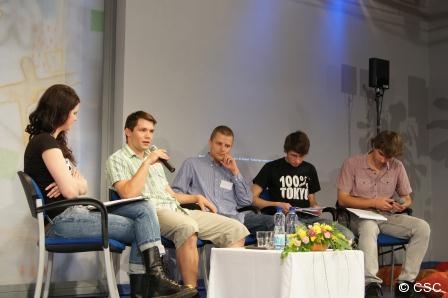 “In 2007 I was diagnosed with leukemia. At first it I reacted well to the news, but in a second moment I was fearful of dying. The support I received from the youth of the Movement, the Gen, which was expressed in so many ways, through sms, emails, and visits was important. During the third cycle of chemotherapy, there was a girl in the hospital with me who had just become a mother. Her condition was worse than mine, she was neither married nor baptized. Nevertheless we spoke about God, about faith, and matrimony. Athough an attempted transplant had failed to help her overcome the disease, just before her health began to deteriorate, she had expressed the desire to marry. So, when she was already dying, I proposed to her family that she receive baptism. A priest came to the hospital and she was baptized “Margherita Maria”. A few days later she died on the feastday of Saint Margherita Maria Alacoque.”
 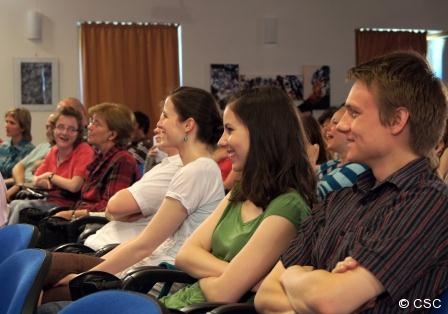 The day-long meeting began with this strong testimony given by Agnieska and it continued with experiences from daily life offered by the young protagonists of the Movement at the Mariapolis Centre. “Traveling the Road Together” was the title given to the day which, as the organisers tell us, was meant to offer an inside look into the “exceptional life of the ideal we believe in”. “To tell the truth, I was sceptical at first,” confesses Lukas, “I thought that there would be fifty young people at most, but that’s not what happened. Evidently the ideal of unity does have something to say.” The hall was barely able to hold the 150 youths who showed up from different regions of the Czech Republic. For most of them it was their first encounter with the Focolare Movement and they were not bashful about expressing their happiness at having found something so great. “I learnt about the Focolare from a friend and I didn’t know what to expect,” says 17 year old Kristina, “but it really surprised me a lot because of the great love you feel from the persons who talk here. I must say that I strongly felt the presence of God. This really moved me, because my father is not a believer and I felt very bad that he didn’t get to know this movement.”
 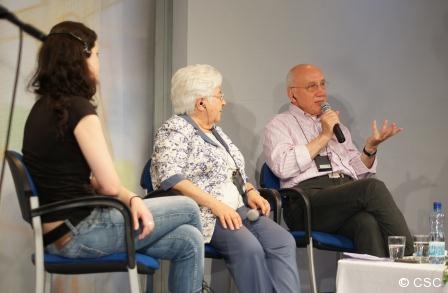 Maria Voce and Giancarlo Faletti share their own “journeys”, the way they met the Ideal of unity all the way to the point of deciding to follow God along the path of the focolare. Immediately questions began to rain down, and the answers were diverse and profound. To one girl who asked her where she could find the courage needed to make radical choices, free of conditioning, Maria Voce suggested: “The period of our life when we’re young is when we make important choices: if you don’t make them now, later you won’t have the opportunity. Yes, you need courage, but there is courage within you and you’ll find it in your relationship with God. If you choose out of love, then you don’t need to worry. Don’t put it off forever and don’t let others make your choices for you.” The invitation was to “love to the maximum”, as Jesus had done on the Cross, “always beginning again”, and never dwelling on “useless regret”. The audience listened attentively in silence. The 150 young people didn’t want to leave. Twenty-seven year old Elizabeth confided: “I’m very critical and at the same time I’m seeking to uderstand how and where to live the Christian life well. I’m searching for my path, and so I gladly agreed to find out what the Focolare Movement was about. What I heard spoken today has been a great enrichment for me and it’s encouraged me to decide to become part of something. I leave here with the understanding that whatever I do in my life, God is important and I can’t only keep him for myself.” Not only for Elizabeth, but for many of those present it really seemed like a new path had opened for them. By Aurora Nicosia [nggallery id=43]
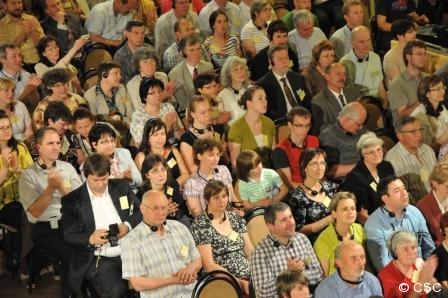 The history of the Focolare Movement in the Czech land has often been marked by heroism. The Ideal of unity first arrived there in the 1960’s when it was still Czechoslovakia and Soviet Communism was in power. Since 1968 and the Prague Spring, which was suffocated by occupation forces after which Communism became even more oppressive, until November 1989 when the regime was terminated, the history of the Czech people was marked by great suffering. But amid al the hiding and persecution many came to be part of the Focolare Movement and, today, more than 700 traveled from across the country to meet the president of the Focolare, in the Palace of Culture in Prague 5, one of the 10 municipalities which subdivided the city. There was excitement, joy and expectation. It was a feast for a family that was reminiscing and looking ahead.
 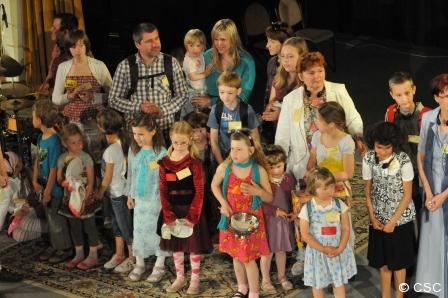 There were numerous questions for Maria Voce and Giancarlo Faletti. A Gen 4 asked: “What were your dreams when you were small?” and some Gen 3: “How did you come to know God? What would you do if you met a poor family? Why didn’t God intervene when Hitler killed so many people? ” Questions from the adults dealt with the significance of the president’s travels, how to pursue the involvement of some of them in the “reconstruction ” of the country, life in local communities of the Movement, and the danger of activism. “My travels bring me to find my family, and so they are a pleasure for me. I go to offer my support, to encourage, to see what everyone is doing,” says Maria Voce. And it doesn’t matter whether they are small or great things. “During a recent trip to North America, she continues, “where everything is huge and our community is small in contrast, I felt that Jesus among those who love each other is a “super-power”. And so the same invitation stands for the Czech Republic to believe in this power so that you can reach the entire nation. With this Ideal not only can we, but we must bring the message of the resurrection into the world, to bring Jesus into the school, the factories, the parliament. This is the greatest thing that we can do.”
 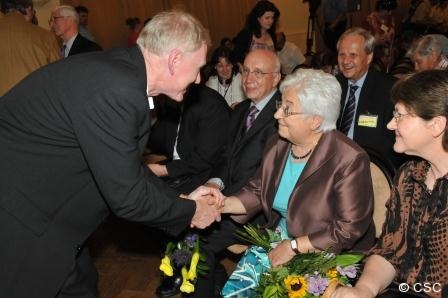 On the same afternoon (21 May) the meeting was opened to all those who wanted to know more about the Focolare “revolution”. The testimonies offered and the initiatives taken showed how this lifestyle has enveloped people of all ages. When considering the progress made since Chiara Lubich launched “Golden Prague” for the city in 2001, it was clear that the commitment to re-evanglize the city has never faultered, nor the fruits. Maria Voce proposed a new step to be taken: “In this country you breathe in history and spirituality which, even during the hardest times, were never destroyed, but perhaps only covered over and protected. Here we are not beginning from zero, we are beginning again from the deep roots left by those who built this society and this culture. The step that we must now take is to bring a new evangelization, a new proclamation, brought by people who have been made new by mutual love. We must commit ourselves to proclaim to others that Jesus is risen, that all the suffering has been redeemed: This is a time of joy.”
 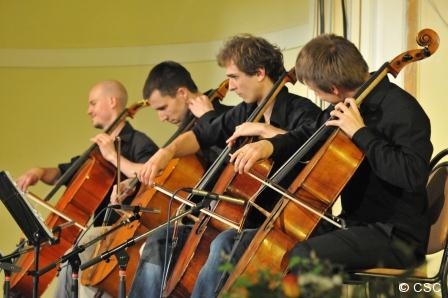 This was confirmed by Bishop Frantisek Radkovský, the Czech Republic Episcopal Conference delegate for the laity: “The Church has great expectations for the movements,” he affirmed during his remarks, “because they are her most dynamic part, a gift of the Holy Spirit for the modern times. Society today is secularized, but now there is an openness to spiritual things and it is important to show with (our) life that Christianity brings the humanism that is true. The movements have the ability to reach everyone and the most diverse fields of action are open to them, from the family to the school, from politics to the economy, from the mass media to sport.” As the meeting drew to a close, the musical quartet which had been offering some fine music throughout the day, began to play the theme song from “Mission Impossible”. It made everyone think that what is impossible for us will be possible for God. By Aurora Nicosia [nggallery id=42]
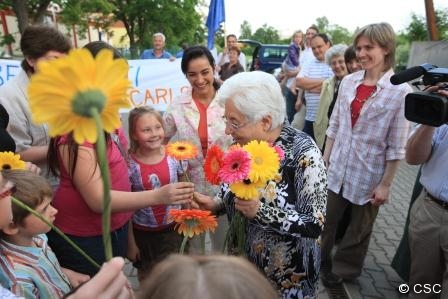 Maria Voce, president of the Focolare Movement, and co-president Giancarlo Faletti were welcomed by an unseasonably warm climate at their arrival from Moscow. And they arrived half an hour early, shortening the waiting time for the thirty people who were at the airport to receive them with applause. Their itinerary would be intense. It included meetings with representatives of the local Church, the archbishop of Prague, Archbishop Dominik Duka, as well as with priests who live the spirituality of communion. There was much expectation among the youths who planned a day meeting at the Mariapolis Centre in Vinoř, and among the entire Focolare community all over the country, which would converge in large numbers on Prague. An open meeting was planned to remember the 10th anniversary of the visit of Chiara Lubich to the Czech Republic and the launching of “Golden Prague”, promoted by Chiara herself on that occasion for the implementation of the “new evangelization”.
 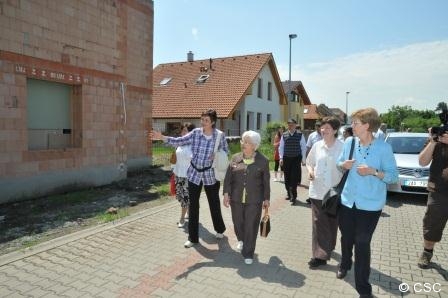 Maria Voce and the small group from Rome were offered hospitality at the small Mariapolis Centre, which was begin over two years, in the heart of the Focolare town which is under construction. “In 2001, when Chiara Lubich came to Prague,” some of the pioneers tell us, “she expressed a twofold desire: to provide a house for the family of the Movement and to have a place where people she had met – members of the political and ecclesial world – could meet.” Said and done, with much entusiasm and many initiatives, the latest being the “first Saturday projects”, which continue until now. Gradually the Mariapolis Centre has taken form and also the little town which is still under construction. Every first Saturday of the month people are invited to come and help in the work, brick by brick, to build a place that is bcoming a centre for the spreading of the spirituality of unity. Ten families have already built their own houses and moved in, others are planning to do the same. Before she left, in 2001, Chiara had buried medals of Our Lady at the various construction sites of the small town which is located in a suburb of Prague. “Some of our neighbors didn’t understand,” report those who were present at the time, “they thought we were burying money. But with time they came to understand the true sense of what was being born here.” Even people who seemed far from God drew near to us and now somehow belong to the family of the Movement. Oh yes, someone explained, because here it isn’t so much atheism, as much as a type of non-belief, which is the result of non-awareness. The desire to know God hasn’t diminished.

The Archbishop of Prage, Msgr Dominik Duka