
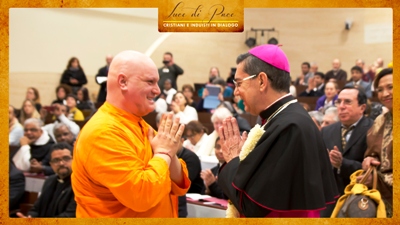
 “So is craving, so is anger, they arise from the Rajas, the passion of the senses that devours everything” (Bhagavad Gita, 3:37)[1]. These words were chosen by Paramahamsa Svami Yogananda Ghiri, honorary president of the Italian Hindu Union (UII), in his welcome speech at the first Christian-Hindu Conference that crowded the main hall of the Pontifical Gregorian University on December 6, 20016. The conference was opened by Cardinal Jean-Louis Tauran, president of the Pontifical Council for Interreligious Dialogue. He was the promoter of the event in collaboration with the UII, the Italian Bishops Conference, Religions for Peace and the Focolare Movement. The cardinal expressed his joy for this moment of dialogue that was so promising and hopeful: “With our interior light that consumes and illumines, we will be able to direct our every step along the path of Peace.” Christians and Hindus were equally represented by 300 people who were animated by a desire for communion and understanding. Like emblems, a Lamp and Crucifix adorned the hall, both symbols of light. Light and Peace was the title of the day spent in dialogue and in the search of Peace. The words of Bishop Paul Gallagher, Secretary for [Vatican] Relations with States, were quite meaningful. After recalling the many conflicts around the world, he appealed to the international community to “overcome the logic of individualism, competition and the desire to be first” and asked that as soon as possible an “ethic of solidarity” be promoted. The presentation by Dr Naso from Sapienza University of Rome was also very significant. After presenting the data on the conflicts that had begun for religious reasons, he recalled that in many cases it was precisely the faith communities that became mediators in the peace process: in Norther Ireland, South Africa and Mozambique…. This makes one hope that “religions can really play a constructive role in conflict situations.”
 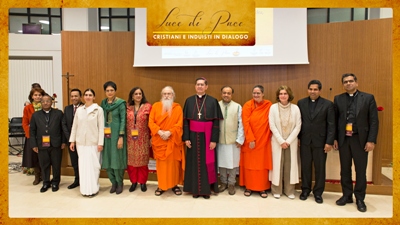 The report by Hindu psychologist Sangita Dubey on cultural differences and on the effects of migration on the psyche due to the different diet, language and mentality was lively and supported with personal experiences. “The challenge of dialogue,” stressed Svamini Hamsananda Ghiri (UII) in his presentation of the Hindu perspective, “is fear, indifference, fundamentalism and suspiscion of the other;” to pursue the common good it is necessary to “see the other as a brother and sister because they are generated by a Father God.” Paul Trianni, the University of St. Anselm, who was asked to give a Christian perspective, he concludes: “When two ancient civilizations encounter one another, two such profound spiritualities, they cannot but recognize the great wealth.” Two experiences of dialogue helped gave substance to the words that had been said: Fr Cesare Bovinelli, Camaldolese monk, recalled the great harmony that existed when it came to themes of environment at Assisi. A young person from the Focolare, Aileen Carneiro of India, described the many activities that were carried out between Hindu and Christian youth. Particularly striking was the synergy with the Ghandian Shanti Ashram group of Coimbatore, who started a project for solving poverty, following the approach of the Economy of Communion. Aileen explained that the dialogue of life must be held up, putting into practice the Golden Rule: “Do to others as you would have them do to you.” La Conferenza si è conclusa con uno spazio culturale di poesie, canti e danze sacre indù, in cui l’arte è diventata ulteriore motivo di comunione, degna cornice alla lettura delThe conference ended with presentation of poetry, Hindu sacred dance and song, in which art became a catalyst of communion, a worthy context for the reading of the Joint Statement. Anna Friso [1] (Our translation from Italian)
Use your goods responsibly
Use your goods responsibly



0 Comments