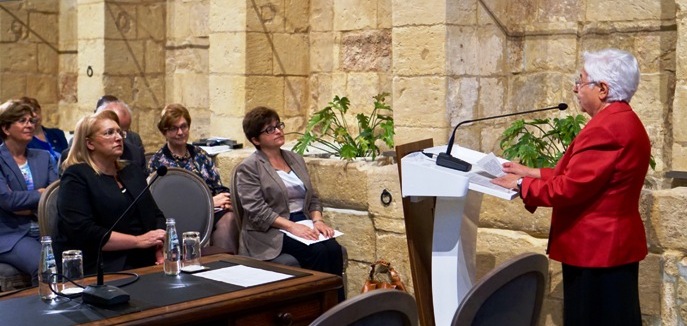
Photo A. Dimech – © CSC Audiovisivi
While taking part in a study seminar in Malta last May,
Maria Voce, president of the
Focolare Movement, the first woman lawyer from her hometown in Cosenza, Italy, says yes. “Most certainly it can, if we go beyond a merely formalistic approach and focus on law as an indispensable means that contributes to creating a reality of fellowship within society, or to re-establishing it where it has diminished. Law, in fact, concerns the yearning for justice deep within all people and it helps them to achieve it. Law teaches us how to live, how to build true relationships between individuals, groups, organisations and states. Law safeguards the individual rights of people, states and communities. However, it is essential to be aware of a higher goal, which is to achieve the common good and build up universal brotherhood.” At a time when war, terrorism and fear of diversity seem to obliterate such a vision of law
Maria Voce recalls: “after the tragedy of the Second World War and of the Shoah,
already states in the preamble, “Recognition of the inherent dignity and of the equal and inalienable rights of all members of the human family is the foundation of freedom, justice and peace in the world”. Also successive European constitutions reiterate it.
The German Constitutional Charter (1949-1990) declares in its first article: ““The dignity of man is inviolable. To respect and protect it is the duty of all state authority” (Article 1).
The Polish Charter (1977) affirms: “The inherent and inalienable dignity of the person shall constitute a source of freedoms and rights of persons and citizens. It shall be inviolable. The respect and protection thereof shall be the obligation of public authorities.” (Article 30). Similarly, the
Charter of Fundamental Rights of the European Union, quoted in the Treaty of Lisbon of December 2009, places dignity as a value that comes before freedom, equality, solidarity, citizenship and justice, stating, “Human dignity is inviolable. It must be respected and protected.” (Article 1)
Sixty years after the signing of the European Union Treaties, which founded the European Union, Maria Voce went on to say, “we know the European Union is experiencing difficulties and I feel I must affirm that the root cause of this crisis seems to be a crisis concerning relationships. The goal was to create a common market, trusting in the laws of capitalism, yet we have remained distant if not indifferent to one another. The crisis therefore demands a tough reappraisal of the deeper meaning of integration, which for the European Union in particular must be founded on a shared heritage, resulting from the encounter between the Greco-Roman heritage and the Judeo-Christian heritage, not forgetting the various contributions from all Mediterranean cultures.”
In her speech, Maria Voce presented the Focolare Movement’s commitment to defend the principles of peace and unity that had inspired the founders of the European Union. “It is the experience of
Together for Europe, which is a network of people belonging to various Christian movements. They have met regularly over the years, gathering from across the continent and locally. It is like a prophetic sign of what Europe could be if its citizens were to participate more in a shared experience, which goes beyond different cultures and different ecclesial traditions. Among other things, these meetings have identified a number of values shared by all: the family, life, peace, the environment, a just economy and solidarity with the least. They wish to bear witness that it is possible to achieve unity between people in Europe, from both North and South, East and West. We shall examine the positive experiences already in place and commit to multiplying them and identifying approaches and actions that can contribute, in the fields of law, politics, economics and education, to building up a society that becomes family.



0 Comments