
NetOne, an international association of media and film professionals and communications operators and information technology, together with New Humanity, a Non-Governmental Organisation (NGO), realities founded on the spirit and values that animate the Focolare Movement, in collaboration with the Mission of the Holy See to the United Nations, launched the initiative “ AI: A Pathway to Global Peace and Integral Human Development”, a reflection on the ethics of artificial intelligence and its implications. On Wednesday, Feb. 21, NetOne together with the NGO New Humanity in collaboration with the Holy See Mission to the United Nations, co-organized the initiative “AI: A Pathway to Global Peace and Integral Human Development,” which took place in New York, UNHQ, Conference Room 6, from 1:15 to 2:45 p.m. and was followed online from different parts of the world. 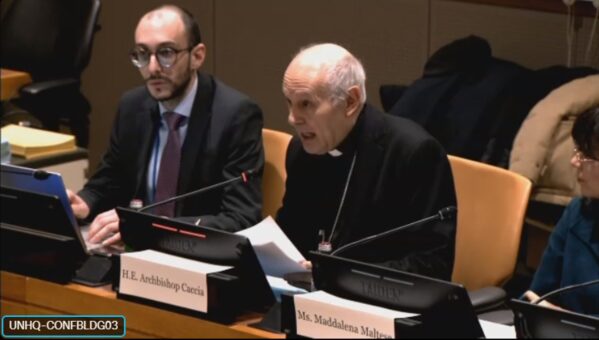 The Opening remarks by His Excellency Archbishop Gabriele Caccia, Permanent Observer of the Holy See to the United Nations, set the tone for the reflections, We stand at the precipice of a technological revolution unlike any other in human history. The emergence of AI is reshaping our world in profound and unprecedented ways. From revolutionizing industries to transforming the way we live, work, and interact, AI has become a driving force of change in the 21st century”. In recent years, digital progress has brought significant opportunities and challenges, with serious implications in all areas of society. In this era of rapid technological change, Artificial Intelligence (AI) has emerged as one of the most powerful tools with the potential to transform societies, advance peace and achieve sustainable development. However, its ethical implications remain a subject of intense debate.
 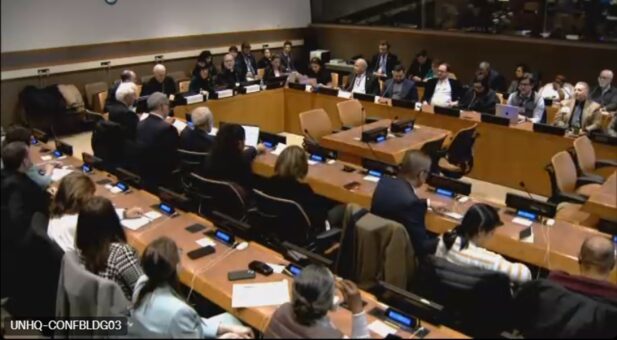 Maddalena Maltese, journalist and representative of the NGO New Humanity, moderator of the event’s panel discussion, recalled that “on January 1, Pope Francis, in his message for the International Day of Peace, raised urgent questions about AI: “What will be the consequences, in the medium and long term, of these new digital technologies? And what impact will they have on individual lives and societies, as well as on international stability and peace?” She also highlighted that Secretary-General Antonio Guterres, discussing priorities for 2024, stressed that AI will affect all of humanity, reiterating the need for a universal approach to address it. The panel discussion with multi-stakeholder dialogue on the ethical challenges posed by AI and strategies discussed the interplay between technical, ethical, political, legal and economic considerations.
 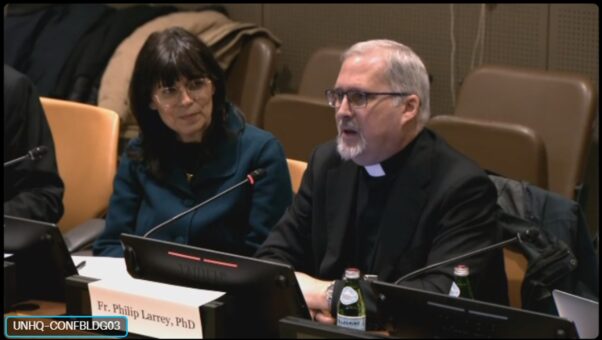 Father Philip Larrey, professor of philosophy at Boston College, former dean of philosophy at the Pontifical Lateran University, and president of Humanity 2.0. laid out a number of pressing issues starting with the theme of peace. “ChatGPT or Gemini could write a perfect peace plan, looking at the situations we are living, but would we be willing to follow its directions?” Fr. Larrey said, emphasizing the human factor as decisive in the decisions to be made, even when it comes to lethal weapons. Another central theme of his talk was the empathy that machines can demonstrate and are sometimes preferred over the human element. “Humans understand meanings. Machines don’t, as much as machines are getting very, very good at simulating what we consider meaningful,” the Boston College professor insisted, warning of the increasingly difficult challenge of discerning what belongs to humans and what belongs to technology, with machines that in the future may even be programmed to feel feelings.
  Laura Gherlone, a researcher in semiotics at the National Council of Scientific and Technical Research in Argentina and a professor at the Catholic University of Argentina and a member of NetOne’s International Commission, spoke about Artificial Intelligence and, more generally, digital technologies in light of the thinking of digital decolonization. She argued that: “today, post-colonial contexts are at a crossroads: either falling behind or catching up. They are obliged, in other words, to dramatically accelerate certain processes that today embody a techno-centric, supposedly universal, model of knowledge: digitization and the implementation of AI systems are among these processes.” She states that this process ” almost always comes at a very high cost, on at least three levels: at the economic and technical-structural level, at the social level and lastly, the accelerated and forced adoption of technological progress as a path towards a universal model of knowledge. She suggests: “the The ethical debate on AI could be greatly enriched through decolonial reflection, integrating, for example, the work of those collective movements committed to rethinking and redesigning technical architectures “from the South”, that is, theoretical-methodological and practical solutions that are often sidelined because they are far from profit logics”. Closing the event were two best practices from civil society. Marianne Najm, a communications engineer based in Beirut, spoke on the ethics of AI and the concept of the digital oath for engineers and anyone active in the digital world. The project started in 2019 inspired by the Hippocratic Oath, the oath that most doctors take at the end of their academic journey. Just as the Hippocratic oath aims to awaken the human obligation of doctors, similarly the digital oath aims to awaken the human obligation of digital actors by directing their work toward ethically human-centered design. Marcelle Momha, Cameroonian living in the United States, policy analyst and researcher specialized in artificial intelligence, emerging technologies and cybersecurity, had prepared an intervention on the AI 2030 community, which due to timing was not possible to illustrate, but her paper is available on this link bellow. “AI 2030 is a vibrant community of business leaders, data scientists, technical builders, and pioneering researchers dedicated to harnessing the transformative power of AI to benefit humanity while minimizing its potential negative impact.” She explained in his theme. In his message for the World Day World Peace, the Holy Father remembers that “technological developments do not lead to an improvement of the quality of life all humanity, but on the contrary aggravate the inequalities and conflicts, can never be considered a real progress.” As organizations of civil society, we want to accompany the efforts of the United Nations and all those institutions that are working for an ethical commitment in the field of technology that sustains digital developments as a contribution to the promotion of human principles of peace and fraternity. To review the live stream, you go to link: https://webtv.un.org/en/asset/k1h/ To see the speeches again and for more information, go to: https://www.net-one.org/ia-una-via-per-la-pace-globale-e-lo-sviluppo-umano-integrale/
Source https://www.net-one.org

0 Comments