
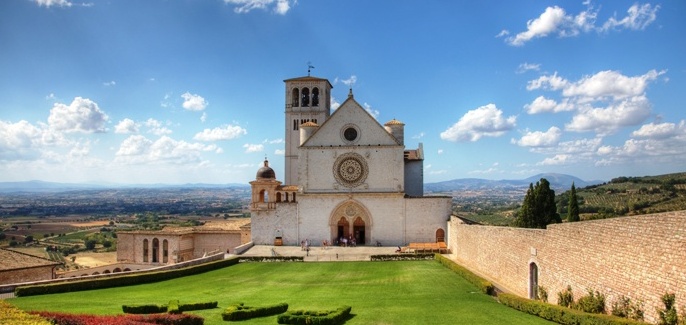
 The first event in Mary’s life mentioned in the New Testament is the Annunciation (cf. Lk 1:25ff). Mary had been chosen by God from eternity, but something very special happened to her at the Annunciation. The angel appeared to her with a message from God, and Mary accepted it. Because of her yes, a new reality was immediately born within her: the incarnation of Jesus in her womb. If we try to understand the lives of some saints, we can see that something analogous to what took place in Mary happens spiritually in them as well, when, for example, they come across a charism that God has given for the good of the Church. We know the story of Saint Clare of Assisi, the most perfect disciple of Saint Francis. It sometimes happens that, while visiting the Church of Saint Damian in Assisi, where she lived, the tour guide describes that sacred place by saying, “Here is where Christ was incarnated in the heart of Clare.” And these are not just words; they reveal a profound truth. Even though Clare of Assisi had, we may assume, lived in a state of grace, her meeting with Francis brought about something new in her. Francis was the personification of a word of God addressed to the world anew — the word “poverty.” Meeting him caused Christ to develop and grow in Clare, to the extent that she became one of the greatest saints of the universal Church. And is it not indeed the thought of popes, saints and Church Fathers, that the Word generates Christ in souls? Likewise, when at a certain point in our lives we come to know the charism of unity, through another person, a publication or a meeting, and we feel God’s call to make it our own, if we say our yes, something similar to that which happened to Mary and the saints happens to us. Christ can truly begin to develop and grow spiritually in our hearts, as though by an actualization of our baptism. I read that Clare of Assisi before dying said these marvellous words, “I thank you, Lord, for having created me,” meaning, by creating me you have acquired your own glory. Hers was a death of love. If only heaven would wish something like this for us! If we remain faithful, our own death too will not be simply a physical death, but a death of love. We too will rise up to meet our mother, our saint, our model, the one who on this earth was our head, our queen, and our mother. And we will see the glory of Mary, queen of heaven and of earth. Above all, we will see her surrounded by those who loved her in a special way. From Chiara Lubich, “Mary – Transparency of God”, New City, London, 2003 – pp. 52-53, 67.
Put God’s word into practice
Put God’s word into practice



0 Comments