
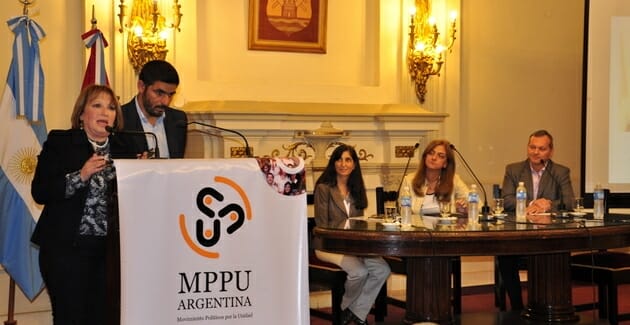
 “Chiara Lubich has brought understanding and gentleness, but basically what she has given to us, through her simplicity, is a great current of love towards the other person. To live in community, to know how to share, to work for the common good and to succeed in building fraternity also through diverse political viewpoints, this in summary is her message.” So stated Alicia Monic Pregno, Vice-Governor for the Province of Cordoba (Argentina), in the context of this international acknowledgement of the inheritance transmitted through the thought and life of Chiara Lubich. During its session on 25 March 2015, the House of Representatives in the Province, approved the posthumous decree in recognition of the Work of Focolare Movement founder.
The ceremony was held in the same parliamentary hall in the presence of a huge crowd which included members of parliament of different political parties, representatives of Comipaz (Interreligious Committee for Peace), young political students of the Movement of Politics & Policies for Unity, university professors, members of social organisation, and others.
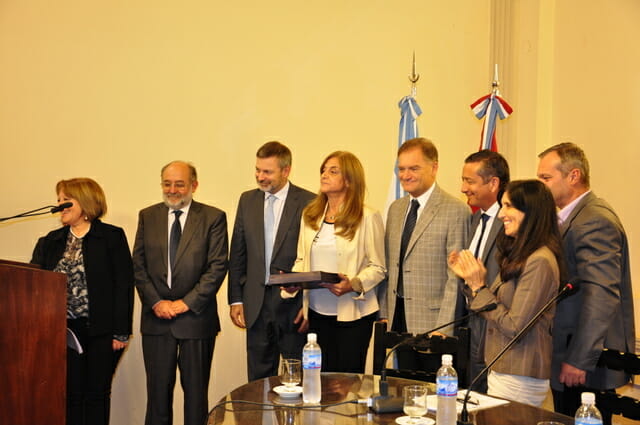 The delegates of the Focolare Movement in Cordoba presented the figure of Chiara Lubich and immediately afterwards the Vice-Governor invited politicians from different political parties to carry out the symbolic gesture of consigning to them, all together, the decree and the commemorative plaque.
Alicia Monica Pregno then went on to explain the motivations for the award: the contribution towards the building up of a community which promotes the “spirituality of unity”, adding that “Lubich’s message raises many questions which lead us to reflect on the reason behind all the conflicts, on why we are not always able to think things out together.” She said, “I believe that the world is called to journey towards a better destiny, and this is achievable in the measure that we lay aside our personal interests and are open to resolve issues through a shared outlook. This is a great challenge in these times characterised by much individualism.”
Pastor Raffa, representing Comipaz, then spoke. He emphasised the contribution of the charism of Chiara Lubich to the “birth of this commission right from the beginning”; and Soher El Sucaría, political activist, shared how through an experience lived within the Interreligious Committee for Peace, the value of this service became more and more evident.
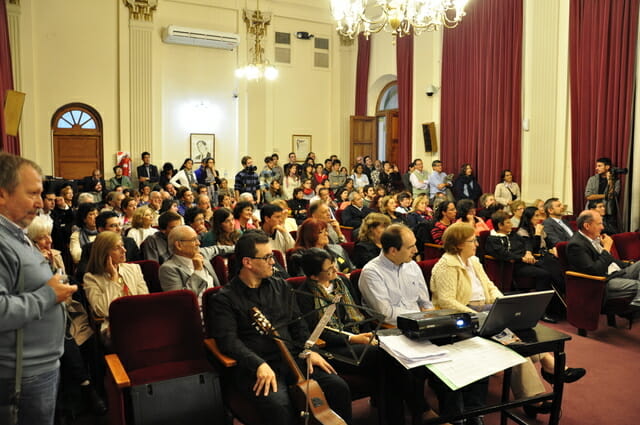 Several testimonies by individual citizens then followed. They told stories of personal transformation and their commitment to local politics: from joining forces with neighbours in order to resolve the problems of their neighbourhoods, to assuming political commitment on a regional and national level. This part of the program was conducted through two round tables. The first, entitled “Fraternity, Seed of Social Transformation”, included the participation of Estela Daima (Director of a Caritas Department in Rio III which conducts a break-making activity involving 40 women), Paola Chávez, Secretary of Fazenda de la Esperanza association (who presented the testimony of Agustina, a reformed juvenile criminal), and Ricardo Galli, economist and entrepreneur of an Economy of Communion project.
In the round table entitled “The Contribution of Fraternity to Politics: Experiences and Challenges”, Laura Blanco, a socialist, presented the Schools of Politics organised in Parliament House, as well as her commitment to live fraternity in the political arena. Other speakers included Julio Bañuelos, Mayor of Mina Clavero, and Guillermo Castillo, member of the Christian Democratic Party and public administrator.
In all those present there was the certainty that when fraternity is lived as a political goal, it provides answers to the challenges of today which call for a society that is more just and all-embracing.
In conclusion, the Vice-Governor expressed her appreciation that the Parliament of Cordoba is the centre for the Schools of Politics for young people and underlined the efforts which are being made in living the concept of fraternity within Parliament itself.



0 Comments