20 Dec 2018 | Non categorizzato
An award for the body of people that perseveres in promoting initiatives that create fraternity in their area and translates this universal value into civic and political commitment. Nominations for the annual “Chiara Lubich International Award for fraternity” should be made by Jan 15 2019. This award is open to local authorities (provincial, regional or rural communities) from any part of the world, be they large or small organisations. Awards are made to projects that initiate or spread activities promoting universal fraternity usually at the local level. However, projects may also be on a national or international scale. They should reflect an understanding of the meaning of universal fraternity and encourage citizens to show commitment in working for the common good and to play an active role in the community. The projects should facilitate the growth of a culture of active and inclusive citizenship. They should also favour collaboration and synergy among areas of administration, local communities and civil society such as associations, groups and committees and they should make an impact upon these areas. The projects should be typical of a sustained way of working in that area favouring fraternity and should not be “one-off” actions. Presentations of the projects can take the form of text or text with links to audio-visual material. Nominations and supporting material should be sent to Presidenza dell’Associazione “Città per la Fraternità”, c/o Comune di Castel Gandolfo, Piazza Libertà, 7 – 00040 Castel Gandolfo – Rome (Italy). Alternatively, if electronic transfer is possible, they can be sent to associazionecittafraernita(at)gmail.com o info(at)cittaperlafraternita.org The nominations should include the following details: the name of the authority or organisation, the leader’s personal details, the full address and contact details, the name of the project or initiative and an abstract (maximum three sides of A4) that describes the project and how it functions. The award giving will take place in S. Maria Capua Vetere- Caserta (Italy) in February 2019. For further information: Associazione “Città per la Fraternità”, telephone +39 340 4182127 – +39 347 4573988; e-mail: associazionecittafraternita(at)gmail.com – info(at)cittaperlafraternita.org.
17 Dec 2018 | Non categorizzato
Christopher Jimènez, member of the Focolare Movement community in Mexico, tells about the migrants’ long exodus from Honduras, while remaining weeks at the foot of the wall bordering the United States. “On 12th October, we received several calls through the social network—affirm Christopher Jimènez, who collaborates with the association Promozione Intergrare della Persona (PIP) — making it viral in a short time. More than thousands of Hondurans left San Pedro Sula”, a city, which until 2014, has been considered for years among the most violent on the planet. From that time on, the whole world has been witnessing what has been defined by many as a biblical exodus. “A week after the caravan crossed the border of Mexico, numerous civil society organizations and government agencies have already set out to provide humanitarian aid, first at Chiapas, then at Oaxaca and Veracruz.” At that point, it was no longer a question of a single contingent of migrants, but of different groups that proceeded in waves, on foot or by some lucky means, crossing the country for thousands of kilometres. “At the end of October – continued Christopher – when their arrival in Mexico City was imminent, an interruption of the drinking water was scheduled for the over four million inhabitants of the capital, due to a serious water problem. Yet, many civil and religious organizations, despite the hardships and intense cold, have responded to the invitation of the local Human Rights Commission, setting up a humanitarian camp to the westside of the city. The Focolare also joined. About thirty people, including doctors, nurses, students, housewives, went to the relief and meal-clothing distribution points. Also, another group organized a collection of basic necessities and a civil association, inspired by the Focolare spirit, offered technical and logistic collaborations.” On the morning of 5th November, about five thousand migrants arrived in the capital. Almost ten thousand people received hospitality, food, blankets, and clothing in the following days. “Despite the solidarity of many, their passage was not free from friction and violence. Some incidents have been on the verge of causing serious episodes of xenophobia. Now the wave of migrants is waiting impatiently under the impassable wall that separates the Mexican city of Tijuana from the United States. We are expecting days of great uncertainty. But in their passage, even amid the pitfalls of a very complex path, they have indicated, the direction by which their dream moves, to the heart of the Mexican people.”
Chiara Favotti
17 Dec 2018 | Non categorizzato
Despite the media spotlights turning on and off on the drama that continues at the border between Mexico and the U.S., there are many people and organizations, including Focolare, who have not abandoned the migrants there. In past weeks, news and images of thousands of people marching from Honduras toward the U.S. border have gone around the world. “In this region, the phenomenon of migrants is really common,” explains Sandra Garcia-Farias Herrera of the Focolare community in Northwest Mexico. “Mexicali and Tijuana are border cities, having grown because of the high number of people who have arrived here dreaming to enter the United States. Yet what we’ve witnessed in the past month is unprecedented. “The people themselves cannot understand how the phenomenon has reached these proportions, or what would have pushed so many families to leave everything behind, even during rough weather, and get on the road. “Here is where the road ends, and it seems that their dreams shatter. Streets and public places have become camps. There is a lot of confusion, and we’ve witnessed violence, the closure of border crossings into the U.S., the installation of razor wire along the wall, and a huge deployment of police forces protecting the borders, with helicopters and armed vehicles never seen before. It feels like war is about to break out. “The lack of information as to what pushed these people to move, as well as news from mainstream and social media, has caused the residents of Mexico to have mixed feelings, from hostility, resentment, to even episodes of xenophobia.” While some young people from Focolare are trying to find a way to enter into the migrant camps – for many the final destination of their Mexican journey – others have reached out to migrants in the street, trying to understand what motivates them, and especially their needs. One family drove two women with small children as far as Tijuana, so they could avoid the extremely arduous route. Others who work at an education center suggested students change their cultural attitudes to show migrants solidarity and the sense of fraternity that every person deserves. “The priority now is to oppose the rampant confusion and the intolerant acts that come from it, even among young people. We need to spread a culture of welcoming.”
Chiara Favotti
14 Dec 2018 | Non categorizzato
There is much good practice going on and prophetic experiences which engage in alternative economic models directed towards integral human development and sustainability. The Prophetic Economy event formed a network to bring together some of these experiences that want to change the world… https://vimeo.com/301634789
11 Dec 2018 | Non categorizzato
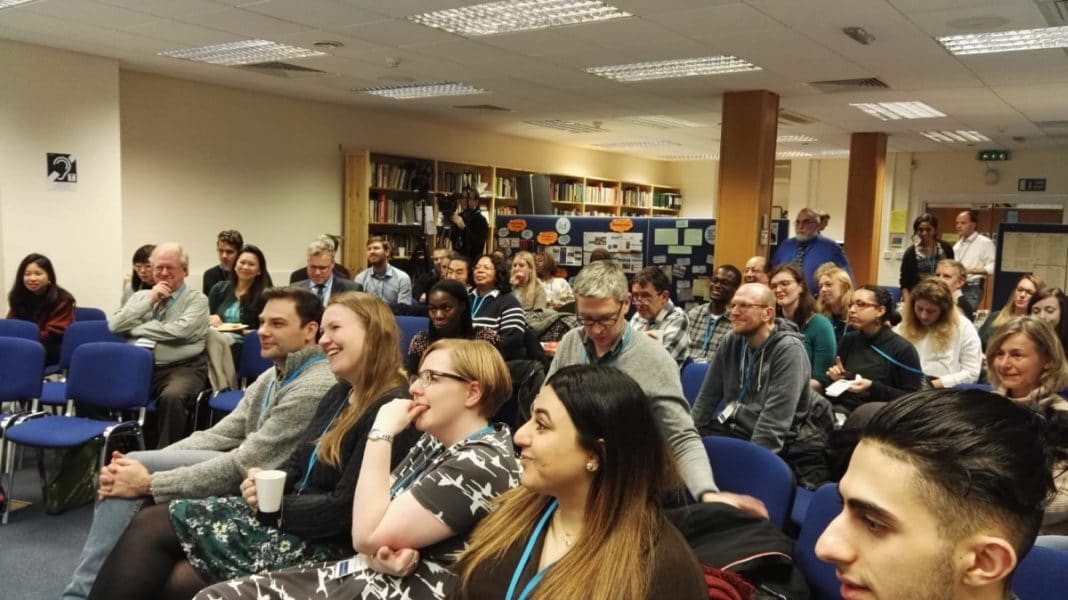
Lawyers and legal students from different Christian churches meet to encourage each other to live out the Gospel in their professional life. “The gospel has profound implications for the legal world. The Lawyers’ Christian Fellowship exists to bring the whole Good News of Jesus Christ within the legal world” (LCF website). Founded in 1852, the LCF unites Christian lawyers from all around Britain, as well as forging international links among legal professionals. It promotes three main areas of action: to live according to the “law of the Gospel” in one’s daily life; to form young legal professionals; to be active on an international level. As part of this third aspect, the LCF held a conference in November entitled: “A lawyer after God’s own heart: Lessons from Psalm 119”, inviting representatives of the “Communion and Law” international network of legal professionals and students animated by the Focolare spirituality. Elisabetta Scomazzon and Pasquale De Rosa, consultants in the field of canon law, attended for “Communion and Law”. What was the main focus of this meeting of lawyers from different Christian Churches? Elisabetta Scomazzon – Faith was at the centre: the bond which links us together most strongly, even more than the legal profession itself. Meetings like this are particularly significant because starting from being united on a personal level, we move on to find ways ahead in the legal field, for example through a clear uncompromising commitment to defend the weakest in our societies. Through choices like this, those of us active in the legal system can contribute towards building relationships that are more constructive and “fraternal”. During the conference, what points in common and what areas for future development in the legal field did you cover? Pasquale De Rosa –We have in common, above all, the shared commitment to witness to our Christian life in our profession. For example in the lawyer-client relationship and in the various environments a Christian lawyer works: to be authentic witnesses to the “good news” which every Christian carries within. Our work proceeds alongside that of our own Churches. What we have to do, is to collaborate together, starting from what Chiara Lubich called the “dialogue of life”, putting in common our experiences as legal professionals. For example, a pressing concern is that of human rights and how they are under threat in the current world situation. How can Christian lawyers and legal professionals contribute to peace and harmony within their own societies, in today’s climate characterized by divisive ideas and praxis? Elisabetta Scomazzon – Every nation and people has its own order and rules. The Law can actually be an instrument of communion which helps to find solutions to the urgent demands of our planet and to the cry of humanity subjected to injustice, exploitation and war. Christians of different churches finding solutions in the legal field does not need to be an utopian idea, but could be a great opportunity to give hope that unity is possible.
Edited by the editorial team
