
16 Jun 2015 | Non categorizzato
The client I manage a banking agency. One evening, leaving the office, I was weighed down by a big, unresolved problem: it regarded a client who had misused his savings account. I could see only two solutions, which made me suffer: seriously damage the client, starting the legal processes, or risk shirking my duties. I had an appointment to meet my wife, to return home together. Usually I try to free myself from all my worries, but that evening I couldn’t. She immediately understood and said to me, “Difficult day today, right?” I began to confide in her. Mary did not know all the problems of the bank, but she listened attentively, in silence. After telling her everything, I felt relieved and more confident. The problem remained, but it was no longer only mine. The next day I was able to imagine a third solution that permitted me, in respect to my duties, to not harm the client. (G. K. – England) Hearing problems I had serious hearing problems, and urged by my parishioners, I went to a specialist. After asking me to which religious order I belonged, he began to list his resentments against the Church for all the inconsistencies and contradictions which had made him lose the faith. I listened to him with love, realizing that I found myself in front of a person who wasn’t satisfied with superficial Christianity. In turn, I responded that there are no arguments for defending the Church except a coherent life. I added, “God loves us as we are.” He asked for my address and phone number. That same evening he came to visit me, and he told me that he had been in the seminary until the age of 18 when it seemed to him that Marxism responded better to what he was seeking; now however these certainties had broken down. After a few days he confided to me that, entering a church, it seemed to him that God was telling him, “I have never abandoned you.” Now both he and his wife have returned to the sacraments. (P. G. – Italy) Layoff At the factory they recently distributed letters of termination of employment, one of which was addressed to Giorgio. Knowing his precarious economic conditions, I went to him and invited him to return with me to the personnel office. “I’m better off than he is,” I stated. “My wife has a job. Fire me instead.” Our boss promised he would have a second look at the case. When we exited, Giorgio embraced me; he was visibly moved. This event naturally spread by word of mouth, and two other employees, more or less in the same conditions as I am, offered their places to two other terminated employees. Management was forced to rethink its methods of choosing layoffs. Our parish priest, who came to know about the episode, told the story during his Sunday homily, without saying names. The next day he told me that two students brought him all their savings for the workers in difficulty, saying, “We too want to imitate the gesture of that worker.” (B. S. – Brazil)

13 Jun 2015 | Non categorizzato
“… One way of applying this faith in God is when we are worried about something that makes us anxious. Sometimes it is fear for the future, or concerns about our health, we are frightened about suspected dangers, we are worried about our relatives, apprehensive about a job we have to do, we are uncertain about how to behave, there is the shock of bad news. There are fears of various kinds. Well then, at times like these, precisely in times when everything is uncertain, God wants us to believe in his love and asks of us an act of trust. If we are really Christians, he wants us to make good use of these painful situations to prove to him that we do believe in his love. This means believing that he is a Father to us and he thinks of us, and casting upon him every anxiety we have, burdening him with them. Scripture says: “Cast all your anxiety on him, because he cares for you.” (1 Pt 5:7). … The fact is that God is our Father and he wants his children’s happiness. This is why they unload every burden onto him. Besides, God is love and he wants his children to be love. All these worries, anxieties, and fears block our soul, shutting it up in itself, and get in the way of our opening up towards God by doing his will and towards our neighbours by making ourselves one with them so as to love them in the right way. In the early times of the Focolare, when the Holy Spirit was teaching us our first steps on the path of love, “casting all our anxiety on the Father” was something we did every day, and often several times a day. In fact we were leaving behind a purely human way of living, even though we were Christians, so as to move into a supernatural, divine way of living. That is, we were beginning to love. Worries are stumbling blocks to love. So the Holy Spirit had to teach us how to get rid of them. And he did. I remember we used to say that just as you cannot hold a hot coal in your hand, but you would drop it at once so as not to get burned, so too with the same speed we had to cast every worry onto the Father. I can’t remember any worry cast into the Father’s heart which he did not take care of. … So let’s cast every anxiety on him. We will then be free to love. We’ll run faster on the path of love which, as we know, leads to holiness.” C.Lubich, Cercando le cose di lassù, Roma 19924, p. 26-29. Read the whole text: Chiara Lubich Center
8 Jun 2015 | Non categorizzato
In the face of immense challenges which also the European society has to tackle – particularly this year, after the attacks in Paris and Copenhagen – one can feel the growing distrust within and between communities. Already at the start of the 1990s, on the initiative of Jacques Delors, the EC President at that time, dialogue with the Churches and the non-religious organisations had been an occasion for an exchange of views on European politics between institutions and the main players of civil society. How can we live together and build a society in which every person and community can feel at home and safe? How can we find ways of accepting the differences when substantially there is no agreement? These are some of the open questions the religious leaders will confront together.. Also the President of the Movement, Maria Voce has accepted the invitation to participate, underlining how the priority of the Focolare is to “build bridges through respectful dialogue at various levels, and to contribute to the peaceful coexistence and fraternity between people of diverse faiths and the most varied ethnic and social origins.”
10 May 2015 | Focolare Worldwide
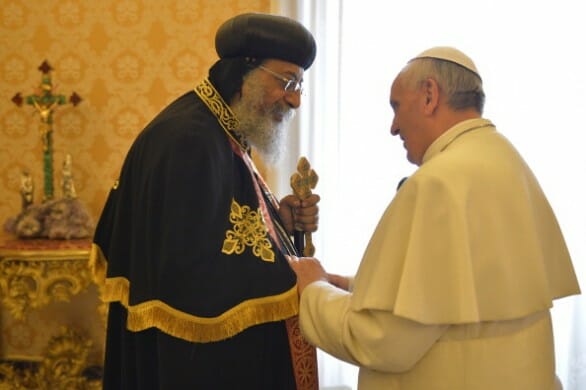 May 10, 2013. Pope Francis and Pope Tawadros II meet at the Vatican to remember the historic appointment that took place 40 years ealier between their predecessors, Pope Paul VI and Pope Shenouda III, and their Common Declaration on the one faith that is professed by churches with different traditions. During his remarks, Pope Francis stated: “I am convinced that – under the guidance of the Holy Spirit – our persevering prayer, our dialogue and the will to build communion day by day in mutual love will allow us to take important further steps towards full unity.” During an interview Pope Tawadros II stated: “I believe in the diversity in unity. Being in a garden where all the flowers are red and of the same hight, is boring. But being in a garden where I see a pink rose, a yellow rose and a white rose; and I see trees of different heights – this diversity expresses beauty and strength. When I am sitting with you I am rich of my brothers and sisters in Christ.” Coptic focolarina, Sherin, offers her thoughts: “These are words spoken by someone who has the courage to love his brothers and sisters, to shorten the distance and time in favour of understanding and renewed sharing after years of distance, enabling the two Churches to take up a path of peace and brotherhood. It will not be possible to erase these words from memory nor from the history of ecumenism until the churches rejoice on the day of the full unity of thier children.” The 2013 visit of Pope Tawadros II had been the first, following his election. Perhaps he wished to pay a visit to the Successor of Peter, Pope Francis. It was the second historic visit of a Coptic Pope to the Pope of Rome, that helped to lessen the distance between the two Churches.
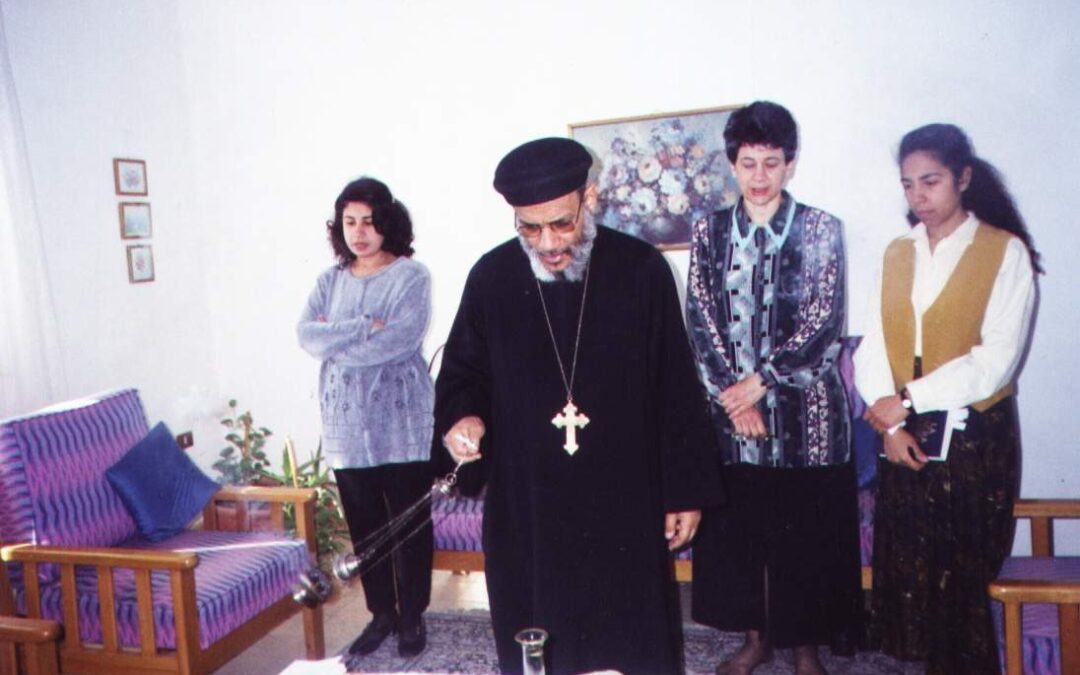
 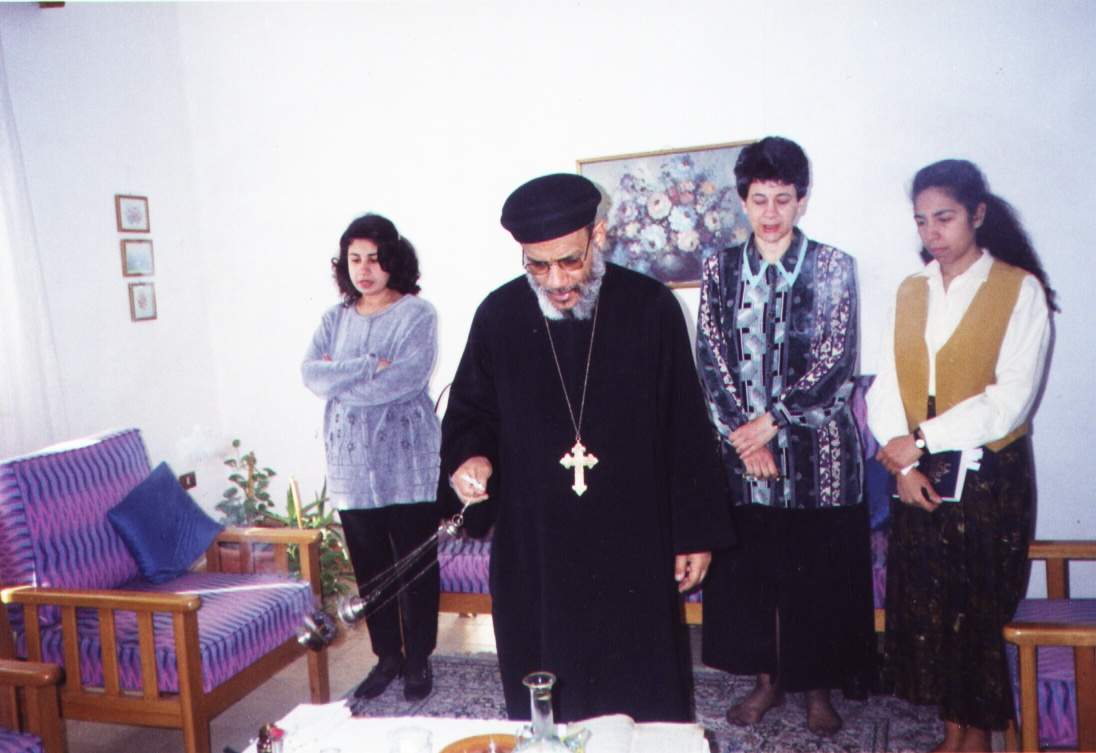 “That encounter between those two great men of God is still alive in my memory as, under the guidance of the Holy Spirit, they continue to conduct their flock towards the one Church that will come in God’s time. The memory of their fraternal embrace and the mutual love that could be visibly seen between them fills me with immense joy. I join my sisters and brothers of both Churches in celebrating this occasion, and with enthusiasm I look towards the near future, confident in the steps that will draw us closer and closer. This is a cause of great rejoicing for the entire Church! It encourages me to live for unity even more, a possibility that had fascinated me years ago when I met the Focolare Movement where I discovered the ‘precious pearl’ of the Gospel, for which you sell everything you have. I share this life in focolare with sisters from various Churches, and this is where I experience the joy of the Risen One, a sign of what the Church will be in its full unity. Each day we pray, work, share moments of suffering as Pope Francis said when he spoke about the ecumenism of suffering, and it makes us grow in love and mutual respect, believing that on the Cross, Jesus has overcome all our divisions and filled every void. I am grateful for the many people across the world with whom I share this experience. We live and pray for this unity, that it might be experienced and lived by everyone.” Sherin, focolare, Sohag, Egypt
7 May 2015 | Focolare Worldwide
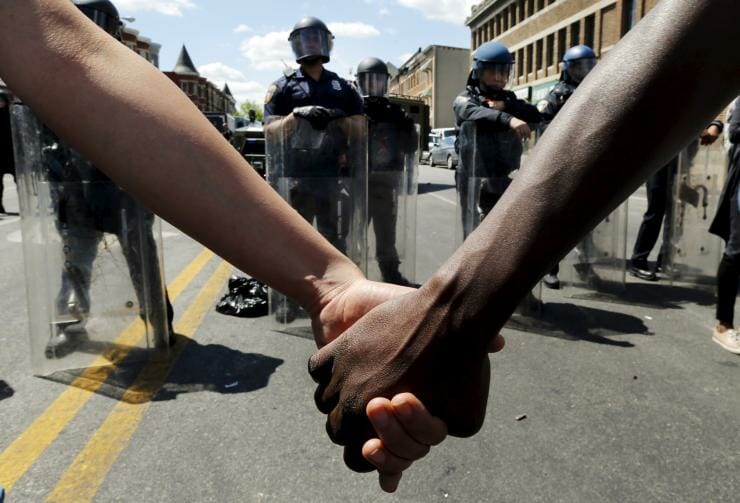
“The events that came about have stirred up the support of the citizens. Many leaders, religious groups and civil organisations decided to work together to clean the streets and buildings and to help in various ways, revealing the positive side of the city, though deeply offended,» Lucia, Co-Director of the Focolare Movement wrote from Washington. We all know about the people’s protests triggered in Baltimore last month, which are still ongoing, after the death of the 25-year-old Afro-American Freddie Gray while he was under arrest. Baltimore, the biggest city of Maryland with more than 600,000 inhabitants is a melting pot of ethnic groups, especially Afro-Americans. Leonie and Jennifer, two volunteers of the Focolare, live in the city centre. “The situation is still very tense, and yesterday the mayor closed the schools and the governor of the state deployed the armed forces. However, all those we know are fine.” Leonie lives close to the place of the clashes and teaches in a primary school of almost all Afro students and where there is great poverty. “On TV I saw one of my third-year elementary students participate in the sacking of buildings and properties.” “We cannot remain indifferent; we want to do something concrete, though aware that our contribution to establish true relationships between people is urgent, more than ever. Furthermore, every act of love builds new relationships that help foster fraternity between people,” wrote Marilena and Mike. “In the meantime we participate in the various moments of prayer organised by the religious authorities, starting from the Mass that Archbishop Lori will celebrate in our district, to invoke peace.” “I returned to school today,” Leonie recounts, “and tried to see my students (those who participated in the plunders) with ‘new eyes’.I contacted an Afro-American Muslim teacher who knows two black religious representatives in the school to offer our solidarity, and we agreed to work together.” Jennifer works in a company where almost all are whites. «A colleague of mine who lives close to the place where violence broke out, came to visit me today, and told me of her suffering in seeing all these events, but did not have the courage to mention it to anyone for fear of being marginalised by her colleagues. It was the occasion to tell her that we can start from ourselves and build a dialogue with all, one at a time, and in this way spread a new mentality. My colleague is not a practicing believer, but her face lit up and she told me that this is precisely what she also wants to do.” Meanwhile, the leaders of the various religious communities have started to work together for peace. “I was invited by the Imam Talib of the mosque of Washington, to give my testimony on the the 5th of May as a focolarina and the ideal that inspires us,” Lucia continued. “He wanted me to speak in a meeting open to the public, something they had organised with the District Procurator, to integrate the religious perspective as an essential dimension to subdue the violence. The event was entitled: Heal the Hurt, Heal the Heart. It seemed to be a great possibility for dialogue between religions but also an opportunity to show, more than the clashing, the richness of our society’s ethnic diversities.”
