
2 May 2015 | Non categorizzato
 Along the way “Taking the same route every day, I usually come across a multitude of people. There are those who cross the street when they shouldn’t, those who honk at me for a jumpstart at the traffic light, those who try to cut in front of me… Luckily, at times I manage to remember that each one of them is a brother and so… even the most chaotic traffic becomes less complicated. It was particularly hot one day, and I noticed that a vagabond, whom I had seen many times, had fainted on the sidewalk. That was his street corner, and that piece of carton was his house. “He generally did not appear to be sick, and I had never stopped for him before, but seeing that something was wrong, even if I was late in my deliveries, I couldn’t act as if nothing had happened. My van, however, stuck in a zone of intense traffic, immediately called the attention of the local police, who from afar made signs to make a move. I mimed that I wanted to take a look at that person in trouble. They continued to urge me to go away, pointing to the booklet of fines. I thought that they themselves should have taken care of the man, but seeing their indifference, I ran into a bar to get a fresh drink for that poor man. When I returned, I caressed his cheek gently so as not to waken him suddenly. Thank God he regained consciousness but was tired and scared. I put the glass to his lips and he answered with a smile, thanking me continually. In the end, also the policemen arrived and seeing that scene, put the fines booklet back into their pockets and greeted me with a smile.” Alexander – Greece Bouncers “I alternate my studies with work as a ‘bouncer’ in a pub: not a fulfilling job at all and at times, even risky, especially when you have to deal with drunks. One month, the Word of Life invited us to be the first to love. How could I live that at my work? As a start I tried to be the first to smile and greet the clients, even if I got no response. After a week, to my great joy, I saw that people started to answer my greetings. So, it worked! And to add, if before with the more ‘difficult’ guys I would adopt harsh methods, now seeing Jesus in every person, I try to be polite, and take interest in him. In this way, in critical moments I manage to avoid brawls and calm people down. And it is in a sense, a preventive measure which furthermore earns the esteem of my clients and my boss. And if anyone asks me why I act this way, it is the occasion to speak about God who is Love. The atmosphere in the club now has changed, and resulted in attracting new clients.” M. – Polynesia
29 Apr 2015 | Non categorizzato, Word of
With the tenderness of mercy our love can give witness to the reality of God’s love. We experience what we share with others. When the Lord God appeared to Moses on Mount Sinai he declared his identity as: ‘The Lord, a God merciful and gracious, slow to anger, and abounding in steadfast love and faithfulness’ (Ex 34:6). To indicate the nature of this merciful love, the Hebrew Bible uses a word (raḥămîm) that recalls a mother’s womb, the place where life begins. By making himself known as ‘merciful’, God shows that for each thing he has made he is concerned as a mother is for her child. He cares, is near, protects, looks after his creature. The Bible uses a further term (ḥesed) to express other aspects of this love which is mercy: faithfulness, benevolence, goodness, solidarity. Mary in her Magnificat too sings of the Almighty’s mercy that is from generation to generation (see Lk 1:50). Jesus himself spoke to us of God’s love, revealing him as a ‘Father’ close and attentive to our every necessity, keen to pardon, to give all we need: ‘he makes his sun rise on the evil and on the good, and sends rain on the righteous and on the unrighteous’ (Mt 5:45). His love is truly ‘rich’ and ‘great’, as is said in the letter to the Ephesians that give us our Word of Life: ‘But God, who is rich in mercy, out of the great love with which he loved us even when we were dead through our trespasses, made us alive together with Christ.’ What Paul says here is almost a cry of joy born of the contemplation of the extraordinary thing God has done for us. We were dead and he revived us, giving us a new life. The words begin with ‘but’, indicating a contrast with what Paul pointed out earlier. This was the tragic condition of humanity crushed beneath its wrongdoing and sins, prisoner of selfish and wicked desires, under the influence of the powers of evil, in open rebellion against God. In this situation it would have deserved God’s wrath (see Eph 2:1-3). In contrast God, instead of punishing – hence Paul’s utter amazement – gives humanity life again. God does not let himself be governed by wrath, but by mercy and by love. Jesus had already suggested that God acts like this when he told the parable of the Prodigal Son, the younger brother who was welcomed back by his father with open arms after he had sunk into an inhuman life. It was the same with the parable of the Good Shepherd who goes in search for the lost sheep and puts it on his shoulders to bring it back home. And the same can be seen in the Good Samaritan who cares for the wounds of the man who had fallen into the hands of robbers (see Lk 15:11-32; 3-7; 10:30-37). God, a merciful father, symbolized in the parables, has not only forgiven us, but he has given us life itself in his son Jesus, that is, given us the fullness of divine life. And this leads to a hymn of gratitude: ‘But God, who is rich in mercy, out of the great love with which he loved us even when we were dead through our trespasses, made us alive together with Christ.’ This Word of Life ought to make us feel the same joy and gratitude as Paul and the first Christian community. To each one of us, too, God shows himself ‘rich in mercy’ and of ‘great love’, ready to forgive and grant trust again. There is no situation of sin, of suffering, of solitude, where he does not make himself present, does not come alongside us to go with us on our way, does not grant us trust, the possibility of rising up and the strength to start again. At his first ‘Angelus’, on 17 March two years ago, Pope Francis started speaking about the mercy of God, a theme that has become characteristic for him. At that time he said, ‘God’s face is the face of a merciful father who is always patient… he understands us, he waits for us, he does not tire of forgiving us.’ He ended that first brief greeting with the words, ‘He is the loving Father who always pardons, who has that heart of mercy for us all. And let us too learn to be merciful to everyone.’ This points to a practical way to live the Word of Life. If God for us is rich in mercy and of great love, we too are called to be merciful towards others. If he loves those who are bad, who are his enemies, we too ought to learn how to love those who are not ‘lovable’, even our enemies. Did not Jesus tell us, ‘Blessed are the merciful, for they will receive mercy’ (Mt 5:7)? Did he not ask us to be ‘merciful, just as your Father is merciful’ (Lk 6:36)? Paul too invites his communities, chosen and loved by God, to clothe themselves ‘with compassion, kindness, humility, meekness, and patience’ (Col 3:12). If we have believed in God’s love, we too can love in our turn with that love which makes us draw close to every situation of pain and need, that forgives all things, that protects, that knows how to look after the other person. Living in this way we will be able to give witness to God’s love and help those we meet discover that also for them God is rich in mercy and of great love. Fabio Ciardi
22 Apr 2015 | Focolare Worldwide
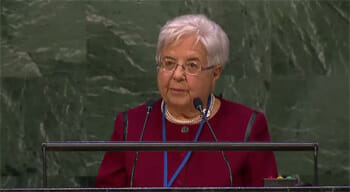
To risk your own life so as to relieve the suffering of the poor. This was Maria Voce’s invitation as she spoke of the last terrible phase of the Second World War, when in 1943 “a group of young women got together in the small city of Trent in northern Italy. While their city was being bombed, those young people, who were guided by a young teacher named Chiara Lubich, and urged on by a new understanding of the radical nature of Gospel love, decided to risk their lives to relieve the suffering of the poor.”
A choice many people make today too, helping to regenerate the fabric of society: Maria Voce referred to the refugee camps in Lebanon, Syria, Jordan and Iraq; the slums surrounding some huge cities and the united strength of those who “introduce into the destructive cycle of conflict a commitment to regenerate the fabric of society, by doing – according to the vocabulary of this organization would say – peace-building action”. She affirmed: “Those young women decided to break the vicious circle of violence by responding with attitudes and actions which in the atmosphere of conflict might have seemed unrealistic or even irrelevant. However, they were not and they are not!”
“Today too we are experiencing very serious political, institutional, economic and social breakdown, which requires equally deep-seated responses, able to change the prevailing paradigm. It seems that conflict and violence prevail in many parts of the world, affecting innocent people, guilty only of being in disputed territory, or belonging to a particular ethnicity or adhering to a specific religion.”
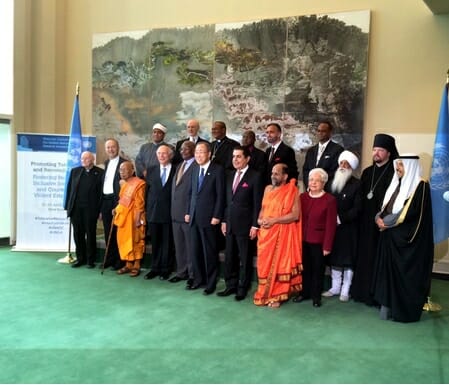 The encounter between cultures forms a new identity: “In the Focolare Movement, which I have the honour to represent – Maria Voce said – the encounter between cultures and religions (Christianity, Islam, Judaism, Buddhism, Hinduism and Traditional Religions) is an ongoing and fruitful experience not confined to tolerance or the mere recognition of diversity. It goes beyond reconciliation, essential as that is, to create, so to speak, a new identity, one that is broader, more general and shared. It is an effective dialogue which brings together people of very different beliefs, including non-religious beliefs. It spurs us to see what the real needs are and to respond together to the most difficult challenges in society, culture, economics and politics, as our commitment to a more united and socially inclusive world. This is happening in places which have been or are at present characterized by very serious crises, such as Algeria, Syria, Iraq, Lebanon, the Democratic Republic of Congo, Nigeria and the Philippines.”
The Focolare President dispensed with half measures. “If violent extremism exists – she stated – (…) our response must be similarly radical, but one that is structurally different, by which I mean “extremism in dialogue”! A dialogue which requires the highest level of engagement, which is risky, demanding, challenging and which aims to sever the roots of incomprehension, fear and bitterness.”
The civilisation of alliance: referring to the United Nations “Alliance of Civilizations”, one of the promotors of this event, Maria Voce asked “whether, nowadays, we could get closer to the roots of this new outlook and focus not only on an alliance of civilizations but on what might be called the “civilization of alliance”; a universal civilization which enables peoples to see themselves as part of a great happening, which is both varied and fascinating, that is humankind’s journey towards unity. A civilization which makes dialogue the pathway to recognizing each other as brothers and sisters, as free and equal.”
Among the many organisations represented at the debate, she mentioned New Humanity, the NGO which represents the Focolare Movement at the UN; and regarding the United Nations Organization itself she posed the question:
“Shouldn’t the United Nations Organization perhaps reconsider its own vocation, and reformulate its own fundamental mission? What does being a “United Nations” organization mean today, if not an institution which truly works towards unity among nations, while respecting their strong identities? It is certainly essential to actively maintain international security but, although security is vital, it is not necessarily the same thing as peace.
Conflicts within nations and international conflicts; the deep divisions we are aware of at world level, together with the great local and global injustices, in fact require a true conversion in the actions and choices made in the field of global governance, to put into practice the motto formulated by Chiara Lubich, and launched in this very place in 1997, “love your neighbor’s country as your own” so as to build up universal fraternity.
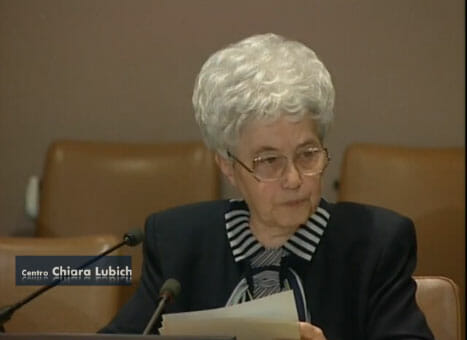
Chiara Lubich: “Toward a Unity of Nations and a Unity of Peoples” – United Nations Headquarters (New York), 28 May 1997
War is irreligion: “Lastly, we cannot give ground to those who attempt to describe current conflicts as “wars of religion” – Maria Voce went on. “War is by definition irreligion. Militarism, economic dominance and intolerance at all levels are causes of conflict, together with many other social and cultural factors among which religion is often only an unfortunate pretext. What we are witnessing in many areas of the world, from the Middle East to Africa, including the tragic deaths of hundreds of people fleeing wars who are shipwrecked in the Mediterranean, has very little to do with religion. From any point of view, in these cases we should not speak so much about wars of religion but more concretely, realistically and prosaically, about the religion of war.
What can be done? Quoting Chiara Lubich, Maria Voce invited the audience to have the courage to “invent peace”. “There are many signs that a new awareness may finally emerge, out of this serious international situation, of the need to work together for the common good, (…) and with the courage to ‘invent peace’. The time for ‘holy wars’ is over. War is never holy, it never has been. God does not want it. Only peace is truly holy because God himself is peace.”
She ended with reference to the Golden Rule which reflects the foundational inspiration of religions and unites them, so that they should “not [be] a tool used by other powers, even for the noblest aims; or precepts studied so as to resolve conflicts or crises, but rather a spiritual process which can be lived and becomes a community able to share and give meaning to the joys and sufferings of people today, channelling everything towards the realization of one universal human family.”
Read the full text
18 Apr 2015 | Non categorizzato
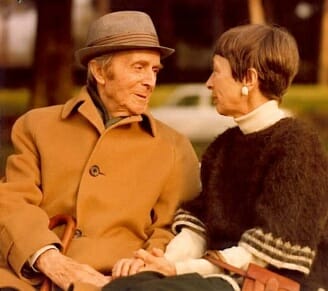
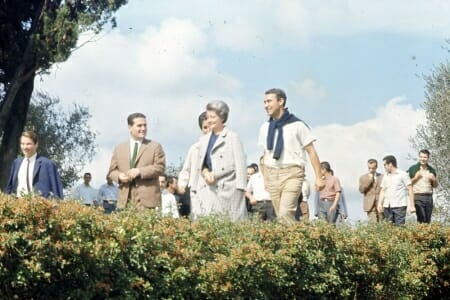
“It is nearly impossible to put into words what Igino Giordani was for the Focolare Movement. He was a co-founder of the Movement. Being co-founder of a Work that the Church recognises as its own involves a multiple and complex activity of grace, true and varied impulses from the Holy Spirit, as well as actions on the part of the individual that are determining for the Work. These graces often come in the form of penetrating and prolonged suffering, often as light, graces and love that are not ordinary. It is better left to the history of the Church and the spiritual movements that embellish it through the centuries, to speak about such people.
A focolarino prays, works, and suffers in order to reach a goal: the perfection of love. Therefore, we feel it is our duty to confirm that Giordani reached this goal. In our judgement he reached the perfection of love.
He personified the name by which he was known in the Movement: “Fire” (Foco), that is, love towards God and towards neighbour, the supernatural and natural love which lies at the roots and is the summit of Christian life. He contributed in a unique way to keeping alive in our midst the reality of the Word of Life given to him when he entered the Movement: “Love one another as I have loved you.”
Those who knew Igino Giordani well are all in agreement that he had lived the Beatitudes. Exceptionally ‘pure of heart,’ he offered married people from around the world the possibility of a unique consecration to God while remaining in the matrimonial state, through spiritual virginity, the effect of burning charity. This purity refined and heightened his holiest sentiments.
He was ‘poor in spirit’ with complete detachment from his possessions, but above all from himself. He was full of mercy. In his company even the most miserable sinner felt forgiven, and the poorest pauper felt like a king. One of the most remarkable characteristics was that of being a ‘peacemaker,’ especially in his life as a politician.
He came to possess that meekness that leads to possessing the earth. He won over everyone who drew near to him. Everyone felt at ease with him, even the young were able to establish a relationship with him. Especially during his last years he seemed to radiate something supernatural when he spoke.
He “hungered and thirsted for justice” and fought for it all his life. Almost immediately he was persecuted for the sake of God’s name. So many sentences of the Gospel make us think of him.
From Giordani one learns the significance of that conversion which Jesus asks for when he says that we must become like little children. He was a fine Christian apologist and apostle. When it seemed to him that he had found a font of clear water flowing from the Church, he “sold everything’ to follow Jesus and to satisfy his thirst with that water.
He suffered because of the marginalization of the laity, and he aspired with that big heart of his to bring down the dividing walls between the people living in the state of perfection and the others – whom he would jokingly add – were living in the state of imperfection. In other words, he was very sensitive to the signs of the times; indeed, he himself was a sign of the times, of these times in which the Holy Spirit calls the entire People of God to holiness.”
(Taken from: Chiara Lubich, Igino Giordani focolarino, «Città Nuova»n. 9-10 – May 1980)
16 Apr 2015 | Non categorizzato
In carrying out his extraordinary mission, the Apostle Paul conducted his life in a particular way: he strove to become all things to all people. In fact, he tried to understand everyone, enter into the mentality of each person: to be a Jew with the Jews, and with the non-Jews – those without a law revealed by God – to be as one without the law.
Paul followed the Jewish customs whenever this served to remove barriers or to reconcile souls; but when he worked in the Gre¬ek-Roman world, he adopted the culture and way of life of that world. He wrote:
“To the weak I became weak. I have become all things to all people, that I might by all means save some”
He saw before him the unlimited horizon of freedom from sin, from death, from the law, from the reign of Satan, from the barriers imposed by nationality, class and sex, from every form of domination by others, from the taboos of food and customs, and so on.
Paul himself lived this freedom, and with the Gospel he offered it to the communities he founded.
And yet in the liberating reality of Christianity that he announced, Paul recognized the need – or rather, the imperative – to become the slave of someone: of his brothers and sisters, of each neighbor.
He understood this essential duty from the example of Christ, who let himself be crucified in order to reach every person whatever his or her situation, in order to become the servant of everyone.
By becoming man, God drew close to every human being, but on the cross, he proved his solidarity with each of us sinners, with our weaknesses, our sufferings, our anguish, our ignorance, our questions, our burdens, our moments of feeling abandoned.
Paul, too, wanted to live this way, and he declared:
“To the weak I became weak. I have become all things to all people, that I might by all means save some”
The purpose of your life and of each new day is to reach God – and not alone, but with your brothers and sisters. In fact, you also, as a Christian, have received a call from God similar to the one received by Paul. Like the Apostle, you too must “save” someone, must “save some at any cost.”
There are those who are next to you all day long, and those you meet on the street; those with whom you speak on the phone, and those for whom you work. They may be rich or poor, men or women, fellow citizens or foreigners.
Love them all.
But this time, prefer the weakest. Make yourself weak with those who are weak in order to save them. Reach out to those who are weak in faith, indifferent or far from God, to those who profess to be atheists or who belittle religion.
If you make yourself one with them, even in their “weaknesses,” you will find that Paul’s apostolic method always works: you will conquer them!
Do you have a spouse who does not like the Church at all, and who enjoys spending hours watch¬ing TV? Keep him or her company whenever you can, as much as you can, taking a lively interest in what he or she likes to watch most.
Do you have a son who has made sports the center of his life, so much so that he is not interested in anything else, and has even forgotten how to pray? Be¬come a more avid sports fan than he is himself.
Do you have friends who love to travel, to read, to study and who have thrown to the wind all religious principles? Try to understand them by understanding their preferences and their needs and if you can, help them to find what they are seeking.
Make yourself one – with everyone, in everything, as much as you can, except in sin. In the case of anything sinful, dissociate yourself.
You will see that making yourself one with your neighbors is not time lost; it is all time gained.
One day, in the not-too-distant future, they will want to know what interests you.
And then, gratefully, they will discover, adore and love that God who has been the impetus for your Chris¬tian behavior.
Chiara Lubich
Audio in italian
Source: www.centrochiaralubich.org
