27 Mar 2015 | Non categorizzato
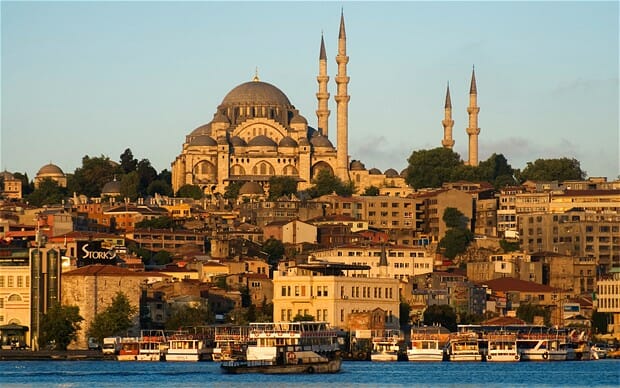
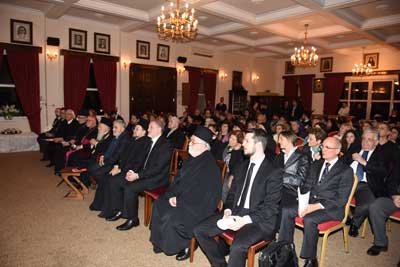
Istanbul: Patriarch Bartholomew does the honours in the Orthodox church of Aya Strati Taksiarhi, at an event involving more than a hundred representatives from the Orthodox and Catholic world, marking the 7th anniversary of Focolare foundress, Chiara Lubich. Attendees included the Metropolitans Ireneos, Apostolos and Elpidophoros; two Archimendrites, Father Vangeli who translated the books from Greek into Turk; and the Great Archimendrite Vissarion. Also attending: Armenian Catholic Archbishop, Levon Zekiyan and the Catholic Bishop, Louis Palâtre, as well as many others. The books were presented by Maria Caterina Atzori, linguist from the Focolare’s Centre for Studies who translated the books into Greek. The moderator was journalist Nikos Papachristou from Athens.
“During the course of the centuries, the divine epiphany of the Lord has been manifested in many ways, so that the human family could understand the things of God,” the Patriarch exhorted, after he opened the event with a prayer for Chiara, and intoning the hymn to the Holy Spirit. “He has never tired of raising up holy men and holy women who, through their example, with their love founded on divine philanthropy, and with their word inspired by the Holy Spirit, have continually solicited a metanoia, a conversion of heart for the whole of suffering humanity.”
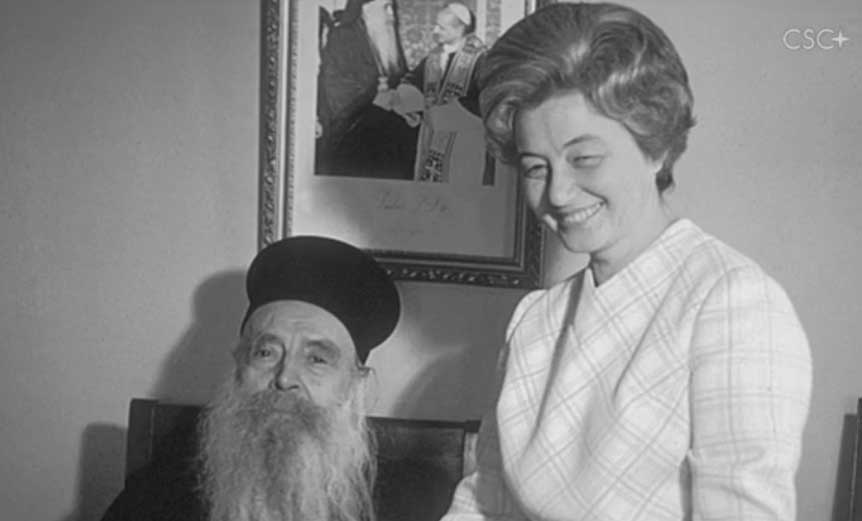
Video “Atenagora, Paolo VI and Chiara Lubich”
In his speech, he described the spiritual figure of Chiara, beginning with his direct testimony as an eye witness of the encounters between Chiara and Patriarch Athenagoras: “How could one not embrace the Wisdom of God in the blessed work that our sister Chiara has offered to our Churches, to our societies and to all people of good will? She whom our beloved Predecessor (. . .) lovingly called Tecla, the disciple of Paul, the woman who is equal to the Apostles.”
Then he outlined the salient points of the path of spirituality that she opened in the Church and beyond: “Gentle Chiara had answered God’s call, being totally conformed to her Master, but especially allowing herself to be made into a vessel that offers salvation, in order to bring all to Christ. Her life was spent in finding paths of encounter and dialogue with everyone, distinguished by a profound respect for every culture in which she knew how to conduct a journey of encounter, mutual understanding and mutual collaboration.”
“Chiara Lubich began her life journey, dedicated to the Lord, in the suffering of war. In this suffering she lived the Jesus Crucified and Forsaken, and understood that there is no Resurrection without passing through the downfall. And the suffering of Christ became her personal suffering, but never despair.”
“Her life was characterised by a zeal for Holy Scripture which, in her, became founding Word, living and exhilarating. She lived the Lord’s commandment to its depths: “As I have loved you, you should also love one another” (Jn 13:34). To the point of infecting countless people with this love, different among themselves, but united in a concrete ideal of communion.
 Chiara was ever faithful to her Church. And in this conviction, she felt the drama of the division, of the impossibility to receive from the same Chalice.
Perceiving the cry of suffering because of the laceration, she offered herself entirely for the charism of unity, becoming its instrument in the hands of God in meeting the heads of Churches and simple faithful. But she did not stop there: she sought, urged and invited us to find new paths of communion.”
“Chiara had a totally particular love for the Holy and Divine Eucharist of the Lord. In the Eucharist she perceived the gift of love from the One who was offered once for all, to draw man to himself. We can say that in her a Eucharistic conscience of unity was formed.” “There is still another aspect that we can see in the work of Chiara: the Unity of the Trinity, through the Eucharist, passes into the family (. . .) The place where mutual love can shine, which joins its members in a totally natural way (. . .) And in this context, the unity of the human family can be glimpsed in all of its aspects, in the society, in politics, in economy, in respect for the work of God for each one of us singularly and in all of His marvelous creation. The message and work of Chiara, therefore, turn out to be ever timely, especially with regards to the global context in which we are living.”
Hence, “the gift that the Focolare Movement today offers in presenting Chiara Lubich in the Greek language is particularly appreciated. We welcome it as a gift amongst brothers and sisters, which will surely be appreciated also by the Greek public. To the Greek-Orthodox faithful this wondrous message of unity and love!”
In conclusion, he turned directly to Chiara that she might intercede “so that the dawn of a new day for this wounded humanity might soon dawn, and that the sentiments for which she had spent her entire life, would produce abundant fruits, wherever today we do not find anything but darkness and bloody martyrdom.”
23 Mar 2015 | Non categorizzato
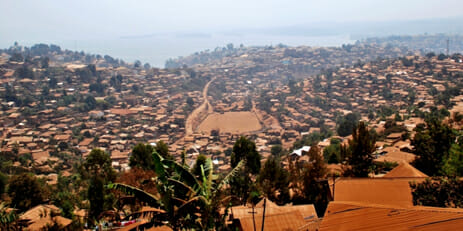
Bukavu, Democratic Republic of Congo
The Democratic Republic of Congo: a big country with immense natural resources. A population of 72 million with hundreds of ethnic groups. The difficult relationships with the West, the war for the exploitation of minerals, the drama of a forgotten people.
We interviewed the Congolese biologist, Pierre Kabeza, trade union member, a family man who, three years ago, had to leave his city in the Great Lakes region, and who now is at Sophia University Institute.
Why did you have to go on exile, leaving your wife and daughters? Bishop Munxihiwa, bisop of Bukayu who was killed for his battle for justice used to say: «At times there are things we don’t unde stand or see clearly, if not with eyes that have cried.” After his death we were all discouraged but Mons. Kataliko arrived, and decided to follow his footsteps, to speak out in the name of those who have no voice. Kataliko dried the tears of a population which was no longer heeded. On 24 December 1999 he wrote a message denouncing the unjust war, the occupation of Congo by the nearby countries, the exploitation and plunder of mineral resources. This was why they stopped him from doing his pastoral work for 7 months and 20 days. The bells no longer rang. We did sit-in protests every day until he returned to the Diocese. Muslims and Christians of Bukavu, went together to the cathedral where Bishop Kataliko offered mass and forgiveness for those who had made him suffer. He died in Italy a few weeks later.
To continue the work of our bishops – defence of the truth, battle for justice and liberty – a new group, the “Dauphin Munzihirwa Kataliko” (DMK) was formed. The initiatives to fulfil these aims irked their enemies. As head of the DMK, I was involved, together with the group in the field of education, to start with the education of children. The teachers in fact, were not paid by the State but financed by the parents. We took the steps to make the Congolese government assume all its responsibility for the country, and I spoke even to the President of the Republic, reminding him of article 43 of our constitution which recognizes the obligation for children to attend elementary school. He listened but sad to say, up to now nothing has changed. Because of my commitments however, I was threatened, arrested and tortured. My house was attached twice and they destroyed everything. This is why I had to leave to save my life.»
A forgotten war, 6 million dead and 2 million women and children escaping from their villages and cities. What else can you recount?
Yes, also Maria Voce, President of the Focolare said that it seems as if the dead in the “lands far from the Western world” are given less value in terms of humanity and “less political importance, thus weighing less on the conscience of the International community. This is the case of Congo. Our dead are of no interest to the international community because we are at the outskirts of the world. And yet, today, war is a common enemy for all. Mandela taught us that “we were born to be brothers.”
In Europe little is said of the war in Congo, and then without saying the whole truth. It is not only an ethnic war. It’s true that we have many problems in Africa, but I wonder: why is the fire lit only in the rich countries where minerals and oil abound? The situation is always fiery in places where we find coltan, gold and diamonds. And where do all these minerals end up? They are used for smartphones, air bags, navigators and so on. It is estimated that for every kilo of coltan extracted in Congo, two children die. Others are obliged to become “children soldiers.” It would important to let our children know that on using a videogame another child in the peripheries of the world loses his life.»
What does this intellectual and human experience at Sophia signify for you? What are your expectations for yourself and for the wellbeing of your country?
«Sophia was one of the gifts I received in Italy, I think it would have been better if I had made this experience before committing myself as a union member because I now understand the importance of fraternity. I think that the failure of our Congolese society lies in the fact that we have forgotten the principle of humanity, a force that unites us all, and excludes no one. Today I understand that the other is part of me, that his problems are my very own. Political commitment should help us understand that we are responsible for one another. We are equal but different and if mankind exploits this wealth, all would benefit. Sophia has taught me also to discern the path of dialogue. True dialogue which makes room for the other, where there is always a part of the truth.»
Video
17 Mar 2015 | Non categorizzato
“Dearest Gen, I’m sure that what you’re expecting from me is a formula that sums up everything, that illustrates the truth and gives you the recipe to live a meaningful life. It’s actually something I’m meditating on during these days. I’m totally convinced that the only sure way to reach perfection is to follow the path of suffering embraced out of love. This is how the saints, throughout the centuries, perceived it. The fact is that to those who wished to follow him, Jesus spoke clearly: “Those who wish to become my disciples, let them deny themselves, take up their cross and follow me” (Mk 8:34). “…take up their cross.” Each of us, in order to follow Him, the Perfect One, needs to embrace our own cross, our own sufferings. We all have them, there’s no doubt about it. So let’s get up in the morning with a new heart, despite our human desire to put suffering aside and forget about it. Christians are asked to go that little bit further. Because they are followers of Christ, they know that suffering is precious, that it should be accepted as Jesus accepted the cross, and so they try to embrace it wholeheartedly. What will be the outcome? What will be the fruits? We will be rewarded with patience, purity, meekness, poverty, temperance and so forth. And along with all these virtues, we will attain perfection, the real life. Are you willing to give it a try? Every athlete who aims high must be willing to experience fatigue, sacrifices and struggles. Our goal is Jesus. In order to follow Jesus, we need to appreciate suffering. This is my ardent wish for you, that you may experience how to be worthy of Him.”
Chiara Lubich
(translation of the Italian text taken from “Gen,” October-November 1979)
Centro ChiaraLubich
11 Mar 2015 | Non categorizzato
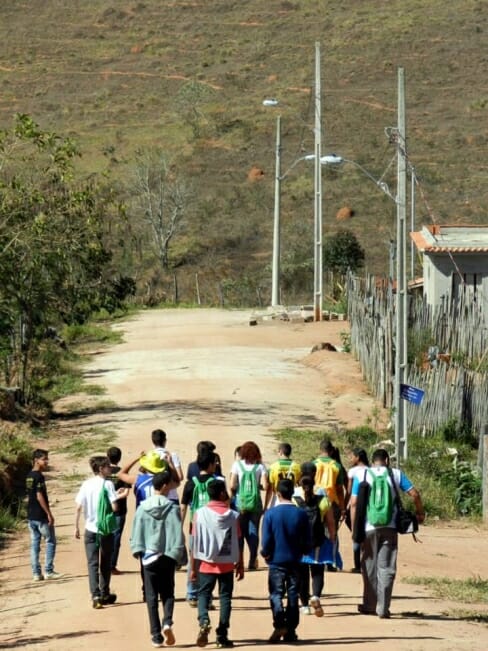
“Yesterday a man was shot 13 times.” This is what the first person who opened the door of his home to several young people who, on the weekend of February 20-22 always presented themselves to him with a smile. We are on the peripheries of Juiz de Fora, a deprived neighbourhood in the State of Minas Gerais (Brazil). After a few hours that same person said to those young people: “Whereas yesterday we experienced terror, today we feel only love.”
Those young people were from the Focolare, Charismatic Renewal, and Shalom Community – parish youth – a hundred in all. In just over a year they have visited ten cities and met some 5,000 families with whom they shared sorrows and joys, courageously announcing to them that God loves them immeasurably. The people expressed joy for their presence: priests are few and do not manage to reach everyone who is in need.
“It all began during World Youth Day 2013 and the meeting of millions of young people with the Pope on Copacabana beach,” the Gen from Minas Gerais recount. “During the final Mass, a girl in our group began to feel the central message of World Youth Day quite strongly: “Go out and make disciples of all the peoples.”
During the return trip to Juiz de Fora, Leticia – that’s the girls name – shared what she had felt with the other Gen and, together they decided that it would be an opportunity to speak with their archbishop, Don Gil Antônio Moreira.
Leticia went to visit him with the encouragement of her friends. The archbishop had already prayed that WYD would not only remain a great memory, but that the intense experience shared by so many young people from around the world might continue in some way.
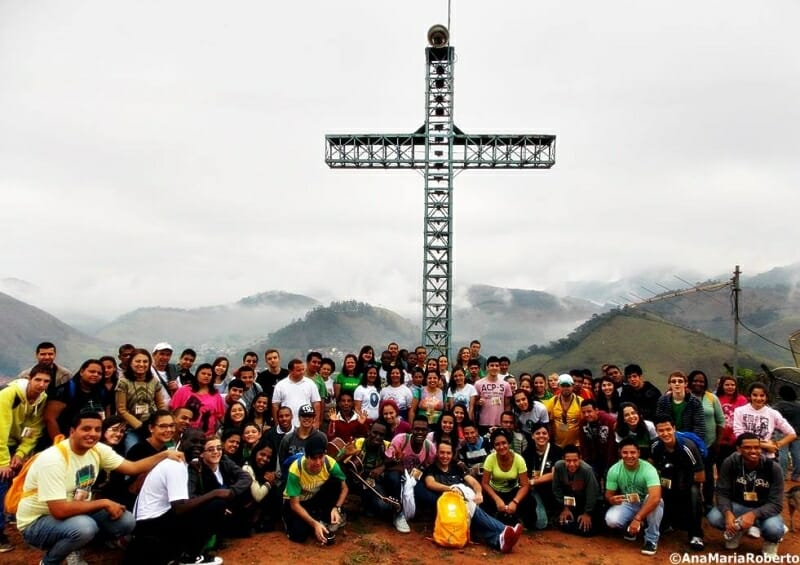 That is how the “Young Continental Missionaries” project began, a name proposed by the archbishop, with the goal of launching young people to reach out to others, to be a living Church that “goes out, together and prepared.” These three words are the three main points of the project: mission, prayer, formation.
“It’s just great to go together, young people from different parishes and Movements, but like brothers and sisters,” Vinicius explains, “respecting each other’s diversity in the way of praying and talking in intimacy with God. Also quite important is the dialogue that is generated with several families from other religions.”
“Going into the homes of the people,” Ana Paula adds, “many open their doors to us and invite us in, and we discover the most beautiful treasures, as when we visited an Evangelical Christian who had lost her husband only a few days earlier. After we were together for a while she said: “I can no longer be sad, because he’s with the Father in Heaven.”
Cristiano concludes: “We go into the peripheries of the city never knowing what we will meet but always trusting in God. We feel Him saying to us today: “Love one another as I have loved you.” Then, especially love those who are most in need, even when we are tired or make mistakes. You can always begin again!”
7 Mar 2015 | Focolare Worldwide
