![I am Rwandese]()
13 Apr 2014 | Non categorizzato
 Twenty years ago, Pina’s country of Rwanda, was struck by an absurd civil war that resulted in the death of at least 800 thousand people in a few short months. “For the past twenty years my people have continued to mourn the victims of the war and, at the personal level individuals visited private cemeteries.” On April 6, 1994 President Juvenal Habyarimana’s aeroplane was struck by a missile attack. None of the passengers survived, and the war that was already brewing broke out.
In that moment Pina was living in the Philippines where she was following her vocation to the spirituality of unity that she had been living since she was a child. She recounts: “My family was also impacted by the war. Thirty-nine of my relatives were murdered. I was taken by despair. Gradually I felt emptied of those sentiments that had filled my soul up until then, I felt that nothing made sense anymore.”
She was transferred to Kenya in order to follow the situation more closely. She worked at the Red Cross and assisted the wounded and refugees from Rwanda: “but I wasn’t able to look at the people of other ethnic groups in the face, the ones who had taken part in the massacres.” The pain was too vivid. One day she came upon some people from another ethnic group and couldn’t avoid catching their eye. The animosity grew. “I thought about revenge, but I felt confused. I had come to a crossroad: either I would close myself in my pain and anger, or I would ask God’s help.”
A few days later at the office, she recognized some people from the enemy group who were living right there in the city. “They recognised who I was and felt uneasy, they began to turn back and walk the other way. They also saw me as their enemy.” Pina saw that forgiveness was the only hope for social reconciliation. She had learnt this from the Gospel. “With a sense of power, I walked up to them and spoke to them in their own language. I didn’t mention my own family, but only tried to show interest in what they needed. Just then, something loosened within me.” A glimmer of light had been given to Pina.
 A year later she returned to Rwanda. She hardly recognised her sister, the only family member who had survived the massacre. She learnt that the man who had betrayed their family – a very close friend – was in prison. “Although I was in pain and opposed to the people who invoked the death penalty, it was clear that I could pull back now that I had taken the first step toward forgiveness.” She took her sister who had witnessed the massacre. “And so we went to the prison together, to visit this man. We brought him cigarettes, some soap and whatever we could find. But mostly we went to tell him that we forgave him. And we did it.” Her sister, Domitilla, would soon adopt 11 children from several ethnic groups, without making distinctions between natural and adopted children, and later won a national award.
This year, Pina explains, “on the 20th anniversary we have something new: Tutsi and Hutu together in carrying remains to the National Cemetery for burial – all of us Rwandese.” They are the true heroes of this country. “This is an important step forward,” Pina remarked, “we are returning to the way we were before the war.” The project was named The Flower of Reconciliation, so that it might continue to bear fruits of peace in Rwandan society.”
See also:
Il Rwanda ricorda, venti anni dopo, by Liliane Mugombozi in Città Nuova online
Il fiore della riconciliazione, by Aurelio Molé in Città Nuova online
![I am Rwandese]()
12 Apr 2014 | Non categorizzato
 Unemployed The factory has for some time now been showing signs of great difficulty. We found ourselves on the street without any possibility of obtaining any aid in time from the unemployment fund or from other sources of providence. Unemployed, without doing anything at home, I was entering into a deep feeling of frustration and uselessness. We were living on the salary of my wife. Then, certainly helped by our faith, I told myself that I could use my time to do odd jobs around the house that my wife had been asking me to do. So I started to repaint the doors and windows, put up the wallpaper… The other members of the family also got excited about it and they started to help me. It wasn’t important anymore to bring home a salary, but the real capital which the family needed was love, unemployed or not, I could love. L. R. – Italia Human justice n spite of the fact that I had prepared myself with the best of intentions, this Monday the audience at the court hearing was sad and lifeless. At the end of the morning I was discouraged by this state of justice that sometimes is so easy to just get over with. I felt that I had to do something. In the meantime the last defendant presented himself. He seemed much older than his age. He was already imprisoned before and this time he was caught with a stolen car. I came to know from him that when he left prison, he was able to get a regular job; his employer was satisfied with his performance. So I modified my closing argument and I asked the court for a prison sentence to be enforced during his annual leave. In this way he could keep his job. The court accepted this. A few days later, a television journalist telephoned me expressing his surprise at my action. I answered him that I just did my job, using all the resources of the law. During the television program, that journalist recounted the fact concluding in this way: «Applying the law with heart and intelligence can make justice more human». A.B. F. –Francia Builder of peace I am a seminarian. In the difficult situation of ethnic conflict in my Country, my village too was divided. Two factions were fighting in the absence of any police presence. Even if I knew of the risks that I faced, I asked God the strength to be a builder of unity among my people and, going through a barricade of tree trunks on the road, I was able to reach one of the two groups that took refuge in the parish grounds. I asked to speak to them and I was able to tell them sincerely how unfounded were the reasons for this hate and division. After listening to me, the asked me to also go and talk to the other group. Maybe I was convincing, because in the end everyone went back to live together. Gilbert – Burundi Taken from: Il Vangelo del giorno (The Gospel of the day), Città Nuova Publishing House.
![I am Rwandese]()
11 Apr 2014 | Non categorizzato
 The title of the event was: “The merciful love of the Holy Trinity in the theological vision of Father Dumitru Stăniloae and of Chiara Lubich in the context of contemporary ecumenical dialogue”. Commenting on it, Professor Vasile Stanciu, Dean of the Faculty, said it expressed the depth of the subject endeavouring to compare the theology of one of the greatest Orthodox theologians of the last century, so Fr. Dumitru Stăniloae is considered, with the charism of Chiara Lubich.
Theologians from three churches took part: Orthodox, Catholic and Lutheran. Five Romanian Orthodox Professors from the Theological Faculty of Cluj, Alba Iulia and Sibiu, and five from the Focolare Movement – from the Sophia University in Loppiano , from the Lucian Blaga University of Sibiu, from the Oriental Institute of Regensburg and from “Centro Uno” the Focolare’s secretariat for ecumenical dialogue.
The symposium began with a prayer and the greeting of Metropolitan Andrei in whose metropolitan area the meeting took place. The Orthodox Auxiliary Bishop, Somesanul Vasile, who participated at various times said: “Yet again, I can’t but be impressed by the warmth of the love with which you come to Cluj, the warmth we find every time and cherish in our being, in our daily life … we certainly try to transform that love into life, as did Fr. Stăniloae and Chiara Lubich”.
Experiences on mutual love of Orthodox and Catholics – young people, families, priests – emphasized that a life [of faith] is essential for Christians; theology understood in a very vital way and the path of ecumenism understood according to the trio of terms, “love – life – truth.” Stanciu highlighted the risk that theology can often remain at the level of theory and is difficult to put it into practice, it needs to be lived.
For Prof. Sonea, pro-dean of Cluj – “doing theology” is not an abstract discourse about God, but about the living God, in God and about God. This way of doing theology is specific to Chiara Lubich and provides an element on which we can build a dialogue that is not seeking the conversion of the other, but the discovery of the other. In the spirit of love we are in unity. We need to give a common witness to the world .

Metropolitan Andrei
As pointed out by Prof. Stefan Tobler from Sibiu at the conclusion, in the radicalism of love and in theological rigor, “we really are together.”
Prof. Ruxandra from Bucharest testified that she knew both Chiara and Fr. Stăniloae. ” I met Chiara first, at a meeting of young people in Rome which revived my faith in God and brought me back to the Church. Then when I was a student I heard Fr. Stăniloae talk about the great love of God towards men and about the love from the heart of the Blessed Trinity, the model of supreme love, the model of love in the family. For me, as an Orthodox, it was amazing to see how Orthodox, Catholic, Lutheran and Reformed theologians have found a common spirituality in the thought of Chiara Lubich and of Father Dumitru Staniloae, both theologians of love. It was a wonderful experience.”
With this meeting another step forward has been taken, opening up new perspectives on this journey together.
![I am Rwandese]()
10 Apr 2014 | Non categorizzato

The Focolare’s little town of Fontem
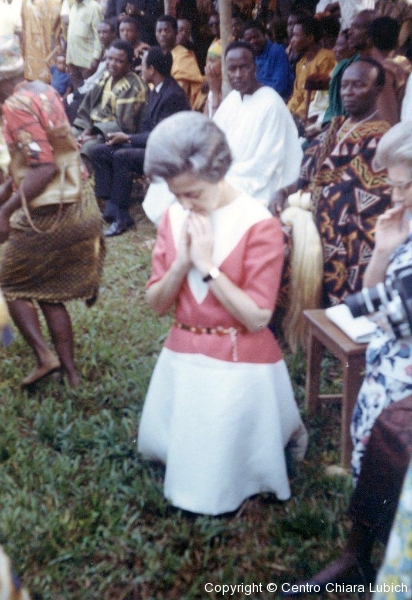
Fontem, 19 January 1969. Chiara prays during the Mass celebrated for the inauguration of the hospital “Mary Health of Africa”

1974 – The inauguration of the Church attended
by the Fon of Fontem
![I am Rwandese]()
9 Apr 2014 | Non categorizzato
 Rio Tercero is a beautiful city in the Province of Cordoba, in Argentina. Situated in a mainly agricultural and livestock area there was great industrial expansion here in the middle of the 19th century (one the most important factories, Fabrica Militar Rio Tercero, is sadly famous for the fatal explosions which occurred there in 1995) which brought with it great demographic growth. Today there are many social challenges, particularly in the outlying neighborhoods where violence is the order of the day due to lack of work and education. Six years ago Estela, who is a dentist, was asked by her parish priest to take on responsibility for Caritas, with the specific task of introducing the spirituality of unity to this particular structure of the church. She began by asking people’s help coming out of church. If she could do it, with the little time she had what with work, children and grandchildren … surely others should be able to help as well. So together with the team that was set up she went to visit families in the poorest districts: meeting many young mothers with their children and husbands who were either alcoholic or drug addicts. They opened the ‘Tienda’, a shop selling clothes for the whole family. When winter came everyone was looking for warm blankets … but there just weren’t enough to go around. They decided to make them themselves. A workshop was set up involving 28 young mothers. As relationships grew, the women felt valued and appreciated. Estela suggested to everyone that they could include some meditation in their daily routine and to try to live a phrase from the gospel each month. When winter was over nobody wanted to leave. What were they going to do? “We had the idea of making bread”, Estela tells us. “We started with just an ordinary oven. We all brought some flour and yeast and would make bread together for our own families and then some extra to sell, sharing the proceeds. But it wasn’t enough. I updated the parish Pastoral Council about our activities and they encouraged me to go ahead setting aside enough money to invest in a bigger oven. We told all the parishioners about the initiative and everyone started to bring flour. In this way a bridge of unity was built between the people of the parish, which is in the centre of town, and the women from the outskirts who come with their children because they have nowhere else to leave them.” But it wasn’t possible to go to sell the bread with the children tagging along.
  So activities for the children were started, with an extra-curriculum support programme and fun activities organized by the young people of the parish. “As time went by, the relationship between the mothers and their children began to change. We tried to help the children appreciate the work the mothers were doing and on their part, the children were also spurred on to study harder seeing the efforts their mothers were making to earn something.” As time went on the business became public: the bread is now sold to several shops in the city and the Local Council has got involved setting up a development project. The result? – a real bakery! With 4 large ovens, all the necessary equipment and a large quantity of flour. A micro-business has been set up, where the workers themselves are the owners. At present there are 4 having responsibility for the bakery, serving schools, pizza shops and other bakeries on a regular basis. “Even if it’s only a small business,” Estela observes, “It is still a source of employment; but the most important thing is the integral human formation that has been carried out with each person and with their families.” A process that continues to influence others.
