![Legal Adoption for Detained Citizens]()
23 Feb 2013 | Non categorizzato

- Five hundred prisoners have benefited from the project that has re-opened 300 court cases. These are prisoners who would otherwise still be awaiting trial and burdening the prison system.
- Three hundred law students took part in the project.
- Three hundred and fifty families of the prisoners we assisted by the students, health care workers and social workers.
- More than 200 citizens were redeemed through the project.
- More than 1000 prisoners have benefited from assistance through clothing drives, toy drives and toiletries.
- Articles, essays and awards
These are only some of the results (between 2001 and 2012) from the Legal Adoption of Arrested Citizens project and presented by Professor meeting organised by CeD Fraternity, Law and Social Change at Mariapolis Ginetta (January 25-27, 2013). This project seeks to face issues related to the penitentiary system in the State of Pernambuco, as they regard detainees – awaiting a court hearing – who should be assisted by Public Defense agencies.
 These are real life stories of legal abandonment, of people without defense, but especially in need of a hopeful and noticing glance. One of the project’s constant challenges is to draw students to this situation, especially since the “adopted” prisoners have committed or attempted to commit serious crimes. Taking brotherhood as a political and legal principle to be taken into consideration, how would the law worker then operate?
Starting from an academic look at the professional humanization of law, and encounter takes place: the prisoner finds the way of having his or her human rights respected, which are often being violated (with overcrowding, for example, where 1,400 people are living in a space that was meant for 98); future professionals develop their critical sense and become aware of their power to change society. But above all a fraternal dimension is established between student and detainee, one that permits both to experience citizenship in all it fullness as this fraternity is joined to freedom and equality.
 The Legal Adoption for Detainees Project began in 2001 as a result of an agreement between the ASCES School, the Tribunal Court of the State of Pernambuco and the State Secretary for Citizenship and Justice. Brotherhood was gradually considered to also be a pedagogical principle in the training of law students. The research group prepares students for accompanying a case before a jury with lessons on theory and technique. The methodology involves interviews with the detainees, their families and raises awareness in schools through the use of media.
Moving from assistance of prison populations to a debate on fraternity, you begin to see how human rights and fraternity are closely linked because of basic democratic values, but especially for spreading a culture of peace. These eleven years of work demonstrate that it is possible to create a system for the protection of human, social and legal rights of detainees by working for the distribution of goods produced by social collaboration.
![Legal Adoption for Detained Citizens]()
22 Feb 2013 | Non categorizzato

From the 10th to the 13th May 2013, the little town of ¨Piero” in Nairobi (Kenya) will host the ¨Enculturation School¨, a workshop that this year will have as the main theme ¨The Person” in various African traditions. Besides, a group of young people will take part in the first stage of the Project “Sharing with Africa”. In preparation for this event, we publish Giulia´s account of her Ugandan experience.
«Malpensa Airport, 2nd August 2011: destination “Kampala – Uganda”. I felt extremely excited although I still couldn’t imagine that in the coming four weeks I would have one of the most beautiful and important experiences of my life. For a month I lived together and shared daily life with another Italian girl and three Ugandans. This obliged me from the very beginning to put aside all my ¨western¨ habits, every way of doing or thinking, in order to be open myself to them and their life. But what at first were just small sacrifices, soon became a treasure, a new way of thinking and relating to people around me.
I was touched by the African concept of person. For them, the person, the other, is at the centre of each event and action, and not time, doing things in a hurry, commitments. Therefore, for instance, a meeting will start when everyone is there, and not simply when the clock says its time, or buses will leave when they’re full and everyone’s on board, and not at a given scheduled time. “How can you westerners base your daily life on the flow of time, when it does not belong to you and you cannot control it in any way?” It’s a question that still echoes in my mind when, overwhelmed by the frantic rhythm of my daily routine, I risk to become indifferent to those around me.
 A typical concept in Sub-Saharan Africa is “Ubuntu”, an expression that could be translated as “I am what I am because of what we are all together”. Nelson Mandela explained it as follows: “Ubuntu does not mean to forget ourselves; rather it means to ask ourselves: do I want to help the community around me to become better?” How wise these words are! And they are not mere words, but real life, daily life lived from the viewpoint of the “we” and not only of the “I”. Everything is shared, everything is done together, the neighbours´ children are like your own, and even a complete stranger who happens to knocks on your door by mistake, immediately becomes a part of the family.
I will never forget the emotion I felt when I was invited for lunch to one of my flatmates home: a house without a toilet, in a neighbourhood not very different from a slum. But the table was set and the food abundant, because no sacrifice is too big when you invite your daughter’s friends for lunch. Hospitality, reciprocity and sharing with the other are more important than anything else.

I left Uganda feeling richer than before. For weeks I was the foreigner, with a different skin colour, a different language, different habits. But I had always been welcomed, I always found a smile and an open hand, and I never felt discriminated, or out of place.
Now, when I meet on the streets many immigrants who live in my city, I look at them with new eyes: I try to put myself in their shoes. This portion of Africa that every day disembarks in Europe deserves that same, huge welcome that I, a foreigner and a white, had received in Uganda in the first place. It’s made up of sharing, of reciprocity, of Ubuntu; it’s something that goes far beyond simple respect for those who are “different”. Different, from whom? A few hours of flight and the “different” one is you, and you realize that we are much more similar than what we may think ».
![Legal Adoption for Detained Citizens]()
10 Feb 2013 | Non categorizzato

The Focolare’s little town of Fontem
«The small town of Fontem in Cameroon deserves to be mentioned today. Its name could truly be this: “You did it to me.” It’s like a fairy-tale story. In the bush of the Cameroon there lived a people who were once very numerous. Almost all of them were pagans, but very dignified, morally sound and rich in human values. We could say that they were a naturally Christian people. They belonged to the Bangwa tribe, but the population had been decimated by sickness. In fact, ninety-eight percent of the children were dying in their first year of life.
Not knowing what to do, those Africans, with a few Christians who were among them, asked themselves: “Why has God abandoned us?” Then they acknowledged: “Because we don’t pray.” And so, all together, they decided: “Let’s pray for a year; who knows, maybe God will remember us!”
They prayed, day after day, with only one thought in mind: “Ask and you will receive; knock and it will be opened to you.”(Mt 7,7). They prayed the whole year long. At the end of the year, however, nothing had happened.
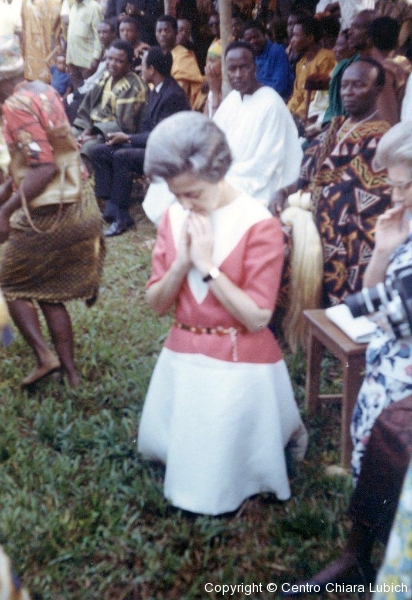
Fontem, 19 January 1969. Chiara prays during the Mass celebrated for the inauguration of the hospital “Mary Health of Africa”
Without becoming discouraged, the few Christians said to the people: “God didn’t answer us because we haven’t prayed enough. Let’s pray for another year!” And so they prayed for another year, the whole year long. The second year passed and still nothing happened. They met again and asked themselves: “Why has God abandoned us? Because our prayers don’t have any value in the eyes of God. We are too bad. Let’s collect some money; we’ll send it to the Bishop who can ask a more worthy tribe to pray, so that God will have pity on us.”
The Bishop was touched by this and began to take an interest. He went to them and promised a hospital. Three more years passed but there was no hospital. At a certain point, focolarini doctors arrived, and the Bangwa people saw this as the answer of God. The focolarini were called ‘the men of God.’
The focolarini understood that in this place what mattered was not to speak. They could not say in those circumstances: “I wish you well, keep yourselves warm and eat plenty” (Jas 2:16).They said: Here we need to roll up our sleeves and get down to work. And they set up a dispensary in the midst of unspeakable hardships.
I went there three years later. That large crowd of people gathered in a vast open space in front of the living quarters of their king, the Fon, appeared to me as being so united and eager to be dignified, that they seemed to me as a people long prepared by Mary for Christianity in its most integral and genuine form. Even then, the village was already unrecognizable. Not only because of the works, roads and houses that had been built, but also because of the people themselves.
The previous work of the missionaries, who could visit the region only rarely, had already laid very solid foundations. Small nuclei of Christians had already risen up here and there, like a seed waiting to develop. But now the movement towards Christianity had assumed the proportions of an avalanche. Although the priests effected a rigorous selection, every month they baptized hundreds of adults. A government inspector who had made the rounds of the zone to inspect the elementary schools, declared: “All the people are strongly oriented towards Christianity because they have seen how the focolarini live it in a concrete way.”

1974 – The inauguration of the Church attended
by the Fon of Fontem
And we must say that the work of evangelization carried out by the focolarini during those three years was almost exclusively based on witness. There was a lot of work to do, indeed, almost only work, and under the most difficult conditions: because of the inadequate means and ability of local workers, and the rough roads and difficulty in receiving supplies. So there were no regular meetings, no large day-meetings, no public talks. Just a few private talks in casual encounters. And yet, every Sunday, the tent-like church became increasingly crowded. Together with the group that was already Christian, there was an ever-growing number of Animists who wanted to know more about Christianity. Now the church was overflowing, with more people outside than the packed crowds inside. Thousands of people assisted at Mass, several hundreds received Communion.
Fontem was a unique experience for us. It seemed that we were re-living the development of the early Church when Christianity was accepted by all in its wholeness, without limitations and compromises. And the experience of Fontem already began to interest other African communities, like that of Guinea, Rwanda, Uganda and Kinshasa in Zaire[1],, so that Fontem increasingly assumed its role as a pilot center for the surging of a characteristic evangelization. Now Fontem is already a large town, with all the essential aspects of a town. And it is also a parish.The focolarini became credible because they did to Jesus what they did to the Bangwa, giving the witness of love first of all among themselves and then with all the people.»
Chiara Lubich
Excerpt taken from a talk at the meeting of the Men Religious Movement at Castel Gandolfo, April 19, 1995
_________________________________
[1] Current Democratic Republic of Congo.
![Legal Adoption for Detained Citizens]()
14 Jan 2013 | Non categorizzato

Chiara Lubich at the World Council of Churches
«Jesus, here we are … first of all to ask you for something great, Lord!
You said: “Where two or three are gathered together in my name [in my love], there am I in the midst of them” (Mt 18:20). Kindle in us all a great fraternal respect, help us to listen profoundly to one another, arouse among us that mutual love which allows, indeed, which ensures your spiritual presence in our midst. Because we know, Lord, that without you we can do nothing” (See Jn 15:5).
But, with you in our midst, we will be enlightened by your light and guided on this day ….
You know … the same and yet different calling that has been laid upon us: to work, together with many others in the Christian world so that the full and visible communion among the Churches may one day become a reality. Even though we know that this requires almost a miracle. This is why we need you, Jesus. For our part … we cannot help but open our heart and reveal to you our deepest sentiments.
First of all, we feel the need to ask you for forgiveness on our own behalf, but also on behalf of our Christian brothers and sisters of all times, forgiveness for having carelessly torn your tunic, for having cut it up into so many pieces; or for having kept it this way because of indifference. At the same time, we cannot help but nurture an ardent hope in your mercy, which is always greater than any of our sins and capable not only of forgiving, but also of forgetting. Just as we cannot deny that we have a great faith in your immense love, which is able to draw good from every evil, if we believe in you and if we love you.
All this burns in our heart, Jesus, in this moment, together with gratitude for what Christians of many Churches have been able to do, with your grace, for almost a century. Prompted by the Holy Spirit, they have worked towards mutual reconciliation through a fruitful dialogue of love, intense theological work, and a general sensitization of the people to the need for unity.
And so, allow us to tell you, Lord, that although always in the acutely painful situation of not having achieved full communion yet, we sense in our heart the Christian optimism that your infinite Love cannot help but kindle. We begin our work then confident that you, who know how to win the world, will help us to help you fulfill your testament here on earth one day. Then with unity achieved, your testament will witness to the world that you are the King and Lord of all hearts and peoples. Amen.
Chiara Lubich at the World Council of Churches
Geneva, 28 October 2002
Published by New City Press in in the book entitled Living Dialogue, Rome 2002, p.47-49 (a collection of Chiara Lubich’s various talks during her trip to Geneva in 2002, with strong ecumenical imprint).
![Legal Adoption for Detained Citizens]()
27 Dec 2012 | Focolare Worldwide

‘Still burning in the Kenyan soul is the pain of the blood-soaked battles of the election in 2007 when more than 1000 people died.
“Never again!” is now the cry of everyone’s heart, while the country prepares for the presidential election in March 2013.
‘Many young people are engaged in initiatives for a year of peace.
‘Sr Bernadette Sangma (Director of Youth Ministry) and a group from the Focolare Movement working in the Catholic University of Nairobi, have welcomed this and promoted the idea of the “peace caravan”, which would unify the voices of the university students in Nairobi and make an impression on public opinion. As a symbol of this “earthquake of peace” the idea was to have a song that would be heard loud and clear throughout the nation!
‘This was the request made to Gen Rosso. After the 2007 tour there was already a profound friendship with Tangaza College and after some of us in 2009 went back to Kenya to give lessons and run workshops to teach “music with values”. We had a tradition of working together. How could we refuse this new request?
‘And so the song was written:
Jivunie nchi yako, kabila si silaha
Nyuma twasema, kamwe haturudi
wito wetu ni umoja
Be proud of your country! Tribe is not a weapon. The past never comes back. Our call is to be one.
‘Tangaza College and the Catholic University began to “recruit” young men and women from the various universities in the capital. Other young people from elsewhere became involved. Enthusiasm grew.
 ‘Magdalene Kasuku, a young journalist, presented “Jivunie” at official State Functions and at the huge celebrations on the 49th anniversary of Kenyan independence, on 12 December, in Nairobi’s Nyayo Stadium.
‘The song was heard with enthusiasm and it had been the government to propose that it should be sung at this major event in the presence of President Emilio Mwai Kibaki.
‘We recorded “Jivunie” with a choir to make it more “Kenyan” and to make it suitable to be left as an audio support for all the initiatives that will take place until next March.
‘Ponsiano Pascal Changa created a choreography for the performance on the 12th. We wanted a choir that danced with energy and joy and the kind of moves young people make.
‘We recorded everything, mixed it and prepared the choreography in just three days!
‘A group of 120 young people, called Kenya Youth for Peace, were brought together up for the occasion. The choreography captured people’s imagination because of its energy and freshness. The young people sang and danced in a stadium full of people: “Jivunie”: “Be proud! We are brothers and sisters of one nation!”
‘We are really happy to have given a platform to Kenyan youth so that they can proclaim to all who they are, expressing their infinite desire for a world at peace. We have become a single family with them. Family: the experience that Africa can give to the whole of humanity.’
Beni Enderle
