![Egypt – An Encounter Imbued with History /1]()
9 Sep 2012 | Focolare Worldwide

“Pharaohs, the Greeks, Bedouins, Christians and Muslims. . . The Egypt of today is a synthesis of these cultures that have all brought something to the unique personality of the Egyptians, with its beauty, originality and, also, contradictions.” Sally, a young woman from Cairo, presented a brief overview of the religious and cultural history of this fascinating land.
It was Friday afternoon, which is holiday for the majority of Egyptians which is Muslim. The gathering took place in the large Jesuit College close to the central railway station and not far from Tahrir Square.
The special guests entered into a darkened hall. It was like entering into the inner chamber of an ancient pyramid surrounded by supernatural mystery. The three hundred and fifty people who had gathered were welcomed amid bursting enthusiasm as the lights were turned on. It appeared a true phantasmagoria of colour and sound, expressing the great joy.
Shortly before, a group of children had handed to Maria Voce the Key of Ankh, the Egyptian symbol for life and immortality. With this same key, Sally offered an hour-long presentation of the history of this people and its society that arose along the banks of the Nile, until the Tahrir Square and the Arab Revolution, which has left the country with a new situation to be faced.
The history of the Focolare Movement is also inserted into the history of this ancient country. It first appeared with the arrival of Aletta Salizzoni, Mariba Zimmermann and Marise Atallah on the 26 January 1981. This moment was the beginning of a change in the lives of many people within the Christian community, producing in this land the birth of many groups of people who spend their lives in the building of communities in which mutual love is practiced and where Christ can be present.
 The spirituality of unity has now spread to Sohag, Luxor, Aswan, Alessandria, Ismailia and other cities, even into the smallest villages. Representatives from Sudan, Eritrea, Ethiopia, Syria and Iraq were also in attendance. There were groups from all over the country, who had gathered in Egypt to share with the president and co-president the latest pages of their country’s history beginning with the “revolution” as everyone calls it here. During that week, Sally recalls, “it was difficult to leave the house, there was not security and we were planted in the present moment. We prayed more and tried to help others. This resulted in deeper relationships with our neighbours and among Christians and Muslims. Our fear had been transformed into mutual love and joyous communion. We could feel the unity of our great family.”
To conclude there were a few pieces of folkore, bright colours, bright like the faces that appeared on stage. This was followed later in the day by meetings with the children, youths, and families where there were open and sincere discussions. Tomorrow there will be more discussion with Maria Voce and Giancarlo Faletti.
By Roberto Catalano
![Egypt – An Encounter Imbued with History /1]()
6 Sep 2012 | Non categorizzato
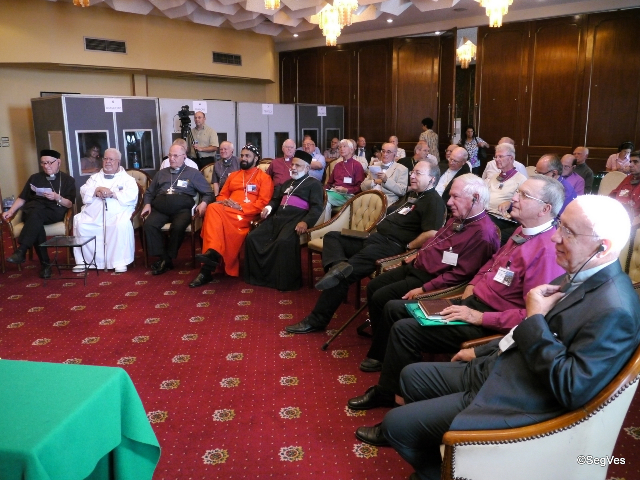 The annual meeting of bishops from different Churches, animated by the spirituality of the Focolare, is currently underway in Cairo, Egypt (3-8 September). This year, the thirty first such meeting, has included bishops from twenty two Christian Churches from every continent. The choice of Cairo, in this time of painful and uncertain change, adds special significance to the event. This time the bishops wish to testify to their solidarity and closeness to their Christian brothers and sisters in the Middle East and particularly the Coptic Church in Egypt. They would like their presence to be a sign that, when faced with external difficulties, it is even more imperative that we draw together in unity.
The program includes moments of reflection on the theme “fraternal relationships amidst diversity”, which the Gospel requires in the form of love for neighbour. There are also moments for ecclesial and personal sharing and for liturgical celebrations with the members of their own Christian communities. On Thursday they attended presentations by the president and the co-president of the Focolare Movement, respectively Maria Voce and Giancarlo Faletti, entitled “To Meet our Neighbour with Love”.
On the first day of the gathering, the small group of bishops who were the animators of the event, visited the Coptic Orthodox Patriarchate, where they met with Anba Bakhomios, temporarily administrator of the Church until a successor is elected to replace Pope Shenouda III. They had a cordial meeting in the Cathedral of St Mark’s. Anba Bakhomios, in fact, had spoken of the importance of unity and of the centrality of the Cross in the Christian life, especially in the life of the Coptic community. Although it has often been silenced, the life of the Christians of Egypt has been persecuted in many ways throughout the centuries. Nowadays the pressure is often subtle, but insupportable because of the injustice that has led to the murdering of Christians in several violent attacks around the country.
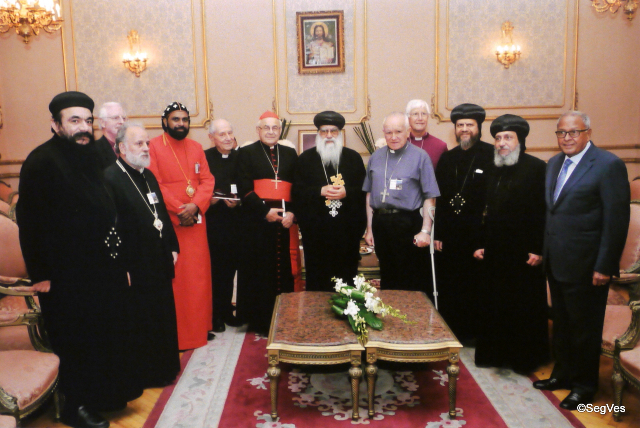 The bishops of the various Churches took the opportunity to thank the Coptic Orthodox Church for its fedelity to the tradition that goes all the way back to Mark the Evangelist, and for its commitment to defending against doctrinal errors and persecutions. The Coptics thanked the bishops for their prayerful presence and support during these difficult times of trial and pain.
Within the context of this experience of ecclesial communion, on Tuesday (4 September), the bishops visited two monasteries three hours away from Cairo, to discover the monastic patrimony of the Coptics that goes back to the third century. Pope Shenouda III, who was so loved by the people, came from this monastic tradition: “The whole experience of these days among the bishops was one of solidarity in action,” affirmed Anba Thomas, who works in the administration of the Church. “The Christians of Egypt have felt the unity of the Christians of the world. It is the Holy Spirit moving among us, and He is demonstrating that if we get to work, and if we trust each other, then unity among Churches will really be possible.” The gathering highlighted the spiritual unity even before the the institutional or theological one. This spiritual aspect remains what is essential, because without it nothing will be possible.
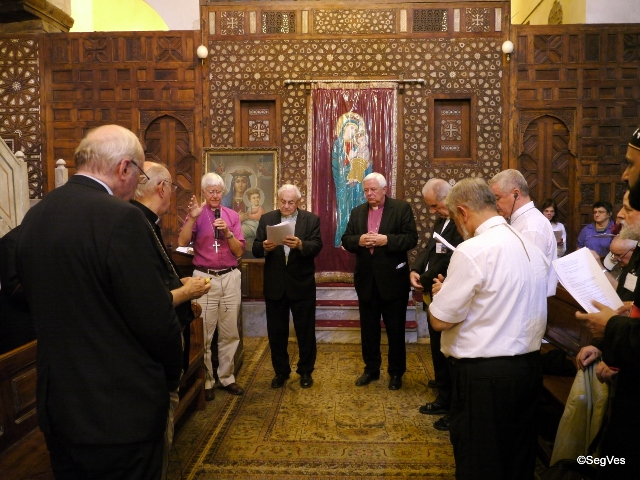 Coming out of the great cathedral building of St Mark’s and from the Coptic Patriarchate, it was difficult not to remember the Arab proverb that says, “Whoever drinks the water of the Nile, will return to Egypt”. And these were the sentiments expressed by Anba Bhakomios when he took leave of Giancarlo Faletti, who assured him of the Focolare’s prayers for the election of the new Coptic Pope: “We’ll invite you; we will invite you,” responded the Administrator of the Coptic Church, seeming to confirm the bond that had really been born among brothers and sisters, members of the one Body of Christ.
By Roberto Catalano
![Egypt – An Encounter Imbued with History /1]()
6 Sep 2012 | Non categorizzato
 In recent years, Hurgarda, on the Red Sea, and Luxor in the vicinity of Alessandria have been welcoming the Mariapolis of the Focolare Movement. These places are rich in natural and artistic beauty, symbols of the deeply religious, open, hospitable, and joyful Egyptian population who are also endowed with a basic human equilibrium which has resulted from their large capacity for suffering and bearing with adversity. They showed this to the world during the events of December 2011.
This history of the spirituality of unity in Egypt reaches back to the end of the 1950’s when Marco Tecilla disembarked in Alessandria for a meeting with one of the first Franciscans who came to know the Movement, Fr Nazareno Beghetto. At the end of 1960 some focolarini from Algeria spent just a few days in Egypt, but in 1975, Aletta Salizzoni went to stay in the land of the Pharoahs along with the Matta family from Lebanon. They had been invited by the Good Shepherd Sisters who, having attended the Mariapolis in that country had begun the first focolare community there.
In the late 1970’s Word of Life groups were spreading. It was through the life in these groups that a group of Gen were born who attended an international convention in Rome, Italy. When they returned home they asked that a focolare be opened there. Their dream came true on 26 January 1981. Aletta arrived in Cairo together with two other focolarine and they found a house in Shoubra. On 13 October 1983 a men’s focolare was also opened.
 In 1982 Fr Morcos Hakim was elected bishop of Sohag (Upper Egypt). This led to a blossoming community of youths and adults in the city and in the surrounding villages: simple poeple, some anable to read or write, who welcomed and lived the Word of Life with commitment. Meanwhile the focolarini and focolarine were taking more trips to other areas of the country. Mariapolises were held both in Cairo and in Sohag. A group of students began to spread the ideal of unity in Assiut as well and, noticing this blossoming of life, Bishop Morcos asked that a focolare be opened in the South as well. In 1995 three focolarine, among them the first Egyptian focolarina, moved to Sohag. From there they took many regular trips, spreading the spirituality of the Movement in Minia, Luxor and Assuan. In the 1980’s a community was begun in Alessandria around Sr. Cecilia, a Salesian. This community continued to flourish even after the death of this religious sister, the members continuing to gather around the Word and sharing how they were trying to live it in their daily lives.
But in the meantime many other elements of the Focolare were beginning to appear – many priests and seminarians embraced the spirituality of unity – Focolare families began to have an impact in their local areas that was much appreciated. A group for couples was formed around an Italian and Lebanese husband and wife that later led to the creation of a formation centre for engaged and young married couples. This centre offered courses in marriage life, motherhood, fatherhood, and welcoming the gift of new life. With the encouragement of the Conference of Bishops and of Patriarch Stephanos II, this centre was relocated within the walls of the Patriarchate.
The Focolare in Egypt today has a clearly ecumencial character: a community composed of members of the Catholic Church, several Eastern Rite Churches and the Coptic Orthodox Church. Many rediscover the beauty of their own Churches and become involved in making them more beautiful according to the design of God for them. This ecumenism demonstrates that the diaologue of life permits prejudices that have sometimes existed for centuries, to be overcome..
New relationships have developed not only among Christians (10% of the population), but also with Muslims, and this encourages and spreads hope and certainty that a united world is possible beyond our differences.
By Roberto Catalano
![Egypt – An Encounter Imbued with History /1]()
4 Sep 2012 | Non categorizzato
 My name is Sam and I come from Thailand. I am a Buddhist and I got to know Youth for a United World through a Buddhist friend of mine. Being and working with them, I saw how it was possible to be truly brothers and sisters, even though we have different faith beliefs.
In October last year, there was severe flooding in my country. The destruction was massive and incalculable. It will take a very long time to rebuild what was lost, because houses, factories, whole villages and cities were under water for various months in different parts of the country!
An extraordinary thing that happened was that this terrible calamity also brought about a great sense of solidarity among all the Thai people. It was an unexpected phenomenon. The country had just come out of a long period of political struggle which had at times been violent because of the elections. Perhaps you remember seeing soldiers shooting and dead bodies on the street. Instead, the flood reunited everyone.
 The floods affected me personally. The water had flooded the entire neighbourhood where I lived. I didn’t have much to lose because I lived in a small apartment, but others even lost their lives through electric shocks. People rushed frantically to escape the danger and found refuge at a reception point.
Together with the Youth for a United World we went to help the people who had found shelter in one of the reception centres. There elderly people as well as children. Some had left their homes in the clothes they were in, not being able to carry anything with them. Some were in a state of shock, a few were seriously ill. It was a terrible scene! So, we tried to help in practical ways, but also encouraging those who were demoralised, giving out food and toys to the children and playing with them; we tried to share in their hopelessness.
The most important thing at the time was to help save the city of Bangkok, the capital from the floods. Students and many other people set about strengthening the banks of the rivers and canals and building barriers to divert any water that overflowed. We too went to fill bags with sand that was delivered by big trucks… When we got to the place where the sandbags were being prepared we worked day and night in the mud. The sand was dirty and stank: it was a real race against time. People came from all over the city at all hours.
It was exhausting work and we also had to miss out on some meals and sleep. The ideal of a united world kept us going. We built and repaired the banks of the canals that protected the capital of Bangkok, but even better than this was the friendships and fraternity that was built amongst everyone and which still remains. In the end the flood passed but what remained was the joy of having given of ourselves to build a more united world. This might mean getting our hands dirty in the midst of the mud, but the greatest joy was in giving and in loving!
![Egypt – An Encounter Imbued with History /1]()
3 Sep 2012 | Senza categoria
 Today young people are able to have quite valid international experiences. Through social networks they are able to meet in the name of common ideals. In this sense, how do you see the role and significance of the Genfest today?
After twelve years since its last edition, this Genfest was quite awaited. And the young people taken a year of Genfest for themselves, extending from 1 May 2012 to 1 May 2013, in order to show that both are part of it – that of grand international events and that of daily life, which they also share on the web.
In his message to the 45th World Communications Day (2011), Pope Benedict XVI makes a very clear analysis of both the potential and the limints of social networks in which young people are immersed, and he invites Christians to be there in creative ways, “because this network is an integral part of human life. “The web,” says the Holy Father, “is contributing to the development of new and more complex intellectual and spiritual horizons, new forms of sahred awareness.” On the other hand, he underscores that “It is important always to remember that virtual contact cannot and must not take the place of direct human contact with people at every level of our lives.” We are also convinced of this (. . . ), young people long for authentic relationships, “globalizing” I would say, realtionships that engage the entire person. It is only through direct contact that you can fully experience the joy of an encounter with another person, the challenge and richness of the diversity, the power of a shared ideal that you can live for together. The Genfest is a moment in which to see already realized the unity and brotherhood that these young people believe in and live for.
The Movement places itself before this challenge aware of the gift that God has given to it, the charism of unity, which is more than ever in keeping with humanity’s call to live as one family, in an interdependence and solidarity that this new cultural situation hastens and underscores (. . . ). This Genfest, not only as an event, but also as a phenomenon of sharing that the youths have begun in the preparations and that continues through concrete projects, is an important step, an experience that will provide significant insights. And it is especially interesting to bring this reflection ahead, young people and adults together.
Up until now the Genfests have been held in Rome. The choice of a Central European country, the city of Budapest, does this contain some special message?
Certainly, a powerful one! For the Movement first of all, it is a new phase in which we are recognizing a need to rediscover together the special riches that each land and people can offer to the world symphony (. . .) It is in the DNA of Hungary, Budapest in particular, part of its history, to search for the unity in diversity: Budapest is the “bridge city” par excellence. I think this was the most favourable place to send a message to today’s world that universal brotherhood is possible, while saving the richness of each individual.
Now that Genfest is over and you are taking scale, how does it scale?
I think that one of the features of this Genfest has been to give a new impulse to our trust for one another and to the complementarity among the generations that teach us much (. . .). I can say that it leaves me with great hope and joy at having seen the radical and concrete committment of these youths. They accepted with great involvement the invitation to aim high, to be on God’s side and to give their own irreplaceable contribution to the society, risking everything, beginning with loving each neighbour without expecting a return. Their bright and joyful visit has transformed Budapest and many have felt it and thanked them for it by joining in the march. Their return to their various homelands will bring a wave of love and joy into the whole world (. . . ).
Source: Tünde Lisztovszki/Magyar Kurír: http://www.magyarkurir.hu/node/41764



